


Defining low-risk high hyperdiploidy in patients with paediatric acute lymphoblastic leukaemia: a retrospective analysis of data from the UKALL97/99 and UKALL2003 clinical trials
- PMID: 34715050
- PMCID: PMC8567211
- DOI: 10.1016/S2352-3026(21)00304-5
Defining low-risk high hyperdiploidy in patients with paediatric acute lymphoblastic leukaemia: a retrospective analysis of data from the UKALL97/99 and UKALL2003 clinical trials
Erratum in
-
Correction to Lancet Haematol 2021; 8: e828-39.Lancet Haematol. 2021 Dec;8(12):e874. doi: 10.1016/S2352-3026(21)00340-9. Epub 2021 Nov 10. Lancet Haematol. 2021. PMID: 34774148 Free PMC article. No abstract available.
Abstract
Background: High hyperdiploidy is the most common genetic subtype of childhood acute lymphoblastic leukaemia and is associated with a good outcome. However, some patients relapse and, given its prevalence, patients with high hyperdiploidy account for a large proportion of all relapses. We aimed to evaluate putative risk factors and determine the optimal pattern of trisomies for predicting outcome.
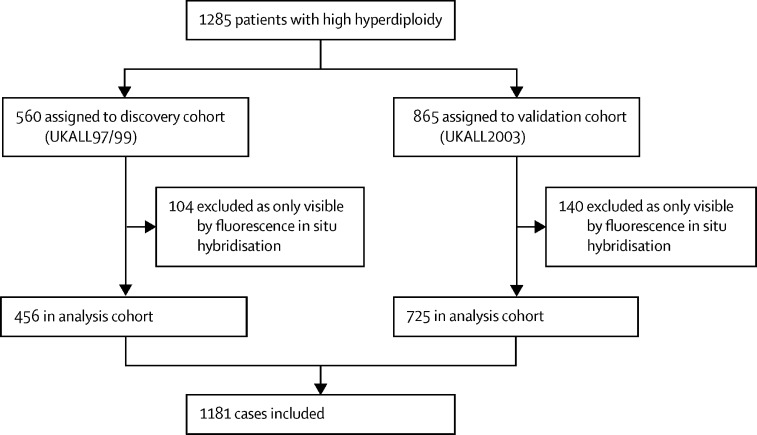
Methods: We used discovery and validation cohorts from consecutive trials-UKALL97/99 (n=456) and UKALL2003 (n=725)-to develop the prognostic profile. UKALL97/99 recruited patients aged 1-18 years between Jan 1, 1997, and June 15, 2002, and UKALL2003 recruited children and young adults aged 1-24 years between Oct 1, 2003, and June 30, 2001, from the UK and Ireland who were newly diagnosed with acute lymphoblastic leukaemia. Cytogenetic and fluorescence in-situ hybridisation testing was performed on pre-treatment bone marrow samples by regional UK National Health Service genetic laboratories or centrally by the Leukaemia Research Cytogenetics Group, and results were reported using established nomenclature and definitions. We examined the prognostic effect of previously proposed genetic and non-genetic risk factors among patients with high hyperdiploid acute lymphoblastic leukaemia treated on UKALL2003. We used Bayesian information criterion, targeted projection pursuit, and multivariate analysis to identify the optimal number of trisomies, and best subset regression and multivariate analysis to identify the optimal combination. Survival analysis considered three endpoints, as follows: event-free survival, defined as time to relapse, second tumour, or death, censored at last contact; relapse rate, defined as time to relapse for those reaching complete remission, censored at death in remission or last contact; and overall survival, defined as time to death, censored at last contact.
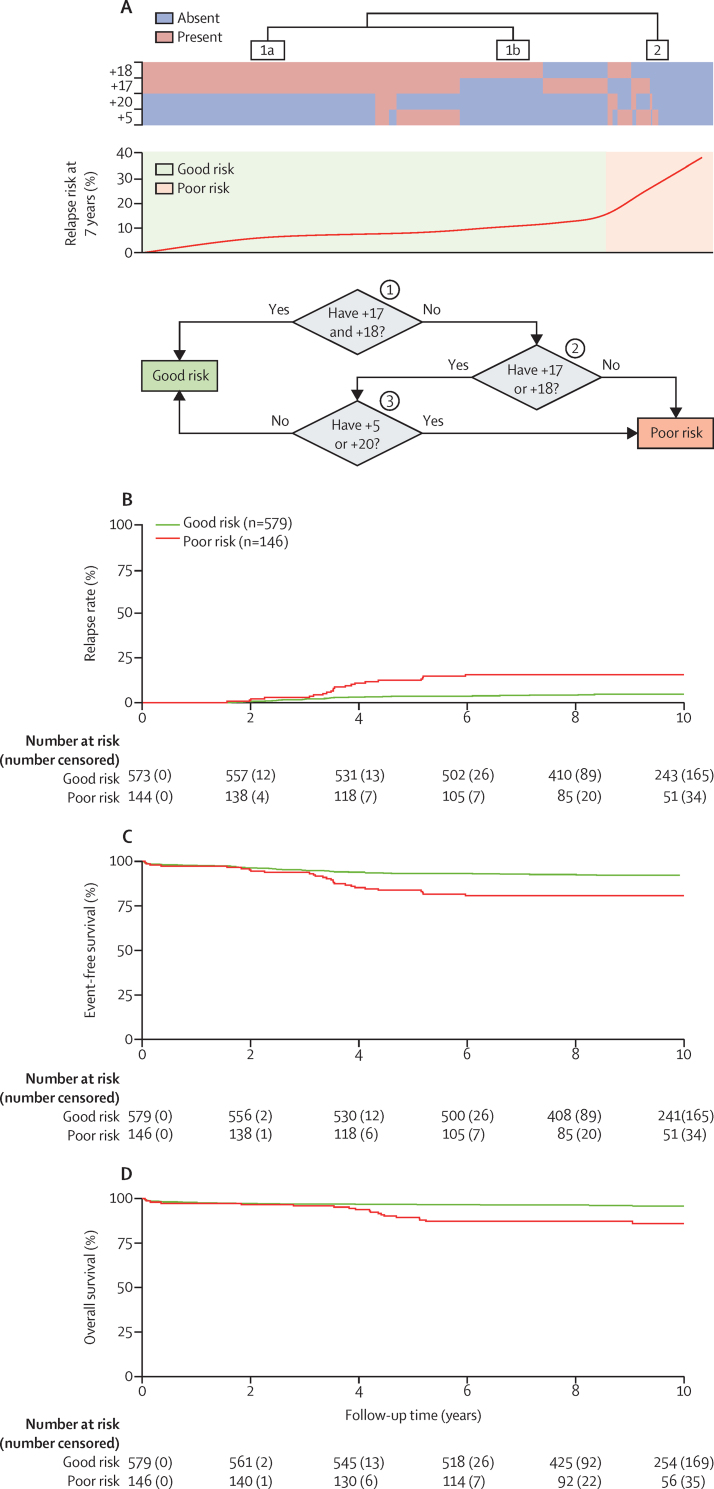
Findings: The median follow-up time for UKALL97/99 was 10·59 years (IQR 9·25-12·06) and 9·40 years (8·00-11·55) for UKALL2003. UKALL97/99 included 208 female patients and 248 male patients, and UKALL2003 included 345 female patients and 380 male patients. We deduced that the trisomic status of four chromosomes provided the optimal information for predicting outcome. The good risk profile comprised karyotypes with +17 and +18 or +17 or +18 in the absence of +5 and +20. All remaining cases were classified in the poor risk profile. The ratio of patients with good risk and poor risk was 82:18 and 80:20 in the discovery and validation cohorts, respectively. In the validation cohort, patients with the high hyperdiploid good risk profile had an improved response to treatment compared with other patients with high hyperdiploidy at 10 years (relapse rate 5% [95% CI 3-7] vs 16% [10-23]; p<0·0001; event-free survival 92% [90-94] vs 81% [73-86]; p<0·0001; and overall survival 96% [94-97] vs 86% [79-91]; p<0·0001). The outcome for high hyperdiploid poor risk patients was similar to that of patients with an intermediate cytogenetic profile. The prognostic effect of the UKALL high hyperdiploid profile was independent of minimal residual disease and the profile outperformed other high hyperdiploid risk profiles.
Interpretation: Future clinical trials and treatment protocols using high hyperdiploidy as a risk stratification factor should consider modifying the definition beyond chromosome count to incorporate this novel UKALL high hyperdiploid profile.
Funding: Blood Cancer UK.
Copyright © 2021 The Author(s). Published by Elsevier Ltd. This is an Open Access article under the CC BY 4.0 license. Published by Elsevier Ltd.. All rights reserved.
Conflict of interest statement
Declaration of interests We declare no competing interests.
Figures
Comment in
-
Redefining high hyperdiploid B-cell acute lymphoblastic leukaemia.Lancet Haematol. 2021 Nov;8(11):e783-e784. doi: 10.1016/S2352-3026(21)00312-4. Lancet Haematol. 2021. PMID: 34715041 No abstract available.
References
-
- Moorman AV, Ensor HM, Richards SM. Prognostic effect of chromosomal abnormalities in childhood B-cell precursor acute lymphoblastic leukaemia: results from the UK Medical Research Council UKALL97/99 randomised trial. Lancet Oncol. 2010;11:429–438. - PubMed
-
- Paulsson K, Johansson B. High hyperdiploid childhood acute lymphoblastic leukemia. Genes Chromosomes Cancer. 2009;48:637–660. - PubMed
-
- Malard F, Mohty M. Acute lymphoblastic leukaemia. Lancet. 2020;395:1146–1162. - PubMed
Publication types
MeSH terms
LinkOut - more resources
Full Text Sources
