


Estimating total morbidity burden of COVID-19: relative importance of death and disability
- PMID: 34715312
- PMCID: PMC8547965
- DOI: 10.1016/j.jclinepi.2021.10.018
Estimating total morbidity burden of COVID-19: relative importance of death and disability
Abstract
Objective: Calculations of disease burden of COVID-19, used to allocate scarce resources, have historically considered only mortality. However, survivors often develop postinfectious 'long-COVID' similar to chronic fatigue syndrome; physical sequelae such as heart damage, or both. This paper quantifies relative contributions of acute case fatality, delayed case fatality, and disability to total morbidity per COVID-19 case.
Study design and setting: Healthy life years lost per COVID-19 case were computed as the sum of (incidence*disability weight*duration) for death and long-COVID by sex and 10-year age category in three plausible scenarios.
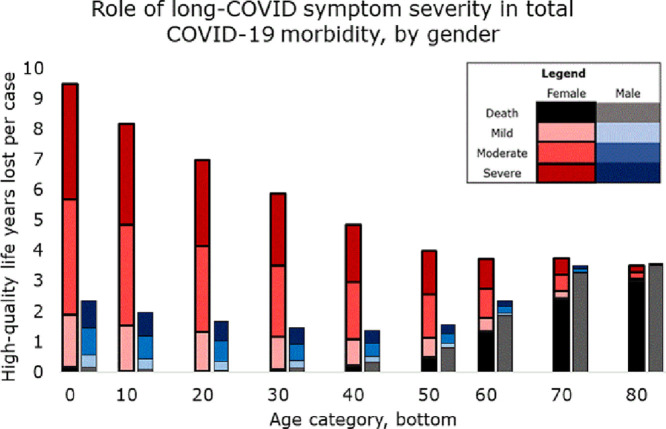
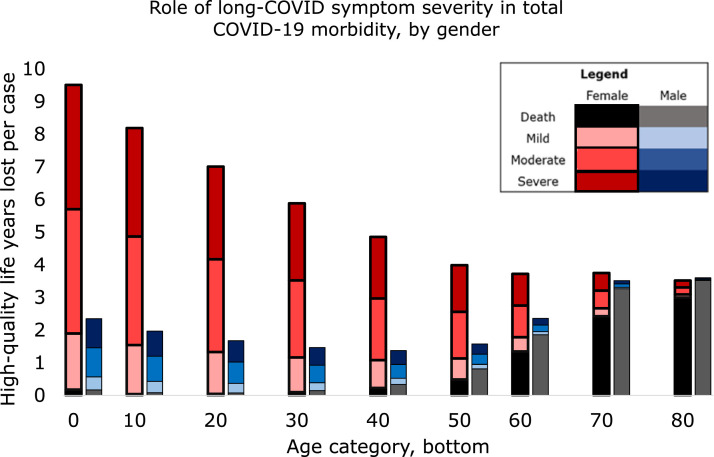
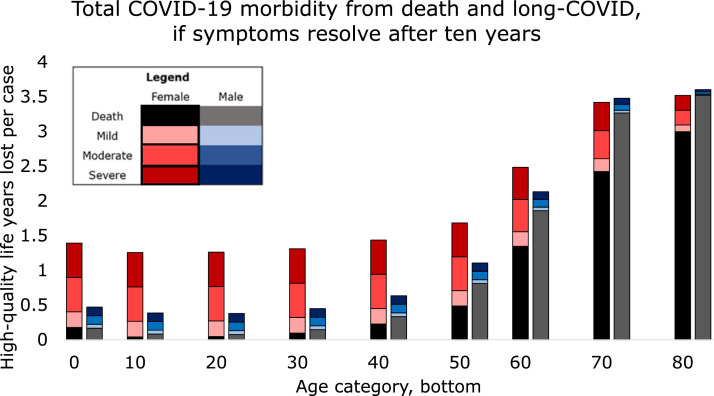
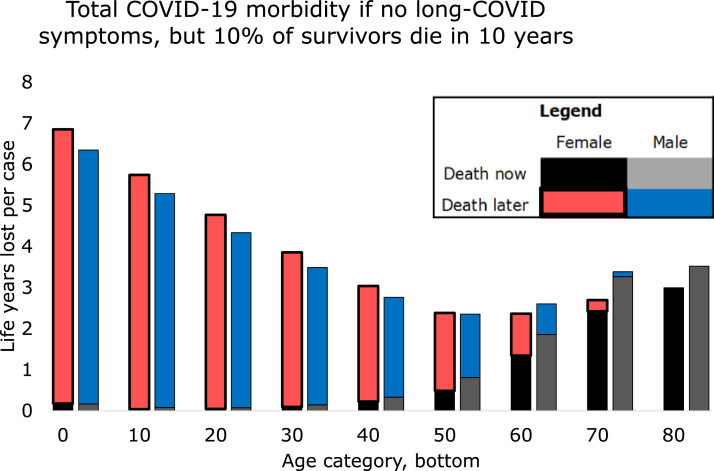
Results: In all models, acute mortality was only a small share of total morbidity. For lifelong moderate symptoms, healthy years lost per COVID-19 case ranged from 0.92 (male in his 30s) to 5.71 (girl under 10) and were 3.5 and 3.6 for the oldest females and males. At higher symptom severities, young people and females bore larger shares of morbidity; if survivors' later mortality increased, morbidity increased most in young people of both sexes.
Conclusions: Under most conditions most COVID-19 morbidity was in survivors. Future research should investigate incidence, risk factors, and clinical course of long-COVID to elucidate total disease burden, and decisionmakers should allocate scarce resources to minimize total morbidity.
Keywords: COVID-19; DALY; Disability; Disability-adjusted life year; Equity; Gender; QALY; SARS-COV-2.
Copyright © 2021 The Author. Published by Elsevier Inc. All rights reserved.
Figures
References
-
- Rubin R. As their numbers grow, COVID-19 “Long Haulers” stump experts. JAMA. 2020;324(14):1381–1383. - PubMed
-
- Bansal AS, Bradley AS, Bishop KN, Kiani-Alikhan S, Ford B. Chronic fatigue syndrome, the immune system and viral infection. Brain Behav Immun. 2012;26(1):24–31. - PubMed
-
- Lambert NJ. COVID-19 “Long Hauler” Symptoms Survey Report; 2020. Survivor corps.
-
- Dimmock ME Mirin AA, Jason LA. Estimating the disease burden of ME/CFS in the United States and its relation to research funding. J Med Therap. 2016;1(1):1–7. doi: 10.15761/JMT.1000102. - DOI
MeSH terms
LinkOut - more resources
Full Text Sources
Medical
Miscellaneous
