


Analysis of social media data for public emotion on the Wuhan lockdown event during the COVID-19 pandemic
- PMID: 34715513
- PMCID: PMC8516441
- DOI: 10.1016/j.cmpb.2021.106468
Analysis of social media data for public emotion on the Wuhan lockdown event during the COVID-19 pandemic
Abstract
Background: With outbreaks of COVID-19 around the world, lockdown restrictions are routinely imposed to limit the spread of the virus. During periods of lockdown, social media has become the main channel for citizens to exchange information with others. Public emotions are being generated and shared rapidly online with citizens using internet platforms to reduce anxiety and stress, and stay connected while isolated.
Objectives: This study aims to explore the regularity of emotional evolution by examining public emotions expressed in online discussions about the Wuhan lockdown event in January 2020.
Methods: Data related to the Wuhan lockdown was collected from Sina Weibo by web crawler. In this study, the Ortony, Clore, and Collins (OCC) model, Word2Vec, and Bi-directional Long Short-Term Memory model were employed to determine emotional types, train vectorization of words, and identify each text emotion for the training set. Latent Dirichlet Allocation models were also employed to mine the various topic categories, while topic emotional evolution was visualized.
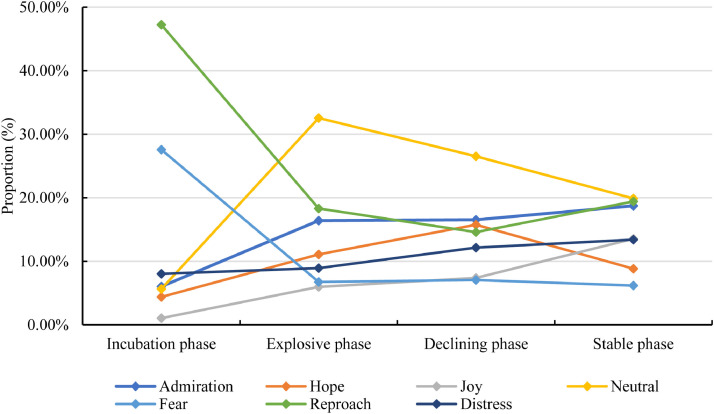
Results: Seven types of emotions and four phases were categorized to describe emotional evolution on the Wuhan lockdown event. The study found that negative emotions such as blame and fear dominated in the early days, and public attitudes towards the lockdown gradually alleviated and reached a balance as the situation improved. Emotional expression about Wuhan lockdown event were significantly related to users' gender, location, and whether or not their account was verified. There were statistically significant correlations between different emotions within the subtle emotional categories. In addition, the evolution of emotions presented a different path due to different topics.
Conclusions: Multiple emotional categories were determined in our study, providing a detailed and explainable emotion analysis to explored emotional appeal of citizen. The public emotions were gradually easing related to the Wuhan lockdown event, there yet exists regional discrimination and post-traumatic stress disorder in this process, which would lead us to pay continuous attention to citizens lives and psychological status post-pandemic. In addition, this study provided an appropriate method and reference case for the government's public opinion control and emotional appeasement.
Keywords: Emotion analysis; Emotional evolution; OCC model; Public opinion; Wuhan lockdown.
Copyright © 2021 Elsevier B.V. All rights reserved.
Conflict of interest statement
Declaration of interests The authors declare that they have no known competing financial interests or personal relationships that could have appeared to influence the work reported in this paper.
Figures




References
-
- World Health Organization, WHO Director-General's opening remarks at the media briefing on COVID-19 - 11 March 2020, https://www.who.int/director-general/speeches/detail/who-director-genera..., 2020 (accessed 1 December 2020).
-
- The Chinese government, A novel coronavirus infection control command in Wuhan, http://www.gov.cn/xinwen/2020-01/23/content_5471751.htm, 2020 (accessed 1 December 2020).
-
- The Chinese government, Hubei novel coronavirus infection prevention and control command announcement, http://www.wuhan.gov.cn/zwgk/tzgg/202004/t20200414_999326.shtml, 2020 (accessed 1 December 2020).
MeSH terms
LinkOut - more resources
Full Text Sources
Medical
Research Materials
