Review
. 2021 Oct 29;21(1):574.
doi: 10.1186/s12935-021-02282-3.

Chemoprotective and chemosensitizing effects of apigenin on cancer therapy

Affiliations
Review

Chemoprotective and chemosensitizing effects of apigenin on cancer therapy

Zahra Nozhat et al. Cancer Cell Int. .

Abstract

Background: Therapeutic resistance to radiation and chemotherapy is one of the major obstacles in cancer treatment. Although synthetic radiosensitizers are pragmatic solution to enhance tumor sensitivity, they pose concerns of toxicity and non-specificity. In the last decades, scientists scrutinized novel plant-derived radiosensitizers and chemosensitizers, such as flavones, owing to their substantial physiological effects like low toxicity and non-mutagenic properties on the human cells. The combination therapy with apigenin is potential candidate in cancer therapeutics. This review explicates the combinatorial strategies involving apigenin to overcome drug resistance and boost the anti-cancer properties.

Methods: We selected full-text English papers on international databases like PubMed, Web of Science, Google Scholar, Scopus, and ScienceDirect from 1972 up to 2020. The keywords included in the search were: Apigenin, Chemoprotective, Chemosensitizing, Side Effects, and Molecular Mechanisms.

Results: In this review, we focused on combination therapy, particularly with apigenin augmenting the anti-cancer effects of chemo drugs on tumor cells, reduce their side effects, subdue drug resistance, and protect healthy cells. The reviewed research data implies that these co-therapies exhibited a synergistic effect on various cancer cells, where apigenin sensitized the chemo drug through different pathways including a significant reduction in overexpressed genes, AKT phosphorylation, NFκB, inhibition of Nrf2, overexpression of caspases, up-regulation of p53 and MAPK, compared to the monotherapies. Meanwhile, contrary to the chemo drugs alone, combined treatments significantly induced apoptosis in the treated cells.

Conclusion: Briefly, our analysis proposed that the combination therapies with apigenin could suppress the unwanted toxicity of chemotherapeutic agents. It is believed that these expedient results may pave the path for the development of drugs with a high therapeutic index. Nevertheless, human clinical trials are a prerequisite to consider the potential use of apigenin in the prevention and treatment of various cancers. Conclusively, the clinical trials to comprehend the role of apigenin as a chemoprotective agent are still in infancy.

Keywords: Apigenin; Chemoprotective; Chemosensitizing; Molecular mechanisms; Side effects.


Conflict of interest statement

There is no competing interests.

Figures
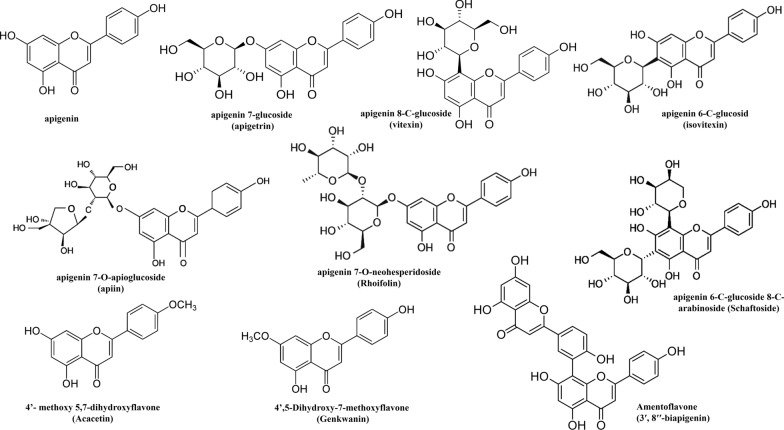
Fig. 1
Fig. 1
Chemical Structure of different forms of apigenin
Fig. 2
Fig. 2
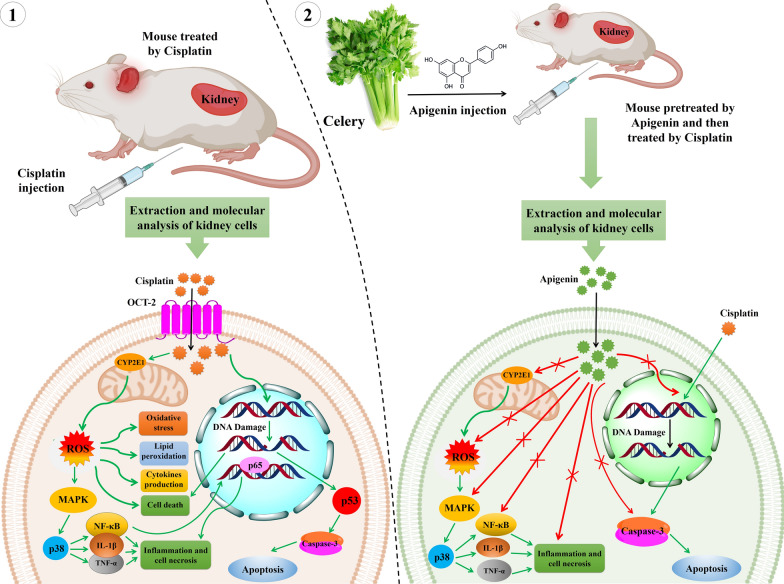
Chemoprotective effects of apigenin. Part. 1, a mouse was administrated with cisplatin. In order to investigate the molecular mechanisms of renal injury by cisplatin, followed by treatment, kidney cells were extracted and molecular analysis were performed. Cisplatin causes nephrotoxicity by oxidative stress, inflammation, apoptosis, and necrosis. Cisplatin enters into the renal cells by OCT-2 and over-activates CYP2E1 as an active producer of ROS in mitochondria and triggers ROS production which in turn leads to oxidative stress, lipid peroxidation, different cytokines (IL-6 and IL-1β) production, MAPK pathway activation and cell death. CYP2E1 plays a pivotal role in the promotion of oxidative stress in the kidney and increases cisplatin-induced nephrotoxicity. The produced ROSs by CYP2E1 can activate NF-κB and MAPK. NF-κB is a pro-inflammatory transcription factor and regulates the expression of different inflammatory factors. NF-κB is separated in the cell cytosol by binding to an inhibitory protein, IκB. Whenever, NF-κB is stimulated by stimuli such as viral, bacterial or other pathogens, a proteasome ubiquitinates and degrades IκB and releases NF-κB to translocate to the nucleus. In the nucleus it triggers the expression of target genes, like TNF-α, IL-1β and TGFβ which play important roles in cisplatin-induced kidney injury. Part 2, a pre-treated mouse by apigenin, was treated with cisplatin. The molecular analysis of the renal cells demonstrates that pre-treatment by apigenin significantly reduced cisplatin-induced renal injury by anti-oxidant and anti-inflammatory effects. Apigenin significantly suppressed the cisplatin-induced increase in the CYP2E1 levels in the mouse. Subsequently, it inhibited the renal oxidative stress, lipid peroxidation, generation of pro-inflammatory cytokines like TNF-α, IL-1β and TGFβ from the kidney tissue of cisplatin-treated mouse. Apigenin protected kidney cells against DNA damage (apoptosis) after cisplatin administration. It also significantly decreased the activities of NF-κB p65 and p38MAPK that were increased by cisplatin. (Inhibition formula image Activationformula image)
Fig. 3
Fig. 3
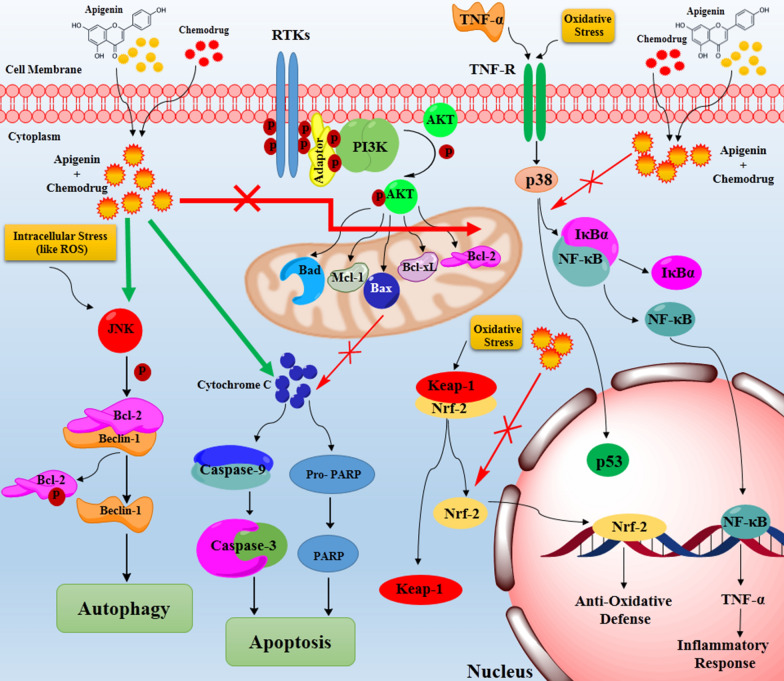
The schematic apoptosis and autophagy induction by apigenin when it is simultaneously used with a chemo drug. Two dimers of the RTK phosphorylate together in multiple tyrosine sites within the RTK intracellular domain which mediate different downstream signaling cascades such as PI3K/AKT pathway. PI3K/AKT signaling is initiated through interaction between activated RTK and adaptor proteins. PI3K phosphorylates AKT protein and p-AKT triggers the activation of several proteins playing critical role in apoptosis. The over-activation of PI3K/AKT results in the over-expression of the anti-apoptic proteins such as Bcl-2, Bcl-xL, Bax, Bad and Mcl-1. These proteins inhibit the down-stream cascade of apoptosis and cause indefinite cell proliferation. Co-administration of apigenin and chemo drugs induces apoptosis by the inhibition of the anti-apoptic proteins. Autophagy is the other activated mechanism by apigenin-chemo drugs suggested in different studies. In autophagy, apigenin-chemo drugs increases JNK. It has been reported that activation of JNK can induce Bcl-2 phosphorylation, resulting in the release of Beclin-1and autophagy activation. Generally, these results revealed a fundamental role of JNK in apigenin-induced autophagy and apoptosis. Nrf2, a redox-sensitive transcription factor, regulates the expression of cytoprotective genes and protective cells against oxidative/electrophilic agents-induced damages. Nrf2 binds to the AREs in the promoters of various cytoprotective genes and regulates their expression. Nrf2 overexpression increases chemoresistance, therefore, its inhibition by apigenin plus chemo drugs sensitizes different cancer cells against chemo drugs. NF-κB, is inhibited by the inhibitory IκB protein in the cell cytoplasm. External stimuli causes to the ubiquitination of IκB and NF-κB release. Then, NF-κB enters to the nucleus and starts the transcription of target genes, such as TNF-α, IL-1β and TGFβ to promote inflammatory responses. These proteins play critical roles in the nephrotoxicity which is induced by some of the chemo drugs such as cisplatin. Apigenin dramatically reduced chemo drugs-induced kidney dysfunction by anti-oxidant and anti-inflammatory effects by inhibition of the NF-κB- IκB complex separation by p38 protein. (Inhibition formula image Activationformula image)

References

    1. Redondo-Blanco S, Fernández J, Gutiérrez-del-Río I, Villar CJ, Lombó F. New insights toward colorectal cancer chemotherapy using natural bioactive compounds. Front Pharmacol. 2017;8:109. - PMC - PubMed
    1. Ahmadi A, Shadboorestan A, Nabavi S, Setzer W, Nabavi S. The role of hesperidin in cell signal transduction pathway for the prevention or treatment of cancer. Curr Med Chem. 2015;22(30):3462–3471. - PubMed
    1. Shokrzadeh M, Habibi E, Shadboorestan A, Chabra A, Ahmadi A: The protective effects of Origanum vulgare L. extract on genetic damage of cyclophosphamide in mice blood lymphocytes using micronucleus test. Pharm Biomed Res 2020.
    1. Shokrzadeh M, Ahmadi A, Ramezaninejhad S, Shadboorestan A. Hesperidin, a citrus bioflavonoid, ameliorates genotoxicity-induced by diazinon in human blood lymphocytes. Drug research. 2015;65(02):57–60. - PubMed
    1. Yan X, Qi M, Li P, Zhan Y, Shao H. Apigenin in cancer therapy: anti-cancer effects and mechanisms of action. Cell Biosci. 2017;7(1):50. - PMC - PubMed