Review
. 2021 Oct 29;19(1):450.
doi: 10.1186/s12967-021-03122-8.

Avenues of research in dietary interventions to target tumor metabolism in osteosarcoma

Affiliations
Review

Avenues of research in dietary interventions to target tumor metabolism in osteosarcoma

Taiana Campos Leite et al. J Transl Med. .

Abstract

Osteosarcoma (OS) is the most frequent primary bone cancer, affecting mostly children and adolescents. Although much progress has been made throughout the years towards treating primary OS, the 5-year survival rate for metastatic OS has remained at only 20% for the last 30 years. Therefore, more efficient treatments are needed. Recent studies have shown that tumor metabolism displays a unique behavior, and plays important roles in tumor growth and metastasis, making it an attractive potential target for novel therapies. While normal cells typically fuel the oxidative phosphorylation (OXPHOS) pathway with the products of glycolysis, cancer cells acquire a plastic metabolism, uncoupling these two pathways. This allows them to obtain building blocks for proliferation from glycolytic intermediates and ATP from OXPHOS. One way to target the metabolism of cancer cells is through dietary interventions. However, while some diets have shown anticancer effects against certain tumor types in preclinical studies, as of yet none have been tested to treat OS. Here we review the features of tumor metabolism, in general and about OS, and propose avenues of research in dietary intervention, discussing strategies that could potentially be effective to target OS metabolism.

Keywords: Caloric restriction; Fasting; Ketogenic diet; Osteosarcoma; Quercetin; Tumor metabolism.


Conflict of interest statement

The authors declare that they have no competing interests.

Figures
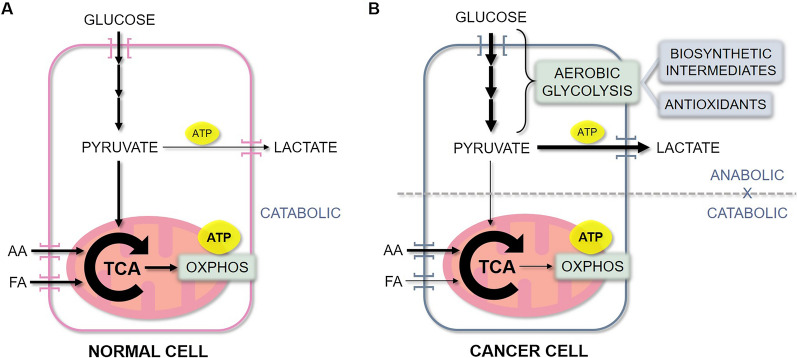
Fig. 1
Fig. 1
Energetic metabolism of normal cells versus cancer cells. A In normal cells, energy in the form of ATP is typically obtained from glucose through the coupling of its initial breakdown (yielding a small amount of ATP—2 ATPs per glucose molecule) with the oxidation of its products in the mitochondrial TCA cycle and OXPHOS (yielding the bulk of ATP—34 ATPs per glucose molecule). Alternatively, energy can also be obtained from fatty acids and amino acids, which are fueled into the TCA cycle and OXPHOS. B Cancer cells, on the other hand, uncouple the anabolic glycolytic pathway from the catabolic TCA cycle and OXPHOS. They increase glucose uptake, utilizing aerobic glycolysis as the main source of biosynthetic molecules, while producing antioxidants and high amounts of lactate. In parallel, these cells fuel the TCA cycle with amino acids and, to a lesser extent, fatty acids, allowing these cells to use OXPHOS as a means of obtaining the bulk of ATP, while uncoupled from glycolysis. AA: Amino acids; FA: Fatty acids; TCA: Tricarboxylic acid cycle; OXPHOS: Oxidative phosphorylation; ATP: Adenosine triphosphate
Fig. 2
Fig. 2
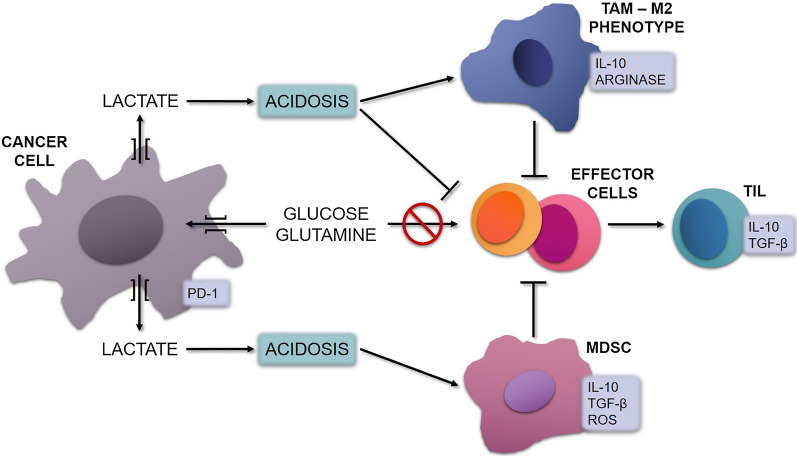
Cancer cell metabolism induces immunosuppression in the TME. Cancer cells compete with the host’s effector cells for nutrients. Their dysregulated metabolism leads to increased uptake of glucose and glutamine, depleting the effector cells from these nutrients, thus hindering their activity. Additionally, cancer cells release high amounts of lactate into the extracellular space, resulting in acidosis. This, in turn, makes the TME favorable for TILs, TAMs and MDSCs, and unsuitable for effector cells. TAMs are induced to express an M2 anti-inflammatory phenotype, secreting Il-10 and arginase. TILs also exhibit an anti-inflammatory phenotype, secreting Il-10 and TGF-β, while MDSC secrete Il-10, TGF-β and ROS. These factors further inhibit effector cells, promoting immunosuppression. TAM: Tumor-associated macrophages; IL-10: Interleukin-10; TGF-β: Transforming growth factor-β; ROS: Reactive oxygen species

References

    1. Mirabello L, Troisi RJ, Savage SA. International osteosarcoma incidence patterns in children and adolescents, middle ages and elderly persons. Int J Cancer. 2009;125(1):229–234. - PMC - PubMed
    1. Luetke A, Meyers PA, Lewis I, Juergens H. Osteosarcoma treatment—where do we stand? A state of the art review. Cancer Treat Rev. 2014;40(4):523–532. - PubMed
    1. Berner K, Johannesen TB, Berner A, Haugland HK, Bjerkehagen B, Bohler PJ, et al. Time-trends on incidence and survival in a nationwide and unselected cohort of patients with skeletal osteosarcoma. Acta Oncol. 2015;54(1):25–33. - PMC - PubMed
    1. Lindsey BA, Markel JE, Kleinerman ES. Osteosarcoma overview. Rheumatol Ther. 2017;4(1):25–43. - PMC - PubMed
    1. Gorlick R, Khanna C. Osteosarcoma. J Bone Miner Res. 2010;25(4):683–691. - PubMed

Publication types