


Do we AGREE on the targets of antihypertensive drug treatment in older adults: a systematic review of guidelines on primary prevention of cardiovascular diseases
- PMID: 34718378
- PMCID: PMC8753036
- DOI: 10.1093/ageing/afab192
Do we AGREE on the targets of antihypertensive drug treatment in older adults: a systematic review of guidelines on primary prevention of cardiovascular diseases
Abstract
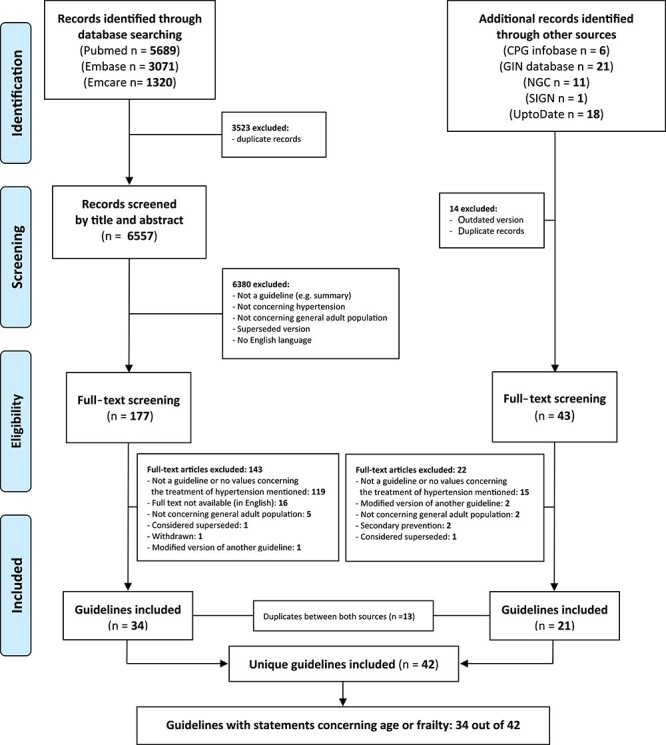
Background: translation of the available evidence concerning primary cardiovascular prevention into clinical guidance for the heterogeneous population of older adults is challenging. With this review, we aimed to give an overview of the thresholds and targets of antihypertensive drug therapy for older adults in currently used guidelines on primary cardiovascular prevention. Secondly, we evaluated the relationship between the advised targets and guideline characteristics, including guideline quality.
Methods: we systematically searched PubMed, Embase, Emcare and five guideline databases. We selected guidelines with (i) numerical thresholds for the initiation or target values of antihypertensive drug therapy in context of primary prevention (January 2008-July 2020) and (ii) specific advice concerning antihypertensive drug therapy in older adults. We extracted the recommendations and appraised the quality of included guidelines with the AGREE II instrument.
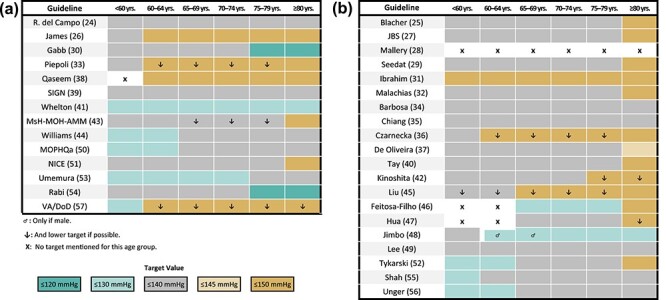
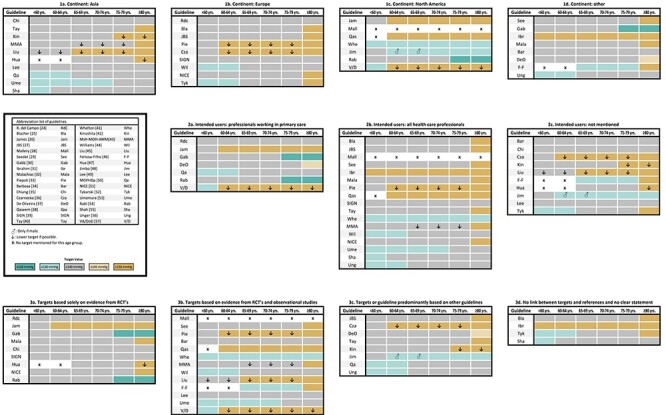
Results: thirty-four guidelines provided recommendations concerning antihypertensive drug therapy in older adults. Twenty advised a higher target of systolic blood pressure (SBP) for octogenarians in comparison with the general population and three advised a lower target. Over half of the guidelines (n = 18) recommended to target a SBP <150 mmHg in the oldest old, while four endorsed targets of SBP lower than 130 or 120 mmHg. Although many guidelines acknowledged frailty, only three gave specific thresholds and targets. Guideline characteristics, including methodological quality, were not related with the recommended targets.
Conclusion: the ongoing debate concerning targets of antihypertensive treatment in older adults, is reflected in an inconsistency of recommendations across guidelines. Recommended targets are largely set on chronological rather than biological age.
Keywords: antihypertensive drug therapy; guidelines; older people; primary cardiovascular prevention; systematic review.
© The Author(s) 2021. Published by Oxford University Press on behalf of the British Geriatrics Society. All rights reserved. For permissions, please email: journals.permissions@oup.com.
Figures
Comment in
-
Hypertension management in older patients-Are the guideline blood pressure targets appropriate?Age Ageing. 2022 Jan 6;51(1):afab226. doi: 10.1093/ageing/afab226. Age Ageing. 2022. PMID: 34864828 Free PMC article. No abstract available.
References
-
- Stanaway JD, Afshin A, Gakidou E et al. Global, regional, and national comparative risk assessment of 84 behavioural, environmental and occupational, and metabolic risks or clusters of risks for 195 countries and territories, 1990–2017: a systematic analysis for the Global Burden of Disease Study 2017. Lancet 2018; 392: 1923–94. - PMC - PubMed
-
- Wilson PW. Established risk factors and coronary artery disease: the Framingham Study. Am J Hypertens 1994; 7: 7S–12. - PubMed
-
- Chow CK, Teo KK, Rangarajan S et al. Prevalence, awareness, treatment, and control of hypertension in rural and urban communities in high-, middle-, and low-income countries. JAMA 2013; 310: 959–68. - PubMed
-
- Vasan RS, Beiser A, Seshadri S et al. Residual lifetime risk for developing hypertension in middle-aged women and men: the Framingham Heart Study. JAMA 2002; 287: 1003–10. - PubMed
