. 2021 Nov;51(11):CPG1-CPG60.
doi: 10.2519/jospt.2021.0304.

Interventions for the Management of Acute and Chronic Low Back Pain: Revision 2021

Interventions for the Management of Acute and Chronic Low Back Pain: Revision 2021

Steven Z George et al. J Orthop Sports Phys Ther. 2021 Nov.

Abstract

Low back pain (LBP) remains a musculoskeletal condition with an adverse societal impact. Globally, LBP is highly prevalent and a leading cause of disability. This is an update to the 2012 Academy of Orthopaedic Physical Therapy (AOPT), formerly the Orthopaedic Section of the American Physical Therapy Association (APTA), clinical practice guideline (CPG) for LBP. The overall objective of this update was to provide recommendations on interventions delivered by physical therapists or studied in care settings that included physical therapy providers. It also focused on synthesizing new evidence, with the purpose of making recommendations for specific nonpharmacologic treatments. J Orthop Sports Phys Ther 2021;51(11):CPG1-CPG60. doi:10.2519/jospt.2021.0304.

Keywords: Academy of Orthopaedic Physical Therapy; clinical practice guidelines; low back pain; nonpharmacologic treatment.


Figures
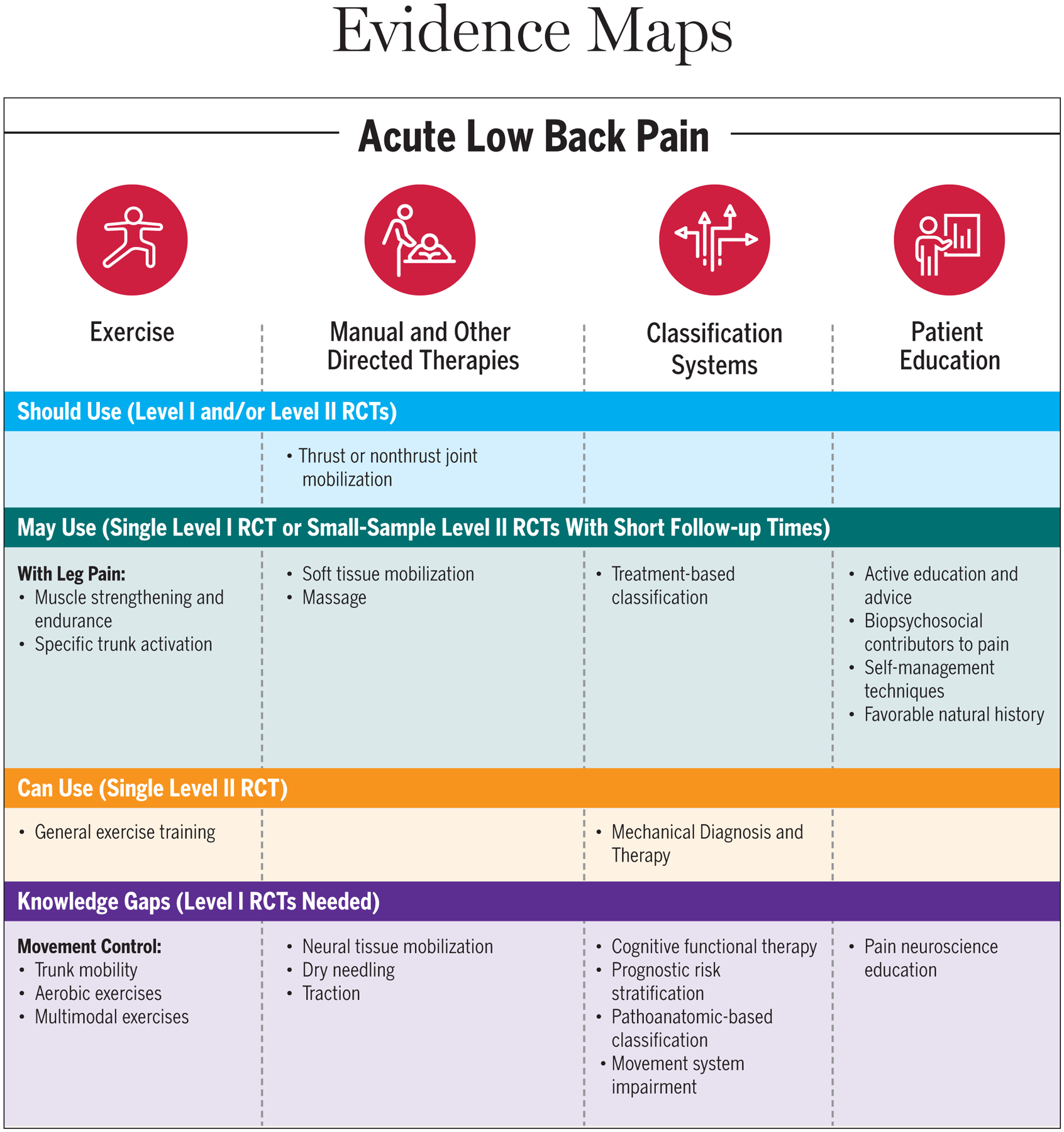
FIGURE 2.
FIGURE 2.
Evidence map for acute low back pain interventions depicting the overall evidence landscape for the 2021 update to the low back pain clinical practice guideline. Grade A–level evidence corresponds with “should use” and is in blue, grade B–level evidence corresponds with “may use” and is in green, and grade C–level evidence corresponds with “can use” and is in orange. Knowledge gaps are summarized in purple. Abbreviation: RCT, randomized clinical trial.
FIGURE 3.
FIGURE 3.
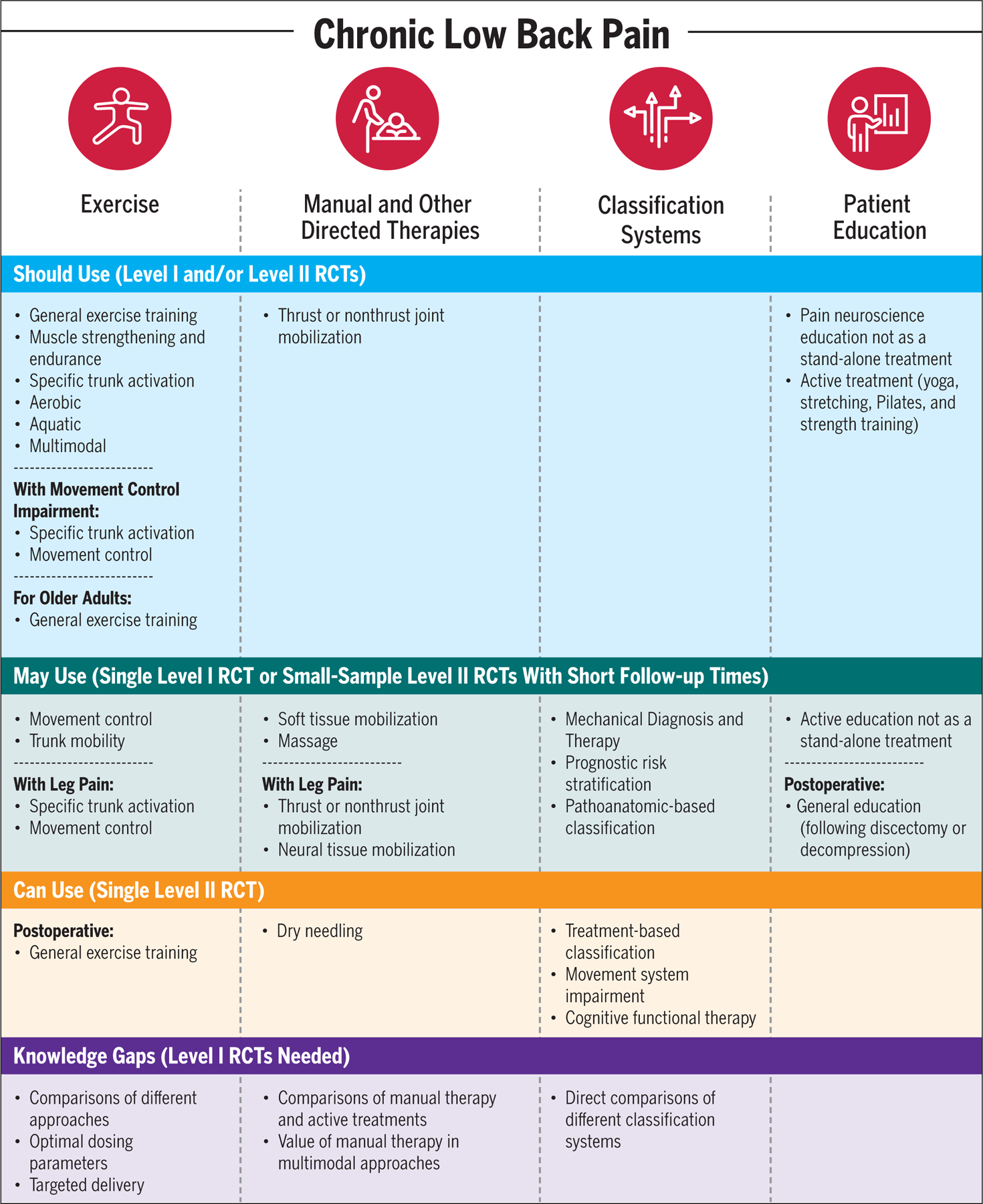
Evidence map for chronic low back pain interventions depicting the overall evidence landscape for the 2021 update to the low back pain clinical practice guideline. Grade A–level evidence corresponds with “should use” and is in blue, grade B–level evidence corresponds with “may use” and is in green, and grade C–level evidence corresponds with “can use” and is in orange. Knowledge gaps are summarized in purple. Abbreviation: RCT, randomized clinical trial.
FIGURE 1.
FIGURE 1.
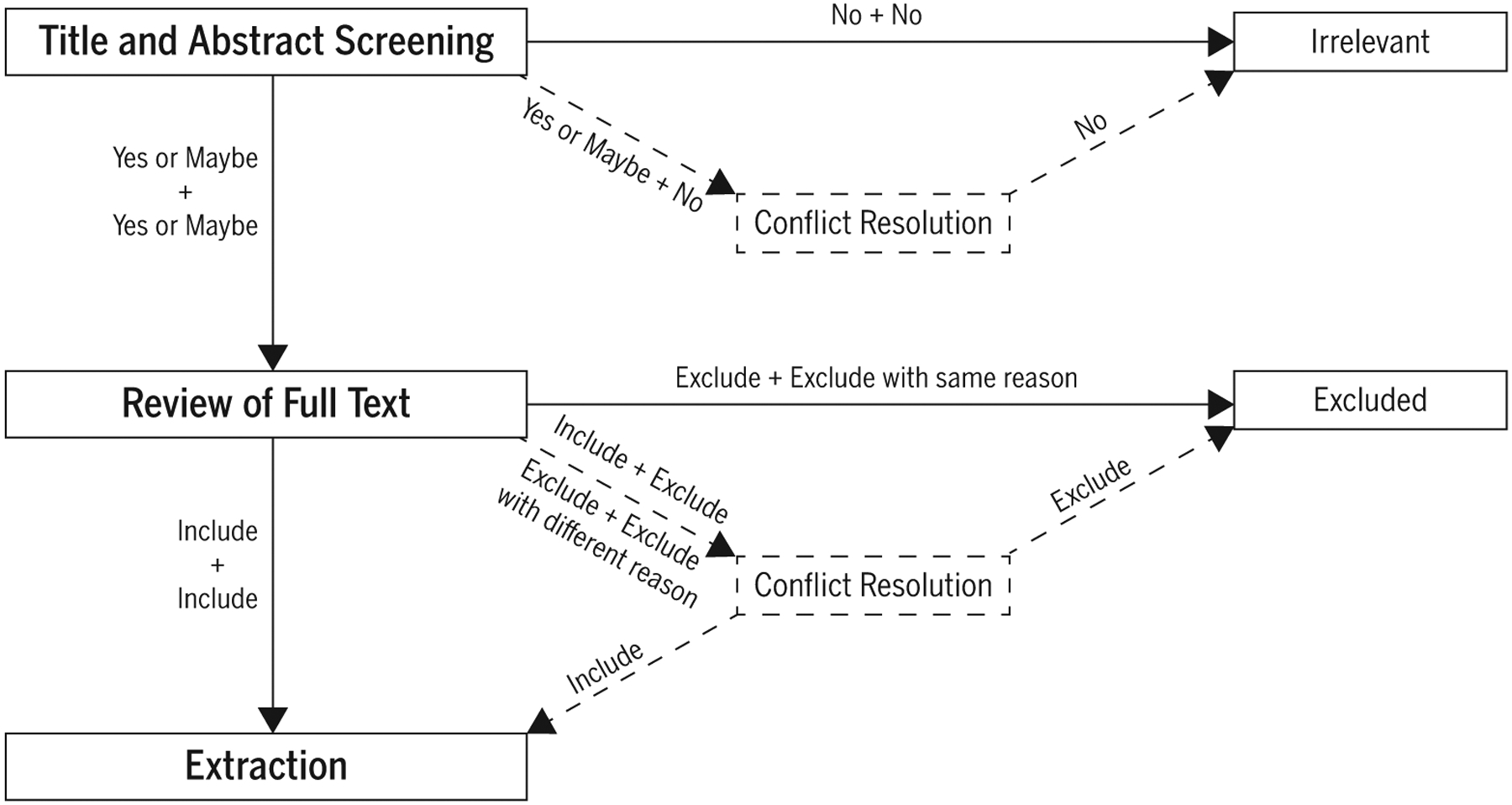
The evidence-selection process started with title and abstract screening and included input from 2 reviewers. Titles and abstracts that were rated as “no” by both reviewers were excluded (ie, irrelevant source). Titles and abstracts that were rated as “yes” or “maybe” by both reviewers were moved forward to full-text review. Disagreements on ratings were resolved before a final decision was made. A similar process occurred during the full-text review, resulting in articles being extracted that were rated as “include” by both reviewers. Adapted from the Covidence Knowledge Base (https://support.covidence.org/help/how-references-move-through-a-review, accessed June 25, 2020).

References

    1. Aalto TJ, Leinonen V, Herno A, et al. Postoperative rehabilitation does not improve functional outcome in lumbar spinal stenosis: a prospective study with 2-year postoperative follow-up. Eur Spine J. 2011;20:1331–1340. 10.1007/s00586-011-1781-y - DOI - PMC - PubMed
    1. Akca NK, Aydin G, Gumus K. Effect of body mechanics brief education in the clinical setting on pain patients with lumbar disc hernia: a randomized controlled trial. Int J Caring Sci. 2017;10:1498–1506.
    1. Albert HB, Manniche C. The efficacy of systematic active conservative treatment for patients with severe sciatica: a single-blind, randomized, clinical, controlled trial. Spine (Phila Pa 1976). 2012;37:531–542. 10.1097/BRS.0b013e31821ace7f - DOI - PubMed
    1. Albornoz-Cabello M, Maya-Martín J, Domínguez-Maldonado G, Espe-jo-Antúnez L, Heredia-Rizo AM. Effect of interferential current therapy on pain perception and disability level in subjects with chronic low back pain: a randomized controlled trial. Clin Rehabil. 2017;31:242–249. 10.1177/0269215516639653 - DOI - PubMed
    1. Alhakami AM, Davis S, Qasheesh M, Shaphe A, Chahal A. Effects of McKenzie and stabilization exercises in reducing pain intensity and functional disability in individuals with nonspecific chronic low back pain: a systematic review. J Phys Ther Sci. 2019;31:590–597. 10.1589/jpts.31.590 - DOI - PMC - PubMed