


Evaluation of a Phenobarbital-Based Protocol for Severe Alcohol Withdrawal in Critically Ill Patients
- PMID: 34720160
- PMCID: PMC8554599
- DOI: 10.1177/0018578720931464
Evaluation of a Phenobarbital-Based Protocol for Severe Alcohol Withdrawal in Critically Ill Patients
Abstract
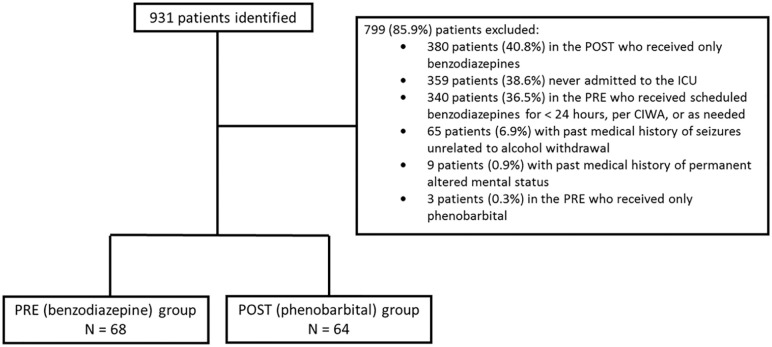
Background: Phenobarbital offers several possible advantages to benzodiazepines including a longer half-life and anti-glutamate activity, and is an alternative for the treatment of alcohol withdrawal. The objective of this analysis was to evaluate the safety and efficacy of a phenobarbital protocol for alcohol withdrawal newly implemented at our institution. Methods: This was a single-center, retrospective analysis of adult patients admitted to the medical/surgical/burn/trauma intensive care unit (ICU) with or at risk of severe alcohol withdrawal. Patients who were admitted prior to guideline implementation and received scheduled benzodiazepines (PRE) were compared to those who received phenobarbital post guideline update (POST). The primary outcome was ICU length of stay (LOS). Results: Upon analysis, 68 patients in the PRE and 64 patients in the POST were identified for inclusion. The median APACHE II score was significantly higher in the POST (4.5 [3:9] vs 10 [5:13], P < 0.001). ICU (2 [1:2] vs 2 [2:5], P = 0.002) and hospital (4.5 [3:6] vs 8 [6:12], P < 0.001) LOS were significantly longer in the POST. There was no difference in mortality or duration of mechanical ventilation. More patients required propofol or dexmedetomidine on day one in the POST (P < 0.001). Conclusion: Patients in the POST had significantly longer ICU and hospital LOS, and had a higher baseline severity of illness. Future research is needed to evaluate the efficacy and safety of phenobarbital compared to benzodiazepines for severe alcohol withdrawal.
Keywords: critical care; neurology; psychiatric.
© The Author(s) 2020.
Conflict of interest statement
Declaration of Conflicting Interests: The author(s) declared no potential conflicts of interest with respect to the research, authorship, and/or publication of this article.
References
-
- Maldonado JR, Sher Y, Ashouri JF, et al. The “Prediction of Alcohol Withdrawal Severity Scale” (PAWSS): systematic literature review and pilot study of a new scale for the prediction of complicated alcohol withdrawal syndrome. Alcohol. 2014;48(4):375-390. - PubMed
-
- Bayard M, Mcintyre J, Hill KR, Woodside J. Alcohol withdrawal syndrome. Am Fam Phys. 2004;69(6):1443-1450. - PubMed
-
- Saitz R, Horton NJ, Larson MJ, Winter M, Samet JH. Primary medical care and reductions in addiction severity: a prospective cohort study. Addiction. 2005;100(1):70-78. - PubMed
-
- Carta M, Olivera DS, Dettmer TS, Valenzuela CF. Ethanol withdrawal upregulates kainate receptors in cultured rat hippocampal neurons. Neurosci Lett. 2002;327(2):128-132. - PubMed
-
- Haugbol SR, Ebert B, Ulrichsen J. Upregulation of glutamate receptor subtypes during alcohol withdrawal in rats. Alcohol Alcohol. 2005;40(2):89-95. - PubMed
LinkOut - more resources
Full Text Sources
