. 2021;81(6):505.
doi: 10.1140/epjc/s10052-021-09184-8. Epub 2021 Jun 7.

Characterization of inverted coaxial 76 Ge detectors in GERDA for future double- β decay experiments

M Agostini  1   2 G Araujo  3 A M Bakalyarov  4 M Balata  5 I Barabanov  6 L Baudis  3 C Bauer  7 E Bellotti  8   9 S Belogurov  6   10   11 A Bettini  12   13 L Bezrukov  6 V Biancacci  12   13 E Bossio  2 V Bothe  7 V Brudanin  14 R Brugnera  12   13 A Caldwell  15 C Cattadori  9 A Chernogorov  10   4 T Comellato  2 V D'Andrea  16 E V Demidova  10 N Di Marco  5 E Doroshkevich  6 F Fischer  15 M Fomina  14 A Gangapshev  7   6 A Garfagnini  12   13 C Gooch  15 P Grabmayr  17 V Gurentsov  6 K Gusev  14   4   2 J Hakenmüller  7 S Hemmer  13 W Hofmann  7 J Huang  3 M Hult  18 L V Inzhechik  6   19 J Janicskó Csáthy  2   20 J Jochum  17 M Junker  5 V Kazalov  6 Y Kermaïdic  7 H Khushbakht  17 T Kihm  7 I V Kirpichnikov  10 A Klimenko  14   7   21 R Kneißl  15 K T Knöpfle  7 O Kochetov  14 V N Kornoukhov  6   11 P Krause  2 V V Kuzminov  6 M Laubenstein  5 M Lindner  7 I Lippi  13 A Lubashevskiy  14 B Lubsandorzhiev  6 G Lutter  18 C Macolino  16 B Majorovits  15 W Maneschg  7 L Manzanillas  15 M Miloradovic  3 R Mingazheva  3 M Misiaszek  22 P Moseev  6 Y Müller  3 I Nemchenok  14   21 L Pandola  23 K Pelczar  22   18 L Pertoldi  12   13 P Piseri  24 A Pullia  24 C Ransom  3 L Rauscher  17 S Riboldi  24 N Rumyantseva  14   4 C Sada  12   13 F Salamida  16 S Schönert  2 J Schreiner  7 M Schütt  7 A-K Schütz  17 O Schulz  15 M Schwarz  2 B Schwingenheuer  7 O Selivanenko  6 E Shevchik  14 M Shirchenko  14 L Shtembari  15 H Simgen  7 A Smolnikov  14   7 D Stukov  4 A A Vasenko  10 A Veresnikova  6 C Vignoli  5 K von Sturm  12   13 T Wester  25 C Wiesinger  2 M Wojcik  22 E Yanovich  6 B Zatschler  25 I Zhitnikov  14 S V Zhukov  4 D Zinatulina  14 A Zschocke  17 A J Zsigmond  15 K Zuber  25 G Zuzel  22 Gerda Collaboration
Affiliations

Characterization of inverted coaxial 76 Ge detectors in GERDA for future double- β decay experiments

M Agostini et al. Eur Phys J C Part Fields. 2021.

Abstract

Neutrinoless double- β decay of 76 Ge is searched for with germanium detectors where source and detector of the decay are identical. For the success of future experiments it is important to increase the mass of the detectors. We report here on the characterization and testing of five prototype detectors manufactured in inverted coaxial (IC) geometry from material enriched to 88% in 76 Ge. IC detectors combine the large mass of the traditional semi-coaxial Ge detectors with the superior resolution and pulse shape discrimination power of point contact detectors which exhibited so far much lower mass. Their performance has been found to be satisfactory both when operated in vacuum cryostat and bare in liquid argon within the Gerda setup. The measured resolutions at the Q-value for double- β decay of 76 Ge ( Q β β = 2039 keV) are about 2.1 keV full width at half maximum in vacuum cryostat. After 18 months of operation within the ultra-low background environment of the GERmanium Detector Array (Gerda) experiment and an accumulated exposure of 8.5 kg · year, the background index after analysis cuts is measured to be 4 . 9 - 3.4 + 7.3 × 10 - 4 counts / ( keV · kg · year ) around Q β β . This work confirms the feasibility of IC detectors for the next-generation experiment Legend.


Figures

Fig. 1
Fig. 1
Left: Main IC detector features. Middle: ADL calculation of the weighting potential. Right: Electric field strength in kV/cm. The minimum required electric field is 200 V/cm (dark blue). The black dashed lines show electron drift paths ending at the n+ contact while white solid lines are the hole drift paths reaching the signal contact
Fig. 2
Fig. 2
Configurations used for detector characterization. Left: Setup for depletion voltage estimation with a mixed 1.5 kBq source of 60Co–137Cs–241Am; bias and readout circuits are indicated. Middle: Setup for PSD studies with a flood top and side 13 kBq 228Th source and with a collimated 250 kBq 228Th source for lateral scans. The vacuum cryostat (cyan) and detector holder (orange), both made of aluminum, are added here for illustration. Right: Setup for scans with the collimated 4.3 MBq 241Am source: lateral at 3 azimuthal angles (dashed lines), 2 orthogonal directions on top (solid lines) and a circular one (dotted lines)
Fig. 3
Fig. 3
Waveform examples of SSEs (top) and MSEs (bottom) of detector 50A after applying a moving window average. The amplitude of the maximum current A and of energy E are explicitly shown. The boundaries of the rise time are estimated at 0.5 and 90% of the maximum charge amplitude
Fig. 4
Fig. 4
Spectrum taken with detector 50A and the mixed source of 60Co, 137Cs, 241Am for the determination of the nominal bias voltage. The inset shows the fit to the 60Co 1333 keV γ line. The MCA module was used for this measurement using a Gaussian energy filter, thus explaining the significant tail of the γ line from ballistic deficit
Fig. 5
Fig. 5
Energy resolution FWHM of the 60Co 1333 keV line as a function of the applied bias voltage. The arrows show depletion voltages and resolutions reported by the manufacturer. The statistical uncertainties are less than the widths of the markers
Fig. 6
Fig. 6
Energy resolution FWHM as a function of γ ray energy; data are taken at the bias voltage recommended by the manufacturer. The dashed lines show fits to the data, performed for each detector separately. The statistical uncertainties are less than the widths of the markers
Fig. 7
Fig. 7
Example of 241Am FEP data recorded with the highly collimated 4.3 MBq source, positioned above the upper surface of detector 50A. The model (red line) is shown together with its decomposition into a Gaussian, a tail and a shoulder functions
Fig. 8
Fig. 8
Results of the lateral (left) and top radial (right) scans for the 60 keV 241Am γ line obtained with detector 50A. Statistical uncertainties are less than the widths of the markers. The dashed gray lines on the left(right) show the expected holder ditch (well) position (see Fig. 2)
Fig. 9
Fig. 9
228Th spectrum taken with detector 50A and the source in lateral position. The main γ lines, 208Tl double escape (DEP), 208Tl single escape (SEP) and 208Tl and 212Bi full energy (FEP) peaks, used in the pulse analysis, are emphasized together with the Qββ ±35 keV Compton continuum region. The inset shows a fit to the 2615 keV γ line
Fig. 10
Fig. 10
Correlation of A/E with the signal rise time [0.5–90%] of detector 50A for indicated heights H of the lateral collimator. The p+ contact is at H=0 mm. The gray dashed lines show the A/E cut position. These four datasets correspond to 208Tl DEP events from the highly collimated 228Th source
Fig. 11
Fig. 11
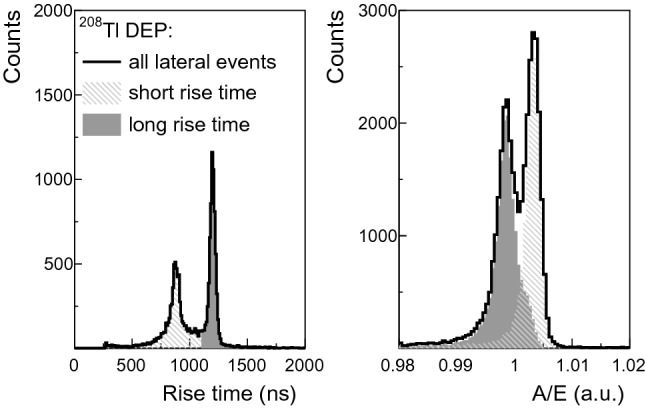
Left (right): Rise time (A/E) distribution of 208Tl DEP events obtained from the lateral 228Th source flood measurement with detector 50A. The lateral, short and long analysis datasets selection are emphasized
Fig. 12
Fig. 12
Spectrum measured with the IC detectors at the exposure of 8.5 kg·year in Gerda prior to and after indicated analysis cuts. The inset shows a zoom in the background analysis window. The only surviving event at 2058.9 keV was recorded with detector 74A on October 9, 2018, 01:09:14 (UTC)

References

    1. M. Agostini et al. (GERDA Collaboration), Final results of GERDA on the search for neutrinoless double-β decay. Phys. Rev. Lett. 125, 252502 (2020) - PubMed
    1. S.I. Alvis et al. (MAJORANA Collaboration), Search for neutrinoless double-β decay in 76Ge with 26 kg yr of exposure from the MAJORANA DEMONSTRATOR. Phys. Rev. C 100, 025501 (2019)
    1. D.Q. Adams et al. (CUORE Collaboration), Improved limit on neutrinoless double-beta decay in 130Te with CUORE. Phys. Rev. Lett. 124, 122501 (2020) - PubMed
    1. A. Gando et al. (KamLAND-Zen Collaboration), Search for Majorana neutrinos near the inverted mass hierarchy region with KamLAND-Zen. Phys. Rev. Lett. 117, 082503 (2016) - PubMed
    1. G. Anton et al. (EXO-200 Collaboration), Search for neutrinoless double-β decay with the complete EXO-200 dataset. Phys. Rev. Lett. 123, 161802 (2019) - PubMed