


Toward Integrated Multi-Omics Intervention: Rice Trait Improvement and Stress Management
- PMID: 34721467
- PMCID: PMC8554098
- DOI: 10.3389/fpls.2021.741419
Toward Integrated Multi-Omics Intervention: Rice Trait Improvement and Stress Management
Abstract
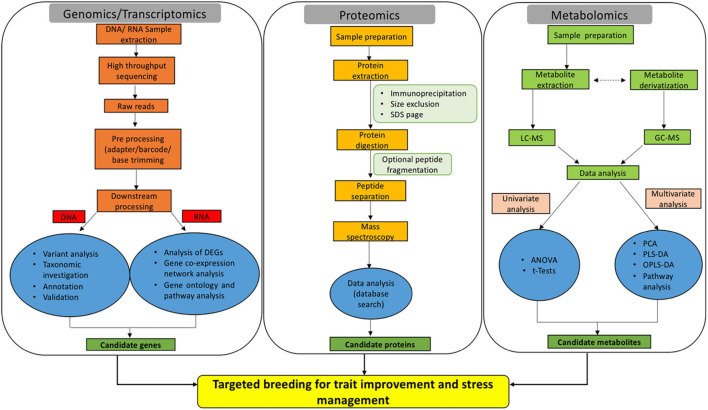
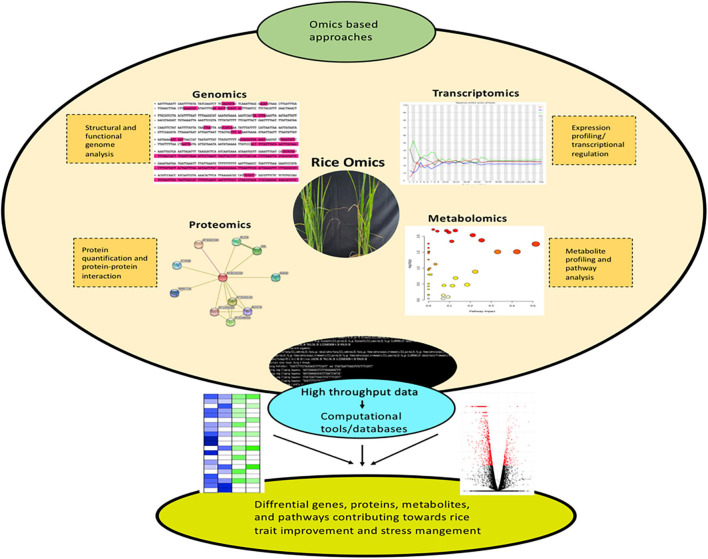
Rice (Oryza sativa) is an imperative staple crop for nearly half of the world's population. Challenging environmental conditions encompassing abiotic and biotic stresses negatively impact the quality and yield of rice. To assure food supply for the unprecedented ever-growing world population, the improvement of rice as a crop is of utmost importance. In this era, "omics" techniques have been comprehensively utilized to decipher the regulatory mechanisms and cellular intricacies in rice. Advancements in omics technologies have provided a strong platform for the reliable exploration of genetic resources involved in rice trait development. Omics disciplines like genomics, transcriptomics, proteomics, and metabolomics have significantly contributed toward the achievement of desired improvements in rice under optimal and stressful environments. The present review recapitulates the basic and applied multi-omics technologies in providing new orchestration toward the improvement of rice desirable traits. The article also provides a catalog of current scenario of omics applications in comprehending this imperative crop in relation to yield enhancement and various environmental stresses. Further, the appropriate databases in the field of data science to analyze big data, and retrieve relevant information vis-à-vis rice trait improvement and stress management are described.
Keywords: genomics; metabolomics; omics; proteomics; rice; stress; transcriptomics.
Copyright © 2021 Iqbal, Iqbal, Khan and Ansari.
Conflict of interest statement
The authors declare that the research was conducted in the absence of any commercial or financial relationships that could be construed as a potential conflict of interest.
Figures
References
-
- Agrawal G. K., Jwa N. S., Lebrun M. H., Job D., Rakwal R. (2010). Plant secretome: unlocking secrets of the secreted proteins. Proteomics 10 799–827. - PubMed
-
- Ahuja I., Kissen R., Bones A. M. (2012). Phytoalexins in defense against pathogens. Trends Plant Sci. 17 73–90. - PubMed
-
- Alam R., Sazzadur Rahman M., Seraj Z. I., Thomson M. J., Ismail A. M., Tumimbang-Raiz E., et al. (2011). Investigation of seedling-stage salinity tolerance QTLs using backcross lines derived from Oryza sativa L. Pokkali. Plant Breed. 130 430–437.
Publication types
LinkOut - more resources
Full Text Sources
