


Comparison of in vivo kinematics of total knee arthroplasty between cruciate retaining and cruciate substituting insert
- PMID: 34722162
- PMCID: PMC8521180
- DOI: 10.1016/j.asmart.2021.10.002
Comparison of in vivo kinematics of total knee arthroplasty between cruciate retaining and cruciate substituting insert
Abstract
Background: The decision to choose cruciate retaining (CR) insert or cruciate substituting (CS) insert during total knee arthroplasty (TKA) remains a controversial issue. We hypothesized that there are different knee kinematics between CR and CS inserts and that a raised anterior lip design would offer a potential minimization of the paradoxical movement and provide joint stability. The objective of this study was to evaluate and compare kinematics of a CR and CS TKA of the same single-radius design.
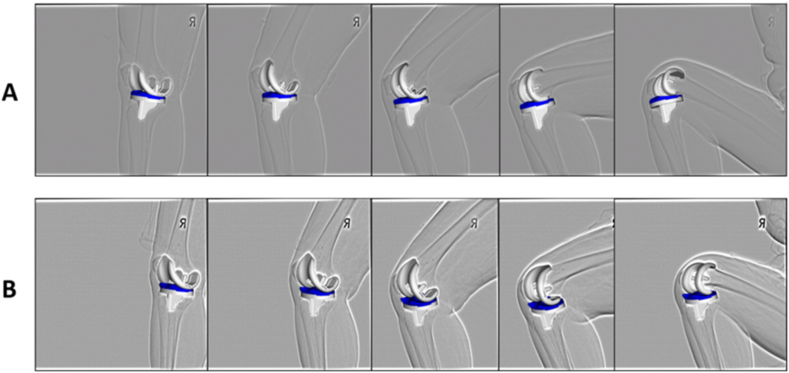
Methods: We investigated the in vivo knee kinematics of 20 knees with a CR TKA (10 knees in the CR insert and 10 knees in the CS insert). Patients were examined during deep knee flexion using fluoroscopy and femorotibial motion was determined using a 2- to 3-dimensional registration technique, which used computer-assisted design models to reproduce the spatial positions of the femoral and tibial components. We evaluated the knee range of motion (ROM), femoral axial rotation relative to the tibial component, anteroposterior translation, and kinematic pathway of the nearest point of the medial and lateral femoral condyles on the tibial tray.
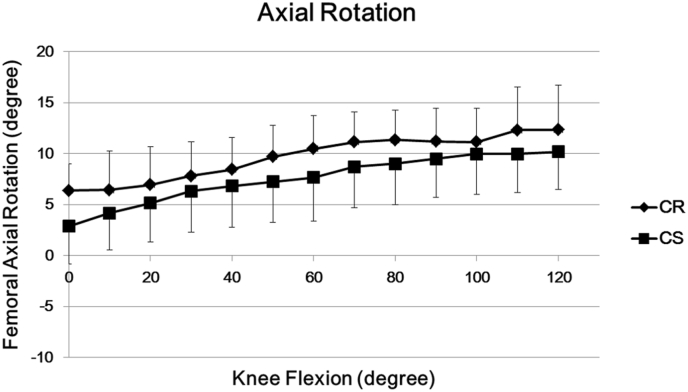
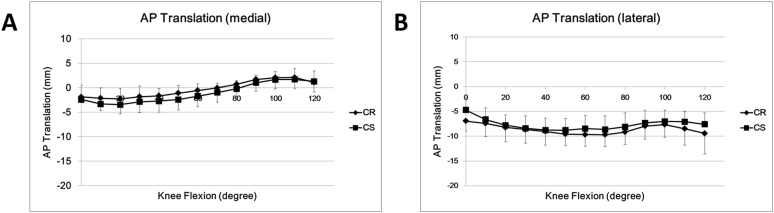
Results: The average ROM was 121.0 ± 17.3° in CR and 110.8 ± 12.4° in CS. The amount of femoral axial rotation was 7.2 ± 3.9° in CR, and 7.4 ± 2.7° in CS. No significant difference was observed in the amount of anterior translation between CR and CS. The CR and CS inserts had a similar kinematic pattern up to 100° flexion that was central pivot up to 70° flexion and then paradoxical anterior femoral movement until 100° flexion.
Conclusion: The present study demonstrated that there was no significant difference between the inserts in knee kinematics. These kinematic results suggested that the increased anterior lip could not control anterior movement in the CS insert.
Keywords: 2D/3D registration; Fluoroscopy; In vivo; Kinematics; Total knee arthroplasty.
© 2021 Asia Pacific Knee, Arthroscopy and Sports Medicine Society. Published by Elsevier (Singapore) Pte Ltd.
Conflict of interest statement
The authors have no conflicts of interest relevant to this article.
Figures


References
-
- Sloan M., Premkumar A., Sheth N.P. Projected volume of primary total joint arthroplasty in the U.S., 2014 to 2030. J Bone Joint Surg Am. 2018;100(17):1455–1460. - PubMed
-
- Rodricks D.J., Patil S., Pulido P., Colwell C.W., Jr. Press-fit condylar design total knee arthroplasty. Fourteen to seventeen-year follow-up. J Bone Joint Surg Am. 2007;89(1):89–95. - PubMed
-
- Vessely M.B., Whaley A.L., Harmsen W.S., Schleck C.D., Berry D.J. The Chitranjan Ranawat Award: long-term survivorship and failure modes of 1000 cemented condylar total knee arthroplasties. Clin Orthop Relat Res. 2006;452:28–34. - PubMed
LinkOut - more resources
Full Text Sources
