


Current malaria infection, previous malaria exposure, and clinical profiles and outcomes of COVID-19 in a setting of high malaria transmission: an exploratory cohort study in Uganda
- PMID: 34723228
- PMCID: PMC8545833
- DOI: 10.1016/S2666-5247(21)00240-8
Current malaria infection, previous malaria exposure, and clinical profiles and outcomes of COVID-19 in a setting of high malaria transmission: an exploratory cohort study in Uganda
Abstract
Background: The potential effects of SARS-CoV-2 and Plasmodium falciparum co-infection on host susceptibility and pathogenesis remain unknown. We aimed to establish the prevalence of malaria and describe the clinical characteristics of SARS-CoV-2 and P falciparum co-infection in a high-burden malaria setting.
Methods: This was an exploratory prospective, cohort study of patients with COVID-19 who were admitted to hospital in Uganda. Patients of all ages with a PCR-confirmed diagnosis of SARS-CoV-2 infection who had provided informed consent or assent were consecutively enrolled from treatment centres in eight hospitals across the country and followed up until discharge or death. Clinical assessments and blood sampling were done at admission for all patients. Malaria diagnosis in all patients was done by rapid diagnostic tests, microscopy, and molecular methods. Previous P falciparum exposure was determined with serological responses to a panel of P falciparum antigens assessed using a multiplex bead assay. Additional evaluations included complete blood count, markers of inflammation, and serum biochemistries. The main outcome was overall prevalence of malaria infection and malaria prevalence by age (including age categories of 0-20 years, 21-40 years, 41-60 years, and >60 years). The frequency of symptoms was compared between patients with COVID-19 with P falciparum infection versus those without P falciparum infection. The frequency of comorbidities and COVID-19 clinical severity and outcomes was compared between patients with low previous exposure to P falciparum versus those with high previous exposure to P falciparum. The effect of previous exposure to P falciparum on COVID-19 clinical severity and outcomes was also assessed among patients with and those without comorbidities.
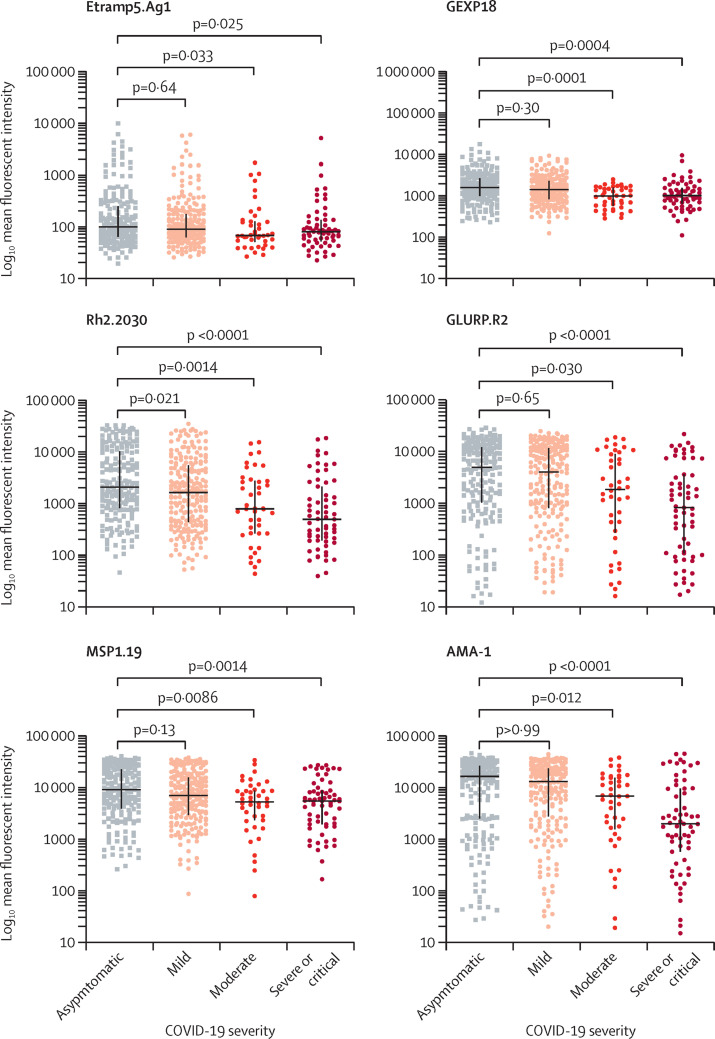
Findings: Of 600 people with PCR-confirmed SARS-CoV-2 infection enrolled from April 15, to Oct 30, 2020, 597 (>99%) had complete information and were included in our analyses. The majority (502 [84%] of 597) were male individuals with a median age of 36 years (IQR 28-47). Overall prevalence of P falciparum infection was 12% (95% CI 9·4-14·6; 70 of 597 participants), with highest prevalence in the age groups of 0-20 years (22%, 8·7-44·8; five of 23 patients) and older than 60 years (20%, 10·2-34·1; nine of 46 patients). Confusion (four [6%] of 70 patients vs eight [2%] of 527 patients; p=0·040) and vomiting (four [6%] of 70 patients vs five [1%] of 527 patients; p=0·014] were more frequent among patients with P falciparum infection than those without. Patients with low versus those with high previous P falciparum exposure had a increased frequency of severe or critical COVID-19 clinical presentation (16 [30%] of 53 patients vs three [5%] of 56 patients; p=0·0010) and a higher burden of comorbidities, including diabetes (12 [23%] of 53 patients vs two [4%] of 56 patients; p=0·0010) and heart disease (seven [13%] of 53 patients vs zero [0%] of 56 patients; p=0·0030). Among patients with no comorbidities, those with low previous P falciparum exposure still had a higher proportion of cases of severe or critical COVID-19 than did those with high P falciparum exposure (six [18%] of 33 patients vs one [2%] of 49 patients; p=0·015). Multivariate analysis showed higher odds of unfavourable outcomes in patients who were older than 60 years (adjusted OR 8·7, 95% CI 1·0-75·5; p=0·049).
Interpretation: Although patients with COVID-19 with P falciparum co-infection had a higher frequency of confusion and vomiting, co-infection did not seem deleterious. The association between low previous malaria exposure and severe or critical COVID-19 and other adverse outcomes will require further study. These preliminary descriptive observations highlight the importance of understanding the potential clinical and therapeutic implications of overlapping co-infections.
Funding: Malaria Consortium (USA).
© 2022 The Author(s). Published by Elsevier Ltd. This is an Open Access article under the CC BY-NC-ND 4.0 license.
Conflict of interest statement
HA and FN are members of the Mulago Hospital Research and Ethics but did not participate in decisions pertaining to this study. All other authors declare no competing interests.
Figures
References
-
- WHO. Coronavirus disease (COVID-19) dashboard. 2021. httwvid19.who.int/ (accessed Oct 8, 2021).
-
- UN Impact of COVID-19 in Africa. 2020. https://unsdg.un.org/sites/default/files/2020-05/Policy-brief-Impact-of-...
-
- WHO Coronavirus disease 2019 (COVID-19): situation reports. 2020. https://www.who.int/emergencies/diseases/novel-coronavirus-2019/situatio...
-
- WHO . World Health Organization; Geneva: 2020. World malaria report.
-
- WHO . World Health Organization; Geneva: 2019. Global tuberculosis report.
Publication types
MeSH terms
LinkOut - more resources
Full Text Sources
Medical
Miscellaneous
