Review
. 2021 Aug 10;1(10):1541-1555.
doi: 10.1021/jacsau.1c00288. eCollection 2021 Oct 25.

Understanding the Logistics for the Distribution of Heme in Cells

Affiliations
Review

Understanding the Logistics for the Distribution of Heme in Cells

Andrea E Gallio et al. JACS Au. .

Abstract

Heme is essential for the survival of virtually all living systems-from bacteria, fungi, and yeast, through plants to animals. No eukaryote has been identified that can survive without heme. There are thousands of different proteins that require heme in order to function properly, and these are responsible for processes such as oxygen transport, electron transfer, oxidative stress response, respiration, and catalysis. Further to this, in the past few years, heme has been shown to have an important regulatory role in cells, in processes such as transcription, regulation of the circadian clock, and the gating of ion channels. To act in a regulatory capacity, heme needs to move from its place of synthesis (in mitochondria) to other locations in cells. But while there is detailed information on how the heme lifecycle begins (heme synthesis), and how it ends (heme degradation), what happens in between is largely a mystery. Here we summarize recent information on the quantification of heme in cells, and we present a discussion of a mechanistic framework that could meet the logistical challenge of heme distribution.


Conflict of interest statement

The authors declare no competing financial interest.

Figures
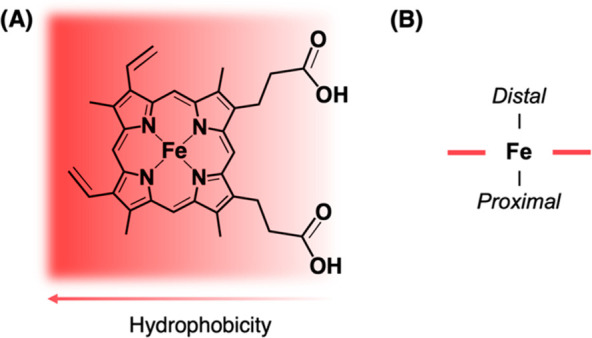
Figure 1
Figure 1
(A) The structure of iron protoporphyrin IX, also known as heme b. While heme is mostly hydrophobic, the carboxylate groups enable hydrogen-bonding interactions between the heme group and other molecules, including assisting the binding of heme to a protein. (B) The heme group is classified as containing distal and proximal sides, which are conventionally drawn above and below the plane of the ring, respectively. In heme proteins, the proximal side is usually bound to an amino acid residue provided by the protein; this helps to control its reactivity as a redox center, and its properties as a gas-binding molecule for storage and signaling.
Figure 2
Figure 2
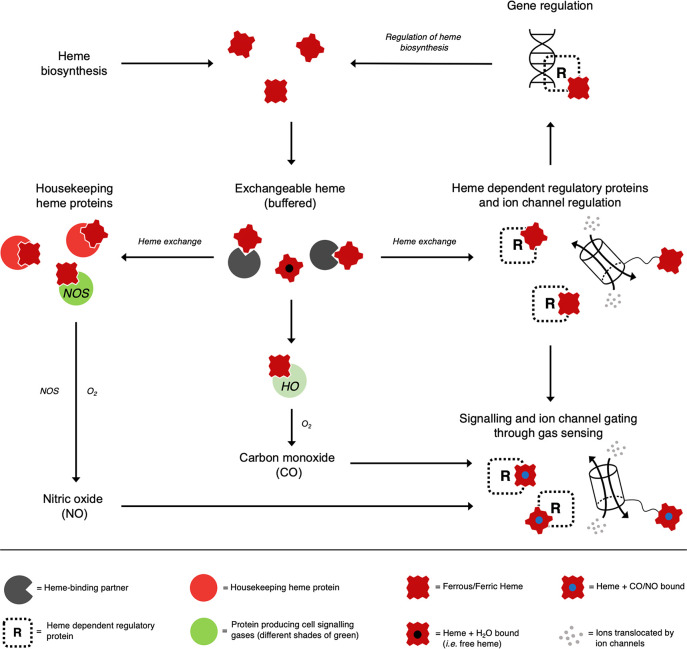
The possible interconnected pathways for the movements of heme in cells, and the links to signaling gases such as CO and NO. From the total heme synthesized in the cell (top), a proportion is bound irreversibly to heme-binding housekeeping proteins (red circles) that are essential for cell survival. A body of exchangeable heme is envisaged as being mostly weakly bound, soon after heme biosynthesis, to heme-binding partners (dark gray pacmans in this and other figures, which could be heme proteins or non-heme proteins) and available for exchange to heme dependent regulatory proteins (R, right). These heme-binding partners constitute an exchangeable, buffered, reservoir that can provide a flexible supply of heme and protect against changes in heme concentration. Once formed, these heme-bound proteins can serve in regulatory roles by, for example, binding to DNA for transcriptional control (top right; including the regulation of heme biosynthesis,,,,−) or to ion channels (middle and bottom right,). In green circles are shown the proteins that produce cell signaling gases—nitric oxide synthase (NOS, left) and heme oxygenase (NOS, middle). The synthesis of NO by NOS, and the production of CO by the heme degrading HO enzyme, adds multiple layers of complexity by coupling the formation of cell signaling gases to the heme-binding process. This would allow both CO and NO to bind to any heme protein with a regulatory function (bottom right) but could equally well occur for other heme dependent regulatory processes. It is worth noting that, while the binding of π-acid ligands like CO is traditionally associated exclusively with heme in its ferrous form, ferric heme has also been shown capable of binding CO/NO. For the purposes of this review, movement of ferric/ferrous heme is presumed to mean heme b.
Figure 3
Figure 3
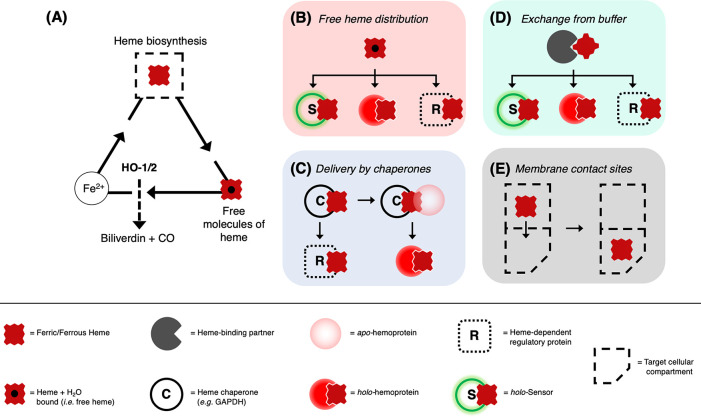
Representation of possible mechanisms for distribution and delivery of heme across the cell. (A) The life cycle of heme in cells starts with its biosynthesis in the mitochondria (full dashed square) and ends with its degradation by heme oxygenase (HO-1/2). Heme oxygenase generates Fe2+ which can be recycled for the synthesis of new heme molecules. A balance between synthesis and degradation contributes to the controlling heme concentrations in cells. (B–E) The supply of heme to the locations where it is in demand is suggested as occurring via four possible mechanisms (colored panels). In (B), direct distribution of free heme into a heme protein (red circle), a heme-dependent regulatory function (R, white box), or a genetically encoded/synthetic heme sensor for quantification studies (S, green circle). Free heme (either ferrous or ferric) is envisaged as being present in minuscule concentrations but will still represent a mechanism for heme to be made available in cells. In (C), chaperone-mediated heme delivery to an apo-heme protein (pale red circle), for example by GAPDH. In (D), heme bound to heme-binding partners (dark gray pacman) constitutes a body of exchangeable heme readily available for downstream applications, in the same way as in (B). Possible candidates for heme-binding proteins are IDO, HBP22/23, SOUL, and albumin.,, In (E), distribution of heme via membrane contact sites between mitochondria—where heme is synthesized—to target cellular compartments which bypasses the need for transporters to mediate the delivery of heme.
Figure 4
Figure 4
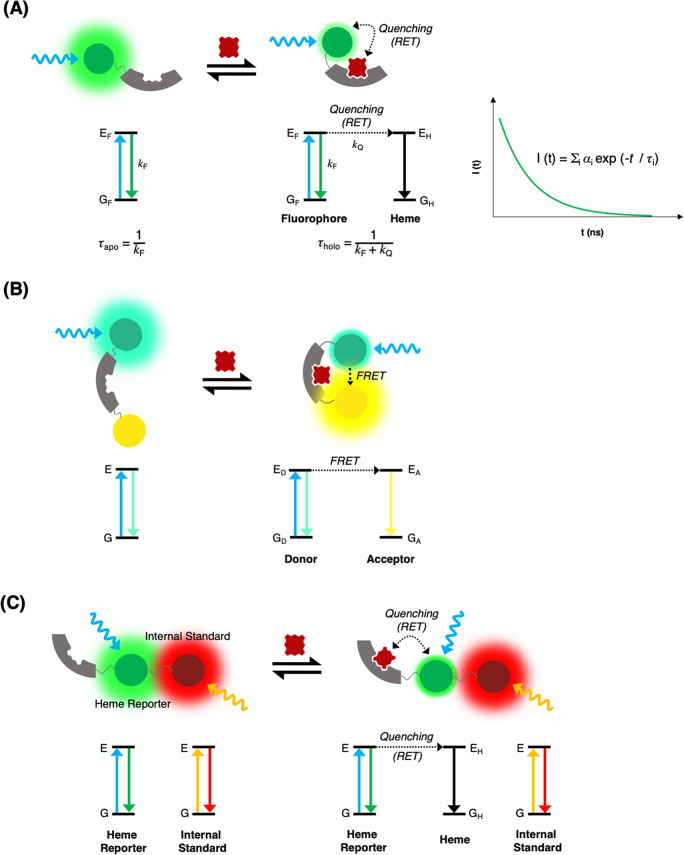
Basic principles of heme sensor designs. (A) RET sensors: Heme-binding to this type of sensor introduces an additional relaxation pathway for the electronic excited state of the fluorophore. The mean fluorescence lifetime of the probe changes between the limiting values of τapo to τholo for the pure apo and holo forms of the sensor dependent on heme concentration. (B) FRET sensors: The heme-binding domain of the sensor undergoes a conformational change that brings two fluorophores into close proximity to one another. In this example, Förster energy transfer results in a decrease in the emission of a green fluorophore and an increase in emission of a yellow fluorophore. Hence changes in the relative emission intensities of the two fluorophores can be used to determine heme concentration. Multiple heme-binding sites may be present in the heme-binding domain. (C) A RET sensor (similar to that shown in (A)) that incorporates an additional fluorophore in order to measure a ratiometric intensity. The sensor is composed of two fluorophores, but heme-binding triggers the selective quenching of the fluorescence of only one of them. The unperturbed tag can then be used as an internal reference to monitor the changes in the intensity of emission for the quenched fluorophore, providing a method for precise heme quantitation.,
Figure 5
Figure 5
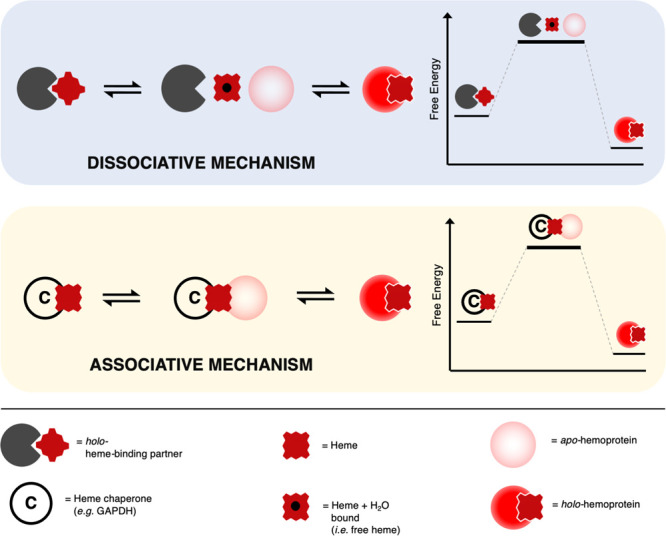
Possible mechanisms for exchange of heme. Heme-binding partners (dark gray pacmans) are envisaged as transferring heme to heme proteins (red circles) by dissociative (pale gray box) or associative (pale yellow box) pathways, resembling classical ligand exchange mechanisms in coordination chemistry. In a dissociative pathway, a free molecule of heme (assumed to be coordinated by a water molecule) is formed transiently following dissociation from a heme-binding partner, and is intercepted by an apo-heme protein (faded red circles). Alternatively, an associative exchange of heme is possible and is shown here for the example of heme delivery by chaperones (C, circles). This latter mechanism may provide better selectivity toward the target heme protein. However, we do not envisage this as being exclusive to chaperones, but a mechanism which, in principle, is available to be used by heme-binding partners as well in delivering heme to apo heme proteins. The different mechanisms of heme exchange may help to fine-tune the delivery of heme to specific acceptors.

References

    1. Moss G. P.; Smith P. A. S.; Tavernier D. Glossary of class names of organic compounds and reactivity intermediates based on structure (IUPAC Recommendations 1995). Pure Appl. Chem. 1995, 67 (8–9), 1307–1375. 10.1351/pac199567081307. - DOI
    1. Martinez S. E.; Huang D.; Szczepaniak A.; Cramer W. A.; Smith J. L. Crystal structure of chloroplast cytochrome f reveals a novel cytochrome fold and unexpected heme ligation. Structure 1994, 2 (2), 95–105. 10.1016/S0969-2126(00)00012-5. - DOI - PubMed
    1. Smith L. J.; Kahraman A.; Thornton J. M. Heme proteins--diversity in structural characteristics, function, and folding. Proteins: Struct., Funct., Genet. 2010, 78 (10), 2349–68. 10.1002/prot.22747. - DOI - PubMed
    1. Perutz M. F. Relation between structure and sequence of haemoglobin. Nature 1962, 194 (4832), 914–917. 10.1038/194914a0. - DOI - PubMed
    1. Kendrew J. C.; Watson H. C.; Strandberg B. E.; Dickerson R. E.; Phillips D. C.; Shore V. C. A Partial Determination by X-ray Methods, and its Correlation with Chemical Data. Nature 1961, 190 (4777), 666–670. 10.1038/190666a0. - DOI - PubMed

LinkOut - more resources