Diagnosis and management of infected arthroplasty
- PMID: 34723789
- PMCID: PMC8559719
- DOI: 10.1051/sicotj/2021054
Diagnosis and management of infected arthroplasty
Abstract
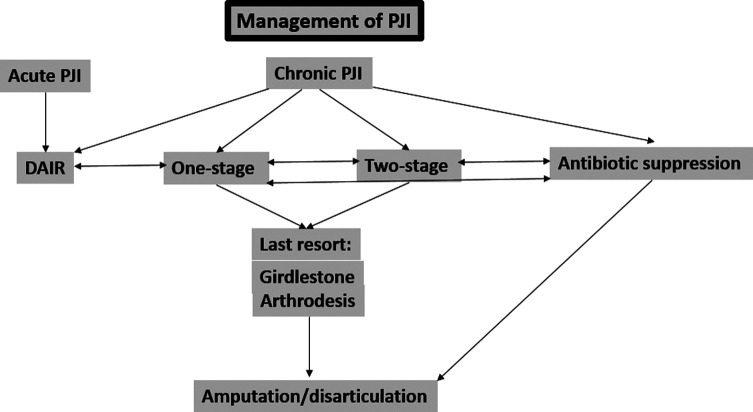
Periprosthetic joint infection (PJI) is one of the most dreadful complications after THA and TKA. Though prevention is of utmost importance in PJI management, the last decade has seen many remarkable developments in PJI diagnosis, including the introduction of several standardized PJI diagnostic definitions and biomarkers. Depending on the specific clinical situation, a myriad of treatment options for PJI are offered. Our review aims to summarize the pertinent information on PJI diagnosis and synthesize literature on the different treatment methods currently used in clinical practice. One of the most accepted PJI diagnostic definitions was developed by the Musculoskeletal Infection Society (MSIS) in 2011, later modified in the 2013 International Consensus Meeting (ICM). After promising results from studies, alpha-defensins and D-dimer were recently incorporated into the 2018 ICM PJI definition. The management choices for PJI include irrigation and debridement (DAIR), one-stage exchange arthroplasty, or two-stage exchange arthroplasty, to name a few. While two-stage revision has traditionally been the treatment of choice in the United States, there has been a growing body of evidence framing one-stage revision as a comparable choice. One-stage revision should be offered in patients meeting strict selection criteria: no sinus tract, proper soft tissue available for wound closure, appropriate bone stock, a favorable identifiable organism with encouraging antibiotic sensitivities (for cement and oral suppression later), and robust immunological status. DAIR can be considered in case of early infections with sensitive infecting organisms. Patients with multiple unsuccessful revisions or those who refuse further surgical intervention for PJI can be offered antibiotic suppression. If nothing seems to work, salvage procedures (resection arthroplasty and arthrodesis) are available as a last resort. Further research is encouraged to improve on diagnostic capabilities and develop evidence on the best treatment of choice for PJI.
Keywords: Diagnosis of PJI; Infected arthroplasty; PJI; Periprosthetic joint infection; Treatment of PJI.
© The Authors, published by EDP Sciences, 2021.
Figures
References
-
- Steiner C, Andrews R, Barrett M, Weiss A (2012) HCUP projections: Mobility/orthopedic procedures 2003 to 2012. HCUP projections report # 2012-03. U.S. Agency for Healthcare Research and Quality. http://hcup-us.ahrq.gov/reports/projections/2012-03.pdf. Accessed 2021 Feb 10.
-
- Kurtz S, Ong K, Lau E, Mowat F, Halpern M (2007) Projections of primary and revision hip and knee arthroplasty in the United States from 2005 to 2030. J Bone Joint Surg Am 89(4), 780–785. - PubMed
-
- Wang FD, Wang YP, Chen CF, Chen HP (2018) The incidence rate, trend and microbiological aetiology of prosthetic joint infection after total knee arthroplasty: A 13 years’ experience from a tertiary medical center in Taiwan. J Microbiol Immunol Infect 51(6), 717–722. - PubMed
Grants and funding
LinkOut - more resources
Full Text Sources