


Prevalence and risk factors of cancer-related fatigue in childhood cancer survivors: A DCCSS LATER study
- PMID: 34724201
- PMCID: PMC9298343
- DOI: 10.1002/cncr.33993
Prevalence and risk factors of cancer-related fatigue in childhood cancer survivors: A DCCSS LATER study
Abstract
Background: Cancer-related fatigue is a debilitating late effect after treatment for childhood cancer. The prevalence of fatigue in childhood cancer survivors (CCSs) and associated factors for fatigue has varied widely in previous studies. Two important aspects of cancer-related fatigue, its severity and chronicity, are often not assessed. This study investigated the prevalence of, and risk factors for, severe chronic fatigue (CF) in a national cohort of Dutch CCSs.
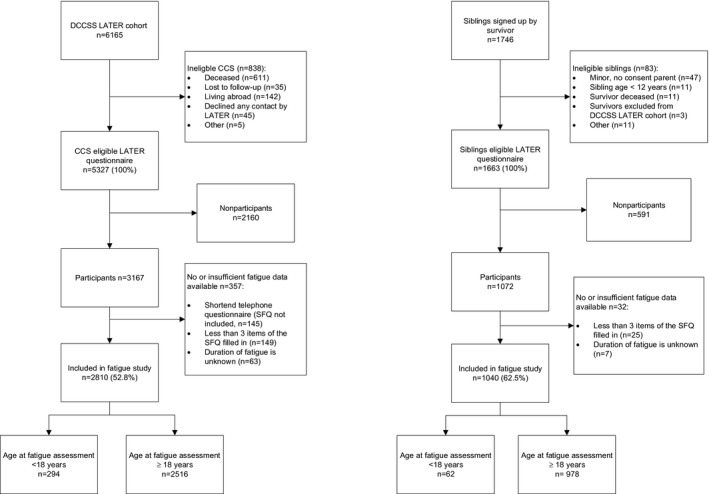
Methods: In this study, 2810 CCSs (5-year survivors of all childhood malignancies diagnosed between 1963 and 2001 with a current age of 12-65 years) and 1040 sibling controls were included. CF was assessed with the Short Fatigue Questionnaire and was defined as a score ≥ 18 and persistence of fatigue for ≥6 months. Cancer- and treatment-related characteristics, current health problems, and demographic and lifestyle variables were assessed as potential risk factors for CF via multivariable logistic regression analyses.
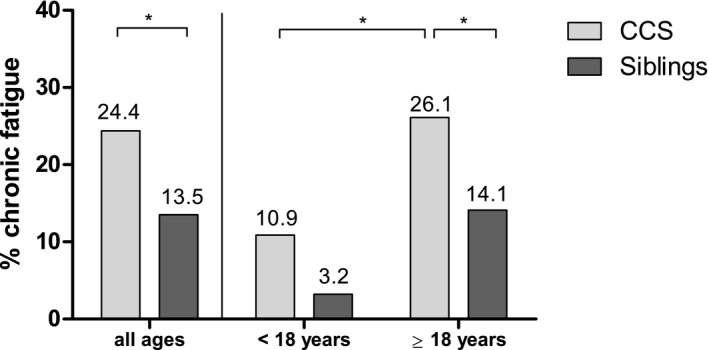
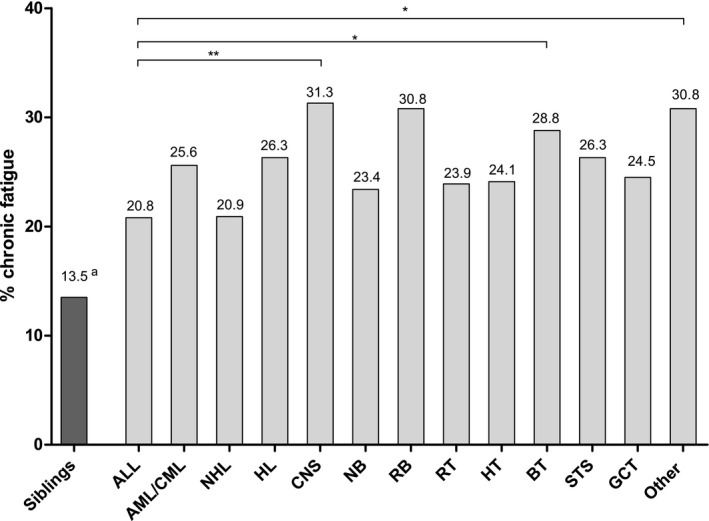
Results: In adult CCSs and sibling controls (≥18 years old), the prevalence of CF was 26.1% and 14.1%, respectively (P < .001). In adolescent CCSs and sibling controls (<18 years old), the prevalence of CF was 10.9% and 3.2%, respectively. Female gender (odds ratio [OR], 2.13; 95% confidence interval [CI], 1.73-2.62), unemployment (OR, 2.18; 95% CI, 1.67-2.85), having 1 or more health problems (OR for 1-2, 1.48; 95% CI, 1.18-1.87; OR for >2, 2.20; 95% CI, 1.50-3.21), and a central nervous system diagnosis (OR, 1.74; 95% CI, 1.17-2.60) were significantly associated with CF in adult CCSs.
Conclusions: This study shows that CCSs, regardless of their cancer diagnosis, report CF more often than sibling controls. This study provides new evidence for the prevalence of fatigue in CCSs.
Keywords: cancer-related fatigue; childhood cancer survivors; late effects; survivorship.
© 2021 The Authors. Cancer published by Wiley Periodicals LLC on behalf of American Cancer Society.
Conflict of interest statement
The authors made no disclosures.
Figures
References
-
- Macartney G, VanDenKerkhof E, Harrison MB, Stacey D. Symptom experience and quality of life in pediatric brain tumor survivors: a cross‐sectional study. J Pain Symptom Manage. 2014;48:957‐967. - PubMed
-
- Kanellopoulos A, Hamre HM, Dahl AA, Fossa SD, Ruud E. Factors associated with poor quality of life in survivors of childhood acute lymphoblastic leukemia and lymphoma. Pediatr Blood Cancer. 2013;60:849‐855. - PubMed
-
- Hamre H, Zeller B, Kanellopoulos A, et al. High prevalence of chronic fatigue in adult long‐term survivors of acute lymphoblastic leukemia and lymphoma during childhood and adolescence. J Adolesc Young Adult Oncol. 2013;2:0015.
Publication types
MeSH terms
Grants and funding
LinkOut - more resources
Full Text Sources
Medical
