Evaluation of Hypofractionated Radiation Therapy Use and Patient-Reported Outcomes in Men With Nonmetastatic Prostate Cancer in Australia and New Zealand
- PMID: 34724555
- PMCID: PMC8561328
- DOI: 10.1001/jamanetworkopen.2021.29647
Evaluation of Hypofractionated Radiation Therapy Use and Patient-Reported Outcomes in Men With Nonmetastatic Prostate Cancer in Australia and New Zealand
Abstract
Importance: Randomized clinical trials in prostate cancer have reported noninferior outcomes for hypofractionated radiation therapy (HRT) compared with conventional RT (CRT); however, uptake of HRT across jurisdictions is variable.
Objective: To evaluate the use of HRT vs CRT in men with nonmetastatic prostate cancer and compare patient-reported outcomes (PROs) at a population level.
Design, setting, and participants: Registry-based cohort study from the Australian and New Zealand Prostate Cancer Outcomes Registry (PCOR-ANZ). Participants were men with nonmetastatic prostate cancer treated with primary RT (excluding brachytherapy) from January 2016 to December 2019. Data were analyzed in March 2021.
Exposures: HRT defined as 2.5 to 3.3 Gy and CRT defined as 1.7 to 2.3 Gy per fraction.
Main outcomes and measures: Temporal trends and institutional, clinicopathological, and sociodemographic factors associated with use of HRT were analyzed. PROs were assessed 12 months following RT using the Expanded Prostate Cancer Index Composite (EPIC)-26 Short Form questionnaire. Differences in PROs were analyzed by adjusting for age and National Comprehensive Cancer Network risk category.
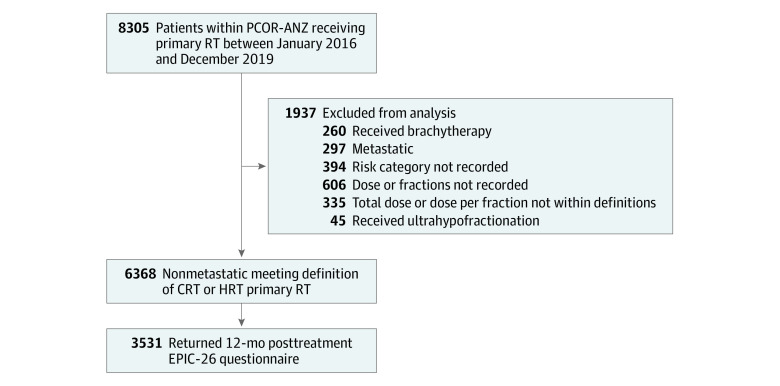
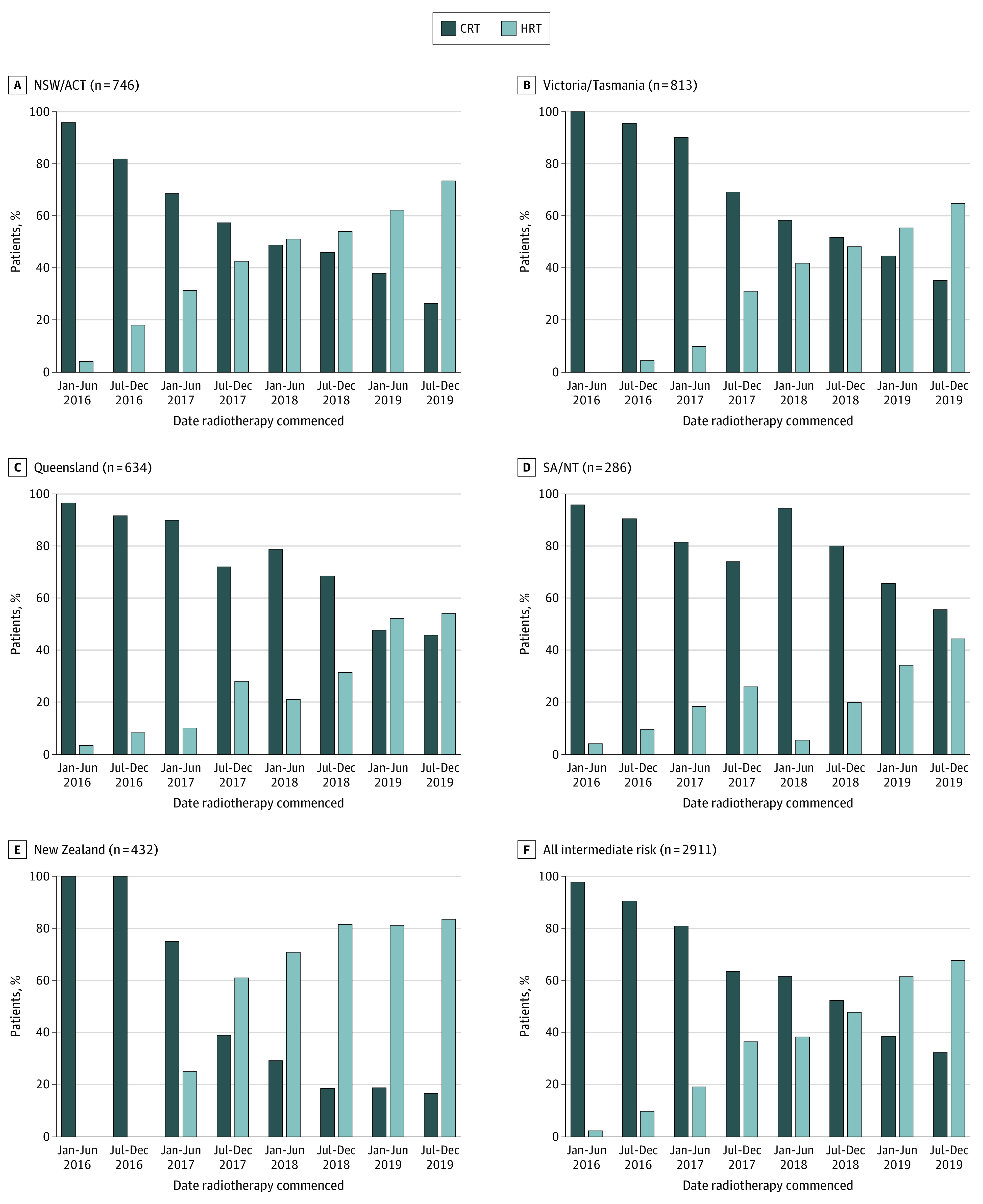
Results: Of 8305 men identified as receiving primary RT, 6368 met the inclusion criteria for CRT (n = 4482) and HRT (n = 1886). The median age was 73.1 years (IQR, 68.2-77.3 years), 2.6% (168) had low risk, 45.7% (2911) had intermediate risk, 44.5% (2836) had high-/very high-risk, and 7.1% (453) had regional nodal disease. Use of HRT increased from 2.1% (9 of 435) in the first half of 2016 to 52.7% (539 of 1023) in the second half of 2019, with lower uptake in the high-/very high-risk (1.9% [4 of 215] to 42.4% [181 of 427]) compared with the intermediate-risk group (2.2% [4 of 185] to 67.6% [325 of 481]) (odds ratio, 0.26; 95% CI, 0.15-0.45). Substantial variability in the use of HRT for intermediate-risk disease remained at the institutional level (median 53.3%; range, 0%-100%) and clinician level (median 57.9%; range, 0%-100%) in the last 2 years of the study period. There were no clinically significant differences across EPIC-26 urinary and bowel functional domains or bother scores.
Conclusions and relevance: In this cohort study, use of HRT for prostate cancer increased substantially from 2016. This population-level data demonstrated clinically equivalent PROs and supports the continued implementation of HRT into routine practice. The wide variation in practice observed at the jurisdictional, institutional, and clinician level provides stakeholders with information that may be useful in targeting implementation strategies and benchmarking services.
Conflict of interest statement
Figures
References
-
- Dearnaley D, Syndikus I, Mossop H, et al. ; CHHiP Investigators . Conventional versus hypofractionated high-dose intensity-modulated radiotherapy for prostate cancer: 5-year outcomes of the randomised, non-inferiority, phase 3 CHHiP trial. Lancet Oncol. 2016;17(8):1047-1060. doi: 10.1016/S1470-2045(16)30102-4 - DOI - PMC - PubMed
Publication types
MeSH terms
LinkOut - more resources
Full Text Sources
Medical
Research Materials
Miscellaneous