


Quantifying contributions of natural variability and anthropogenic forcings on increased fire weather risk over the western United States
- PMID: 34725162
- PMCID: PMC8609294
- DOI: 10.1073/pnas.2111875118
Quantifying contributions of natural variability and anthropogenic forcings on increased fire weather risk over the western United States
Abstract
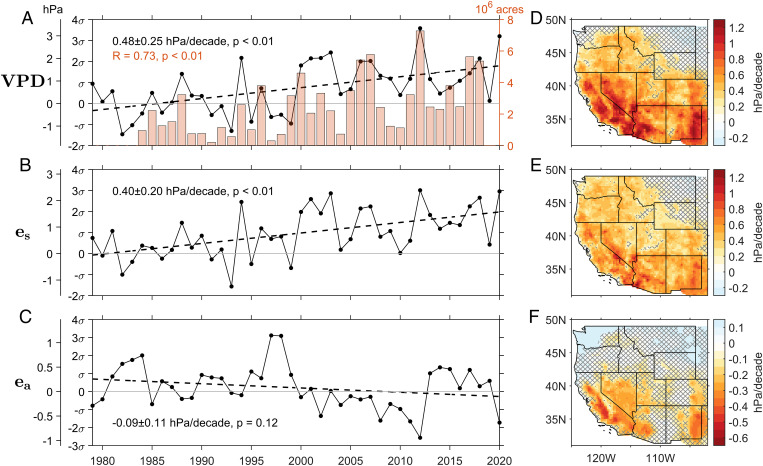
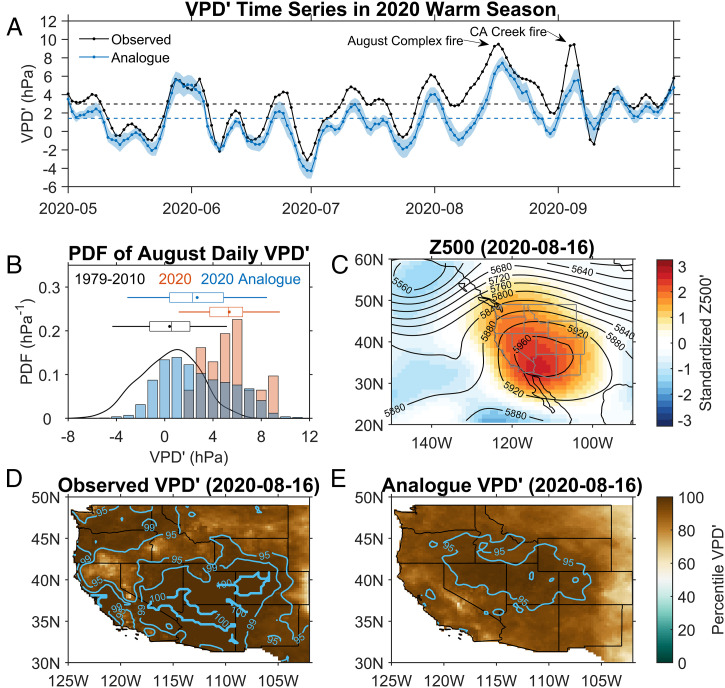
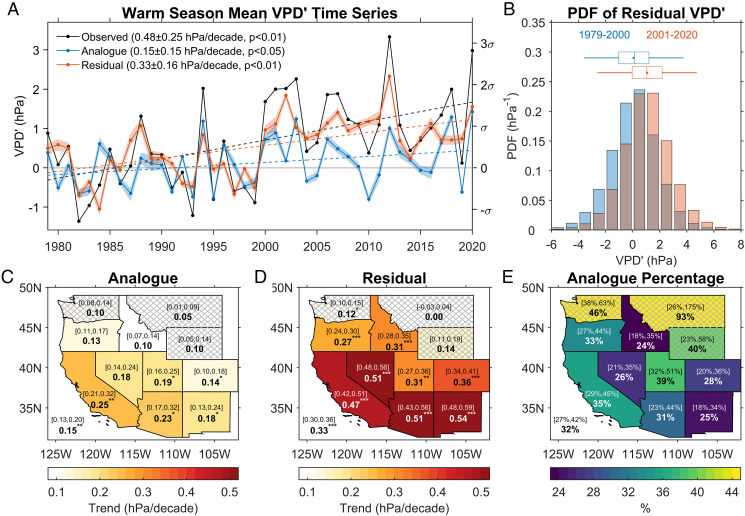
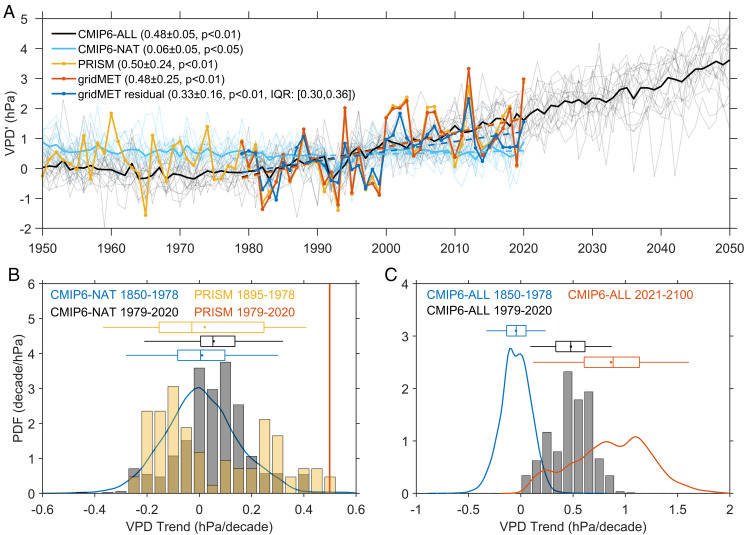
Previous studies have identified a recent increase in wildfire activity in the western United States (WUS). However, the extent to which this trend is due to weather pattern changes dominated by natural variability versus anthropogenic warming has been unclear. Using an ensemble constructed flow analogue approach, we have employed observations to estimate vapor pressure deficit (VPD), the leading meteorological variable that controls wildfires, associated with different atmospheric circulation patterns. Our results show that for the period 1979 to 2020, variation in the atmospheric circulation explains, on average, only 32% of the observed VPD trend of 0.48 ± 0.25 hPa/decade (95% CI) over the WUS during the warm season (May to September). The remaining 68% of the upward VPD trend is likely due to anthropogenic warming. The ensemble simulations of climate models participating in the sixth phase of the Coupled Model Intercomparison Project suggest that anthropogenic forcing explains an even larger fraction of the observed VPD trend (88%) for the same period and region. These models and observational estimates likely provide a lower and an upper bound on the true impact of anthropogenic warming on the VPD trend over the WUS. During August 2020, when the August Complex "Gigafire" occurred in the WUS, anthropogenic warming likely explains 50% of the unprecedented high VPD anomalies.
Keywords: anthropogenic warming; atmospheric circulation; attribution; fire weather; western United States.
Copyright © 2021 the Author(s). Published by PNAS.
Conflict of interest statement
The authors declare no competing interest.
Figures
Comment in
-
Atmospheric variability contributes to increasing wildfire weather but not as much as global warming.Proc Natl Acad Sci U S A. 2021 Nov 16;118(46):e2117876118. doi: 10.1073/pnas.2117876118. Proc Natl Acad Sci U S A. 2021. PMID: 34764227 Free PMC article. No abstract available.
References
-
- Picotte J. J., et al. ., Changes to the monitoring trends in burn severity program mapping production procedures and data products. Fire Ecol. 16, 16 (2020).
-
- Agee J. K., Skinner C. N., Basic principles of forest fuel reduction treatments. For. Ecol. Manage. 211, 83–96 (2005).
-
- Stephens S. L., Ruth L. W., Federal forest-fire policy in the United States. Ecol. Appl. 15, 532–542 (2005).
-
- Littell J. S., McKenzie D., Peterson D. L., Westerling A. L., Climate and wildfire area burned in western U.S. ecoprovinces, 1916-2003. Ecol. Appl. 19, 1003–1021 (2009). - PubMed
-
- Williams A. P., Abatzoglou J. T., Recent advances and remaining uncertainties in resolving past and future climate effects on global fire activity. Curr. Clim. Change Rep. 2, 1–14 (2016).
