. 2021 Nov 1;11(1):21380.
doi: 10.1038/s41598-021-00973-5.

Persistent Plasmodium falciparum infections enhance transmission-reducing immunity development

Affiliations

Persistent Plasmodium falciparum infections enhance transmission-reducing immunity development

Ruth Ayanful-Torgby et al. Sci Rep. .

Abstract

Subclinical infections that serve as reservoir populations to drive transmission remain a hurdle to malaria control. Data on infection dynamics in a geographical area is required to strategically design and implement malaria interventions. In a longitudinal cohort, we monitored Plasmodium falciparum infection prevalence and persistence, and anti-parasite immunity to gametocyte and asexual antigens for 10 weeks. Of the 100 participants, only 11 were never infected, whilst 16 had persistent infections detected by reverse transcriptase-quantitative polymerase chain reaction (RT-qPCR), and one participant had microscopic parasites at all visits. Over 70% of the participants were infected three or more times, and submicroscopic gametocyte prevalence was high, ≥ 48% of the parasite carriers. Naturally induced responses against recombinant Pfs48/45.6C, Pfs230proC, and EBA175RIII-V antigens were not associated with either infection status or gametocyte carriage, but the antigen-specific IgG titers inversely correlated with parasite and gametocyte densities consistent with partial immunity. Longitudinal analysis of gametocyte diversity indicated at least four distinct clones circulated throughout the study period. The high prevalence of children infected with distinct gametocyte clones coupled with marked variation in infection status at the individual level suggests ongoing transmission and should be targeted in malaria control programs.


Conflict of interest statement

The authors declare no competing interests.

Figures
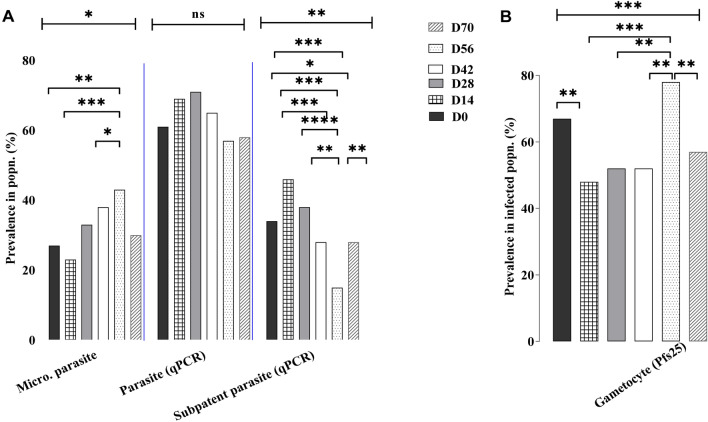
Figure 1
Figure 1
Plasmodium falciparum infection dynamics in the population. (A) The prevalence of parasites detected in the study population at each time point [Day (D)] using microscopy (Micro) and Pf 18srRNA reverse transcriptase-quantitative polymerase chain reaction [RT-qPCR (qPCR)]. Infections detected only by Pf18S rRNA using RT-qPCR, not microscopy were considered subpatent. Microscopic (Micro) parasite prevalence differed slightly (p = 0046) between sampling days. The prevalence of individuals infected only at the submicroscopic (Subpatent) level differed significantly (***p < 0.001) between time points. (B) Gametocyte prevalence detected in the infected population using Pfs25 RT-qPCR also differed significantly (***p = 0.007). Analysis for all time points was by Chi-square and between time points by two sample tests of proportions (nsp > 0.05, *p ≤ 0.05, **p ≤ 0.01, ***p ≤ 0.001).
Figure 2
Figure 2
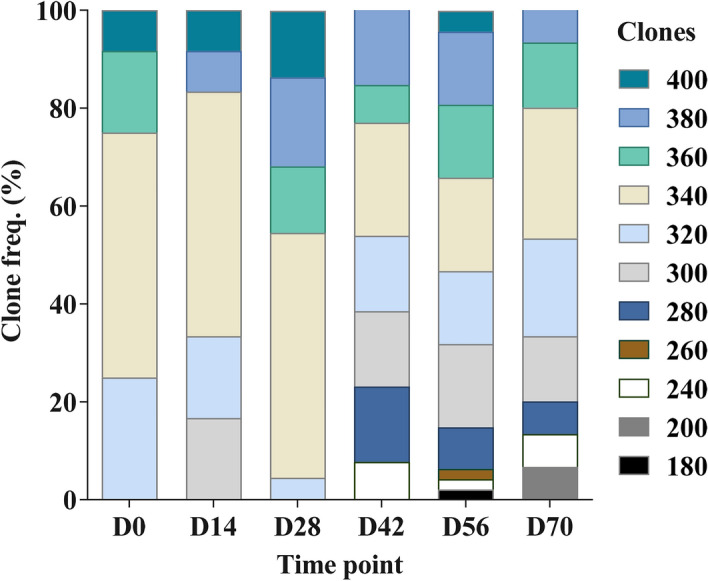
Distribution and duration of circulating gametocyte clones. At each time point analyzed [Day (D)] the different gametocyte clones (n = 11) detected in the subpopulation (n = 149) of infected samples tested are shown. Clonal frequency and distribution differed between time points. The highest number of diverse clones were observed on days 56 and 70. Clones below 300 bp (180–280) were least represented and observed only after day 28.
Figure 3
Figure 3
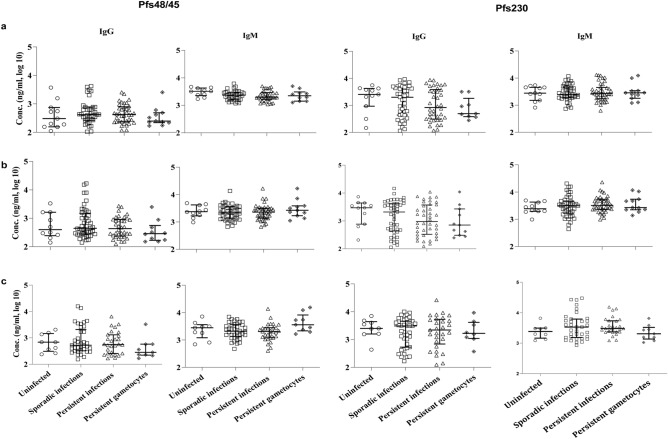
Antibodies against gametocyte antigens Pfs48/45.6C and Pfs230proC over the course of the study. Infectivity status did not influence the concentrations of IgG and IgM antibodies against gametocyte antigens, Pfs48/45.6C and Pfs230.proC. IgG and IgM antibodies levels (ng/ml, log 10) specific for gametocyte antigens, Pfs48/45.6C and Pfs230.proC were measured monthly [days 14 (a), 42 (b), and 70 (c)] in plasma from all the participants. The antibody concentrations obtained at each time point are plotted in groups based on overall infectivity status, uninfected (n = 11), sporadically infected; ≤ 4 infections (n = 49), persistently infected; ≥ 5 infections (n = 39), and persistent gametocytes; ≥ 5 episodes (n = 11) of gametocytemia. The median and interquartile range of the antibody concentrations are shown and differences between groups were analyzed by one-way ANOVA. The p values (p = 0.0631–0.994) are listed in Supplementary Table 4.
Figure 4
Figure 4
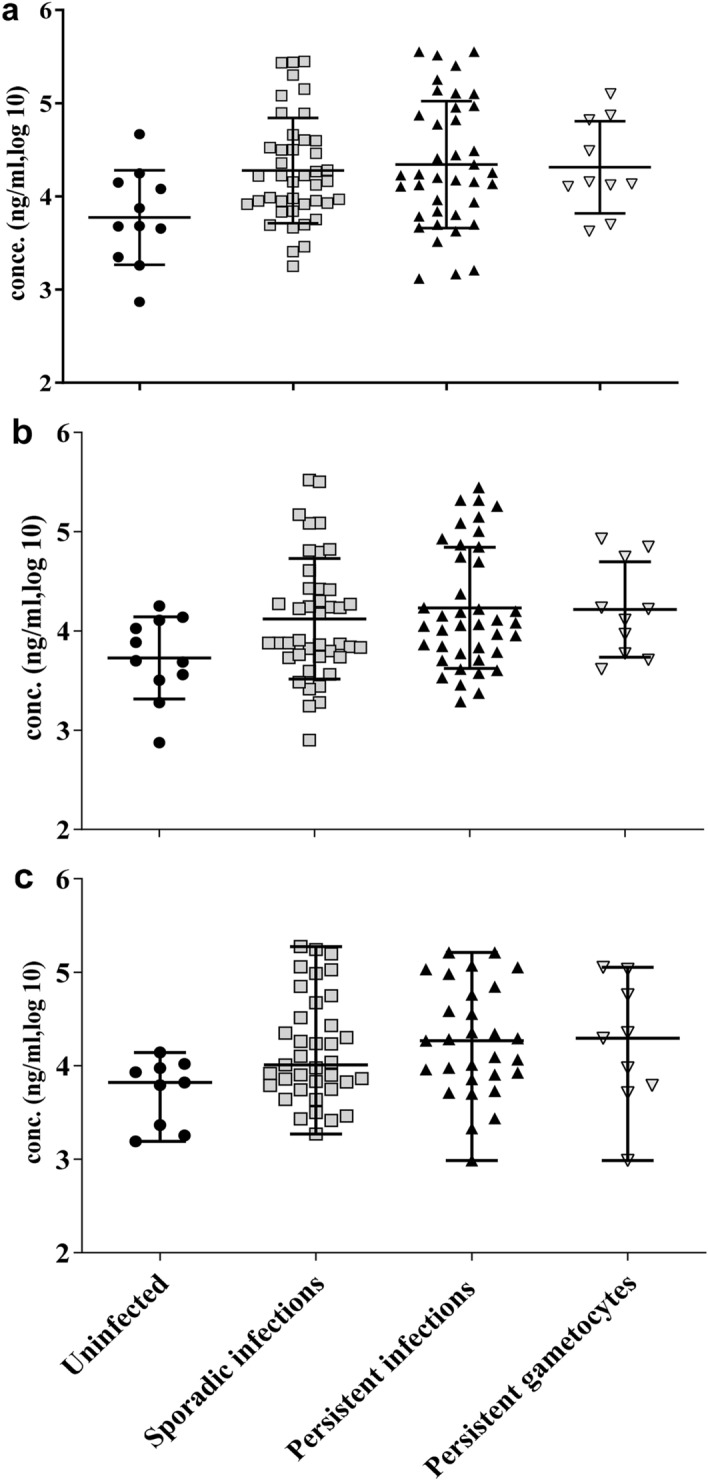
Antibodies against the asexual antigen EBA175 RIII–V over the course of the study. Anti-EBA175RIII–V IgG antibody concentrations (ng/ml, log 10) were measured monthly [days 14 (a), 42 (b), and 70 (c)] in plasma from all the participants. The antibody concentrations obtained at each time point are plotted in groups based on overall infectivity status. Uninfected (n = 11), sporadically infected, ≤ 4 infections (n = 49), persistently infected ≥ 5 infections (n = 39), and persistent gametocytes, ≥ 5 episodes (n = 11) were assessed using P. falciparum Pf18S rRNA and Pfs25 transcripts for the detection of total parasite and gametocyte infections respectively. The median and interquartile range is shown and one-way ANOVA did not detect differences between the groups. The p values (p = 0.1647–0.7274) are listed in Supplementary Table 4.
Figure 5
Figure 5
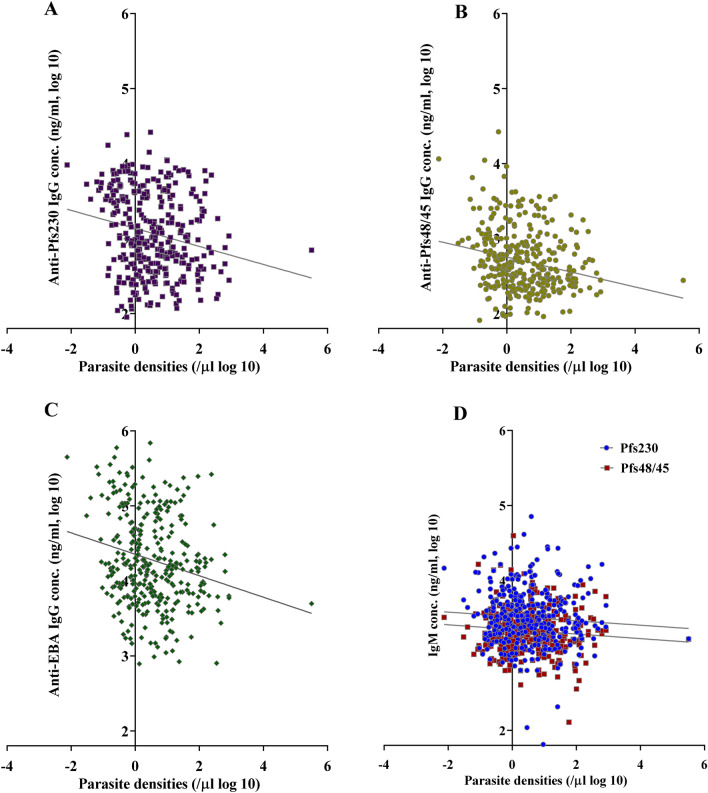
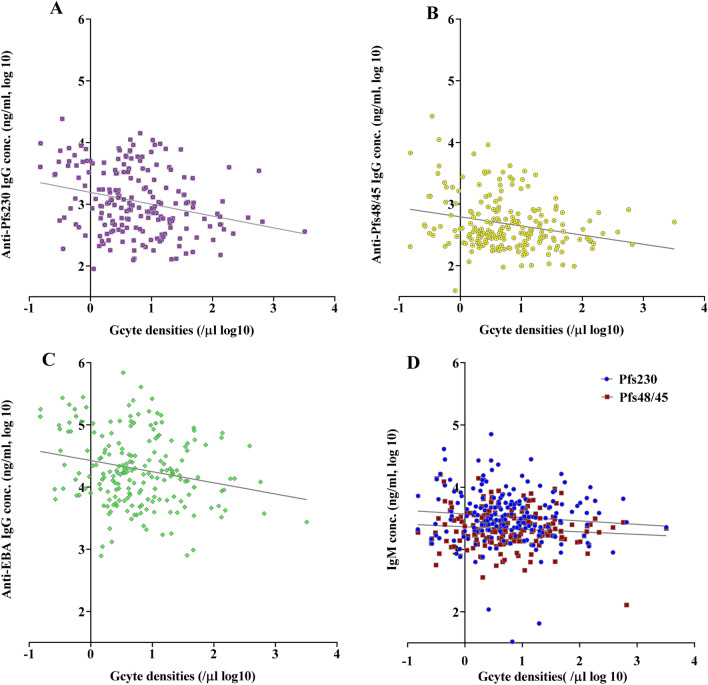
IgG antibody titers inversely correlate with parasite densities. Comparison of parasite densities estimated from Pf18s rRNA RT-qPCR analysis and the corresponding IgG (AC) titers against Pfs230proC (A), Pfs48/45.6C (B) and EBA175RIII–V (C), and IgM (D) titers against Pfs230proC and Pfs48/45.6C. IgG, not IgM, responses were significantly inversely correlated with parasite densities. IgG Pearson r = − 0.2109**** (anti-Pfs230), r = − 0.2252**** (anti-Pfs48/45) r = − 0.2143**** (anti-EBA175). IgM Pearson r = − 0.07071 ns (Pfs230) and r = − 0.1010 ns (Pfs48/45). nsp > 0.05, ****p ≤ 0.0001.
Figure 6
Figure 6
IgG antibody titers inversely correlate with gametocyte densities. Comparison of gametocyte densities estimated from Pfs25 RT-qPCR analysis and the corresponding IgG (AC) titers against Pfs230proC, Pfs48/45.6C and EBA175RIII–V, and IgM (D) titers against Pfs230proC and Pfs48/45.6C. IgG, not IgM, responses were significantly inversely correlated with gametocyte densities. IgG Pearson r = − 0.2656*** (Pfs230), r = − 0.2505*** (Pfs48/45) r = − 0.2144** (anti-EBA175). IgM Pearson r = − 0.0929 ns (Pfs230) and r = − 0.1033 ns (Pfs48/454). nsp > 0.05, **p < 0.01, ***p ≤ 0.001.

References

    1. World Health Organisation. World malaria report 2018 (WHO Press, 2018). https://www.who.int/malaria/publications/world-malaria-report-2018/en/
    1. Lindblade KA, Steinhardt L, Samuels A, Kachur SP, Slutsker L. The silent threat: Asymptomatic parasitemia and malaria transmission. Expert Rev. Anti Infect. Ther. 2013;11:623–639. doi: 10.1586/eri.13.45. - DOI - PubMed
    1. Weiss DJ, et al. Mapping the global prevalence, incidence, and mortality of Plasmodiumfalciparum, 2000–17: A spatial and temporal modelling study. Lancet. 2019;394:322–331. doi: 10.1016/S0140-6736(19)31097-9. - DOI - PMC - PubMed
    1. National Malaria Control Programme Ghana. NMCP. Annual Report. Ghana 2017. National Malaria Control Programme Ghana Health Services, Accra, 2018. (2018).
    1. Cooper L, et al. Pareto rules for malaria super-spreaders and super-spreading. Nat. Commun. 2019;10:3939. doi: 10.1038/s41467-019-11861-y. - DOI - PMC - PubMed

Publication types