. 2022 Jan 13;106(1):118-131.
doi: 10.1093/biolre/ioab201.

VEGFA165 can rescue excess steroid secretion, inflammatory markers, and follicle arrest in the ovarian cortex of High A4 cows†

VEGFA165 can rescue excess steroid secretion, inflammatory markers, and follicle arrest in the ovarian cortex of High A4 cows†

Mohamed A Abedal-Majed et al. Biol Reprod. .

Abstract

A population of cows with excess androstenedione (A4; High A4) in follicular fluid, with follicular arrest, granulosa cell dysfunction, and a 17% reduction in calving rate was previously identified. We hypothesized that excess A4 in the ovarian microenvironment caused the follicular arrest in High A4 cows and that vascular endothelial growth factor A would rescue the High A4 phenotype. In trial 1, prior to culture, High A4 ovarian cortex (n = 9) had greater numbers of early stage follicles (primordial) and fewer later-stage follicles compared to controls (n = 11). Culture for 7 days did not relieve this follicular arrest; instead, High A4 ovarian cortex had increased indicators of inflammation, anti-Mullerian hormone, and A4 secretion compared to controls. In trial 2, we tested if vascular endothelial growth factor A isoforms could rescue the High A4 phenotype. High A4 (n = 5) and control (n = 5) ovarian cortex was cultured with (1) PBS, (2) VEGFA165 (50 ng/mL), (3) VEGFA165B (50 ng/mL), or (4) VEGFA165 + VEGFA165B (50 ng/mL each) for 7 days. Follicular progression increased with VEGFA165 in High A4 cows with greater early primary, primary, and secondary follicles than controls. Similar to trial 1, High A4 ovarian cortex secreted greater concentrations of A4 and other steroids and had greater indicators of inflammation compared to controls. However, VEGFA165 rescued steroidogenesis, oxidative stress, and fibrosis. The VEGFA165 and VEGFA165b both reduced IL-13, INFα, and INFβ secretion in High A4 cows to control levels. Thus, VEGFA165 may be a potential therapeutic to restore the ovarian steroidogenic microenvironment and may promote folliculogenesis.

Keywords: A4; VEGFA165; fibrosis; in vitro culture; ovarian cortex; oxidative stress.


Figures

None
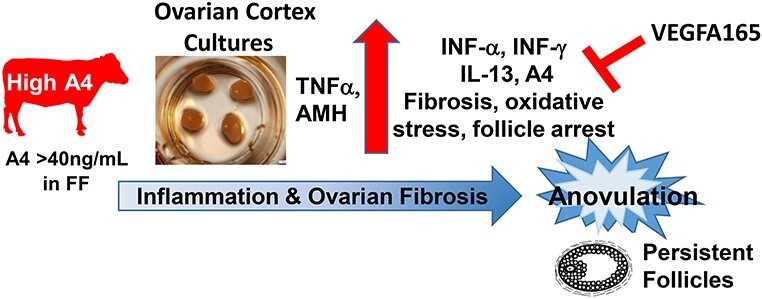
Graphical abstract
Figure 1
Figure 1
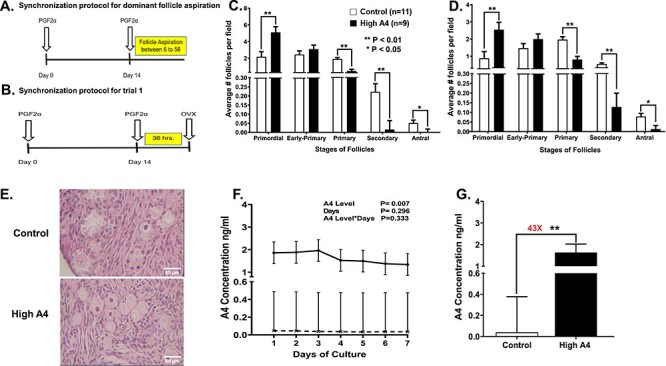
Demonstrates the synchronization protocol (A) to obtain follicular fluid through dominant follicle aspiration to classify the cows into High A4 or control groups for all trials; (B) synchronization of estrous cycles prior to ovariectomy to obtain ovarian cortex pieces to culture for trial 1; (C) the average number of follicles per fields at different follicle stages in control and High A4 cows before culture; (D) the average number of follicles for each stage and per field after 7 days of ovarian cortex culture; (E) representative H and E staining for control and High A4 cows, demonstrating follicle stages present in each cow classification; (F) the concentrations of A4 daily during the 7 day ovarian cortex culture for each cow classification; and (G) the total amount of A4 that was collected for all 7 days during the ovarian cortex culture in control and High A4 cows. Control (n = 11); High A4 (n = 9); difference is shown between bars with *P < 0.05; **P < 0.01; NS = not significant.
Figure 2
Figure 2
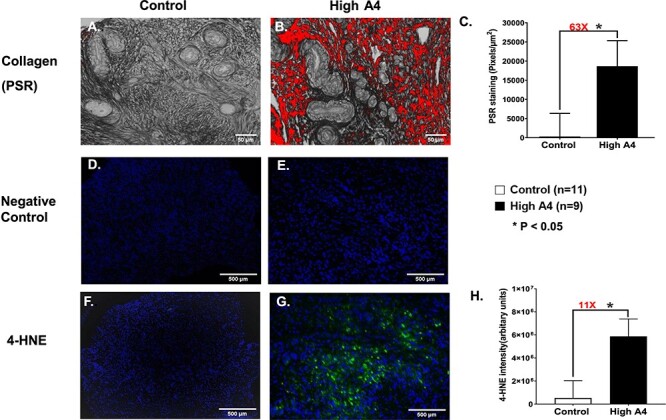
Collagen staining (PSR) for (A) control and (B) High A4 ovarian cortex cultures. (C) Graph comparing the average area of PSR-positive staining per ovarian cortex field (pixels/μm2) between High A4 and control cows; control (n = 11), High A4 (n = 9). (D–H) Immunofluorescent staining for oxidative stress (4-HNE) negative controls for (D) control and (E) High A4 cow (4-HNE) and (F) controls. (G) High A4 cow ovarian cortex and (H) graph quantitating the integrated intensity of 4-HNE-positive staining per ovarian cortex field (arbitrary units) between High A4 and control cows. *P < 0.05.
Figure 3
Figure 3
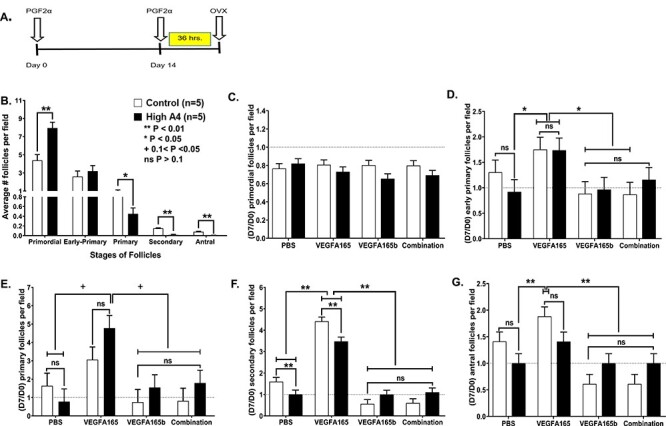
Synchronization of estrous cycles of cows in trial 2 (A) and graphs of follicular counts at each follicular stage for High A4 and control cows (control, n = 5; High A4, n = 5) (B) before culture all stages; and (C–G) after culture in trial 2 treated with different VEGFA isoforms; (C) primordial; (D) early primary; (E) primary; (F) secondary; and (G) antral follicles. Differences are denoted by **P < 0.01; *P < 0.05; ns = not significant.
Figure 4
Figure 4
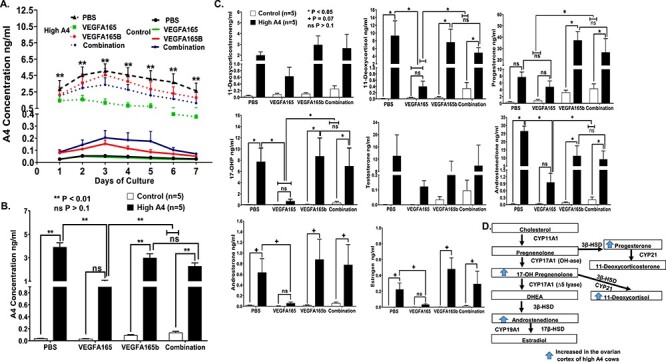
Concentrations of steroids secreted into ovarian cortex media in trial 2 for High A4 and control cows with different in vitro treatment (A) over each day of the culture period and (B) average of 7 days in culture. (C) HPLC-MS analysis for different steroid hormones and metabolites secreted from PBS, VEGFA165, VEGFA165B, and combination-treated cortex culture media for control and High A4 cows. (D) Schematic of increased steroid in ovarian cortex of High A4 cows. Statistical differences are denoted by *P < 0.05; +P < 0.07; n for control = 5; n for High A4 = 5; ns = not significant.
Figure 5
Figure 5
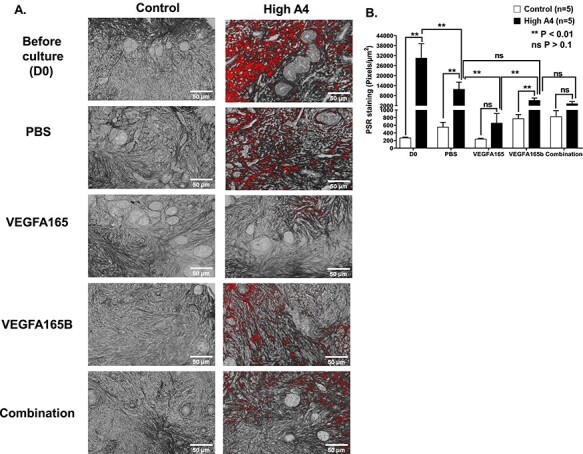
(A) Collagen staining (PSR) for High A4 and control ovarian cortexes before culture and after culture with different VEGFA isoforms in trial 2; (B) graph comparing the average area of PSR-positive staining per ovarian cortex field (pixels/μm2) between High and control cows before culture and after culture with different VEGFA isoforms. Statistical differences are denoted with **P < 0.01 or ns P > 0.10. n for control = 5; n for High A4 = 5.
Figure 6
Figure 6
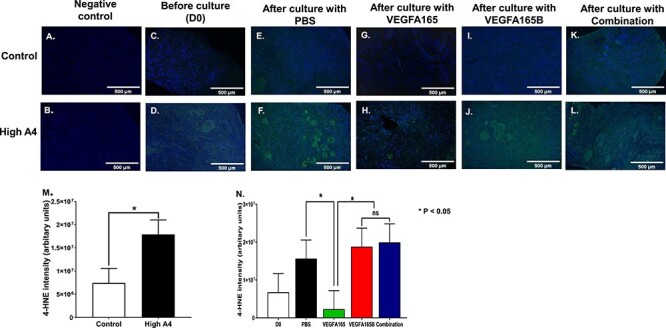
(A–L) Immunofluorescent staining for oxidative stress (4-HNE) negative controls for (A) control and (B) High A4 cows; before culture (C) controls and (D) High A4 cows; after culture with PBS (E) control and (F) High A4 cow; after culture with VEGFA165 (G) control and (H) High A4 cow; after culture with VEGFA165B (I) control and (J) High A4 cow; after culture with combination (K) control and (L) High A4 cow ovarian cortex. (M) Graph comparing the integrated intensity of 4-HNE-positive staining per ovarian cortex field (arbitrary units) between High and control cows; (N) graph quantitating the integrated intensity of 4-HNE-positive staining per ovarian cortex field (arbitrary units) between different in vitro culture treatments. Statistical differences are denoted by *P < 0.05. n for control = 5; n for High A4 = 5.
Figure 7
Figure 7
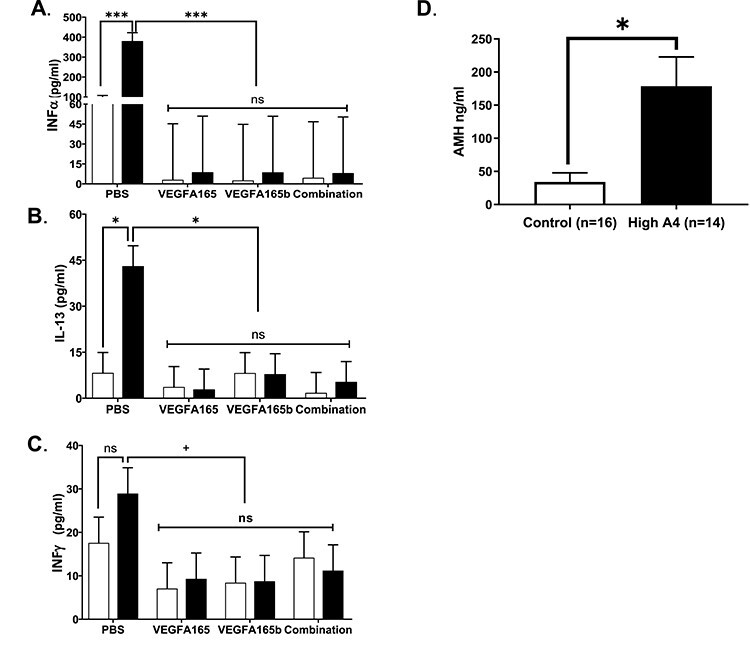
Effects of VEGFA isoforms on cytokines and chemokines in ovarian cortex culture media. Graphs representing PBS, VEGFA165, VEGFA165b, and combination treatments for (A) INFα, (B) IL-13, and (C) INFγ. (D) Concentrations of AMH in ovarian cortex cultures in trials 1 and 2. Control, n = 16; High A4, n = 14. Statistical differences are denoted on the graphs where P < 0.05 are different and P > 0.05 but <0.1 tend to be different.

References

    1. Badawy A, Elnashar A. Treatment options for polycystic ovary syndrome. Int J Womens Health 2011; 3:25–35. - PMC - PubMed
    1. Hackbart KS, Cunha PM, Meyer RK, Wiltbank MC. Effect of glucocorticoid-induced insulin resistance on follicle development and ovulation. Biol Reprod 2013; 88:153. - PMC - PubMed
    1. Smith S, Pfeifer SM, Collins JA. Diagnosis and management of female infertility. JAMA 2003; 290:1767–1770. - PubMed
    1. Beshay VE, Carr BR. Hypothalamic-pituitary-ovarian axis and control of the menstrual cycle. 2013; 31–42.
    1. Wiltbank MC, Gumen A, Sartori R. Physiological classification of anovulatory conditions in cattle. Theriogenology 2002; 57:21–52. - PubMed

Publication types

MeSH terms