Patient-Reported Testing Burden of Breast Magnetic Resonance Imaging Among Women With Ductal Carcinoma In Situ: An Ancillary Study of the ECOG-ACRIN Cancer Research Group (E4112)
- PMID: 34726748
- PMCID: PMC8564581
- DOI: 10.1001/jamanetworkopen.2021.29697
Patient-Reported Testing Burden of Breast Magnetic Resonance Imaging Among Women With Ductal Carcinoma In Situ: An Ancillary Study of the ECOG-ACRIN Cancer Research Group (E4112)
Erratum in
-
Errors in Table 3 Footnotes.JAMA Netw Open. 2021 Dec 1;4(12):e2141485. doi: 10.1001/jamanetworkopen.2021.41485. JAMA Netw Open. 2021. PMID: 34870684 Free PMC article. No abstract available.
Abstract
Importance: The use of magnetic resonance imaging (MRI) in pretreatment planning of ductal carcinoma in situ (DCIS) remains controversial. Understanding changes in short-term health-related quality of life associated with breast MRI would allow for a more complete comparative effectiveness assessment.
Objective: To assess whether there are changes in patient-reported quality of life associated with breast MRI among women diagnosed with DCIS.
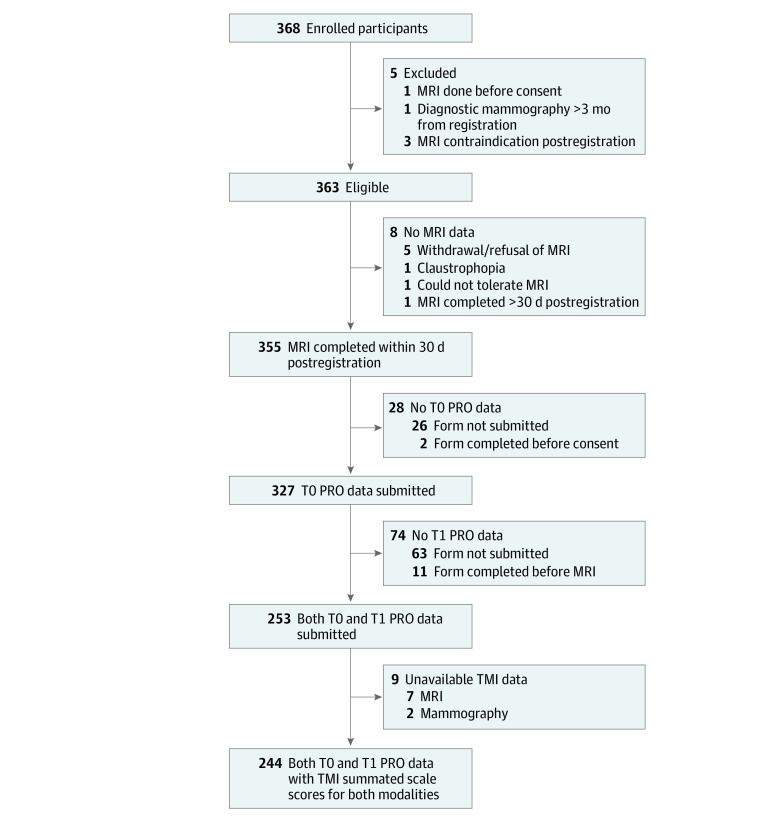
Design, setting, and participants: This cohort study was a substudy of a nonrandomized clinical trial conducted at 75 participating US institutions from March 2015 to April 2016. Women recently diagnosed with unilateral DCIS who were eligible for wide local excision and had a diagnostic mammogram within 3 months of study registration were included. A total of 355 women met the eligibility criteria and underwent the study MRI. Data analysis was performed from June 3, 2020, to July 1, 2021.
Exposures: Participants underwent bilateral breast MRI within 30 days of study registration and before surgery. Information on patient-reported testing burden for breast MRI was collected after MRI and before surgery.
Main outcomes and measures: The primary outcome of this substudy was the patient-reported testing burden of breast MRI, measured by the Testing Morbidities Index (TMI) summated scale score. The TMI is a 7-item instrument that evaluates the temporary changes in quality of life associated with imaging before, during, and after the test (0 represents the worst possible, 100 the hypothetical ideal test experience).
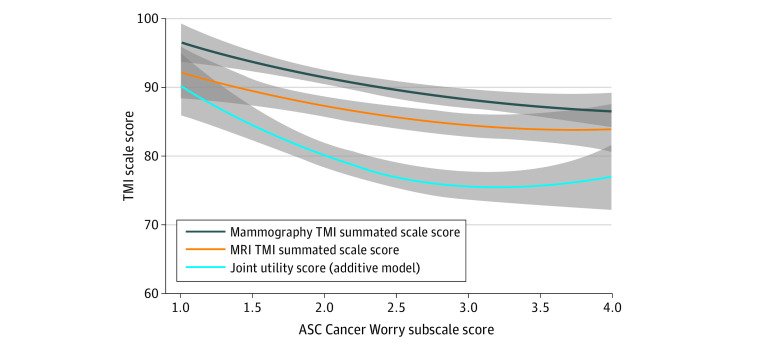
Results: Of the 355 women who met the eligibility criteria, 244 (69%) completed both questionnaires and were included in this analysis. The median age was 59 years (range, 34-85 years). The mean MRI TMI summated scale score was 85.9 (95% CI, 84.6-87.3). Of the 244 women, 142 (58%) experienced at least some fear and anxiety before the examination, and 120 women (49%) experienced fear and anxiety during the examination. A total of 156 women (64%) experienced pain or discomfort during the examination. In multivariable analyses, greater test-related burden was associated with higher levels of cancer worry (regression coefficient, -2.75; SE, 0.94; P = .004).
Conclusions and relevance: In this cohort study, a clinically meaningful breast MRI testing burden among women with DCIS was revealed that was significantly associated with cancer worry. Understanding the potential quality-of-life reduction associated with MRI, especially when used in combination with mammography, may allow development of targeted interventions to improve the patient experience.
Conflict of interest statement
Figures
References
-
- Office of Disease Prevention and Health Promotion . Health-related quality of life and well-being. HealthyPeople.gov. Accessed September 28, 2021. https://www.healthypeople.gov/2020/about/foundation-health-measures/Heal...
Publication types
MeSH terms
Grants and funding
LinkOut - more resources
Full Text Sources
Medical
Miscellaneous