


Incidence and predictors of preterm neonatal mortality at Mbarara Regional Referral Hospital in South Western Uganda
- PMID: 34727140
- PMCID: PMC8562818
- DOI: 10.1371/journal.pone.0259310
Incidence and predictors of preterm neonatal mortality at Mbarara Regional Referral Hospital in South Western Uganda
Abstract
Introduction: Preterm neonatal mortality contributes substantially to the high neonatal mortality globally. In Uganda, preterm neonatal mortality accounts for 31% of all neonatal deaths. Previous studies have shown variability in mortality rates by healthcare setting. Also, different predictors influence the risk of neonatal mortality in different populations. Understanding the predictors of preterm neonatal mortality in the low-resource setting where we conducted our study could guide the development of interventions to improve outcomes for preterm neonates. We thus aimed to determine the incidence and predictors of mortality among preterm neonates born at Mbarara Regional Referral Hospital (MRRH) in South Western Uganda.
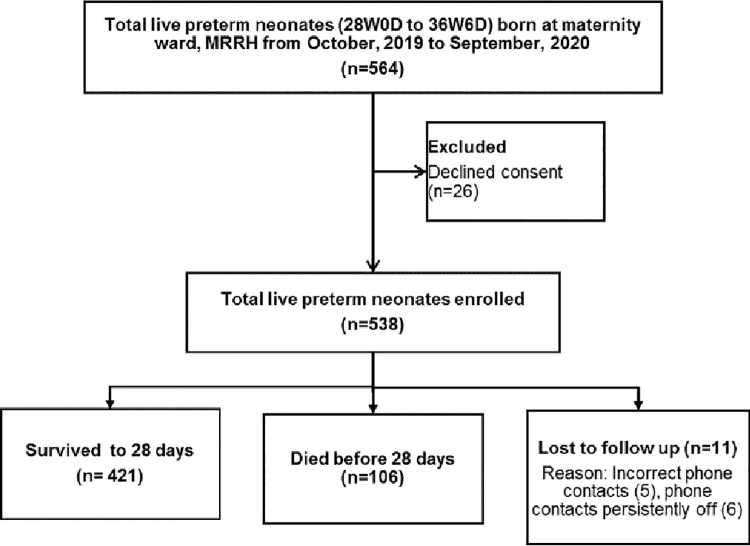
Methods: We prospectively enrolled 538 live preterm neonates born at MRRH from October 2019 to September 2020. The neonates were followed up until death or 28 days, whichever occurred first. We used Kaplan Meier survival analysis to describe preterm neonatal mortality and Cox proportional hazards regression to assess predictors of preterm neonatal mortality over a maximum of 28 days of follow up.
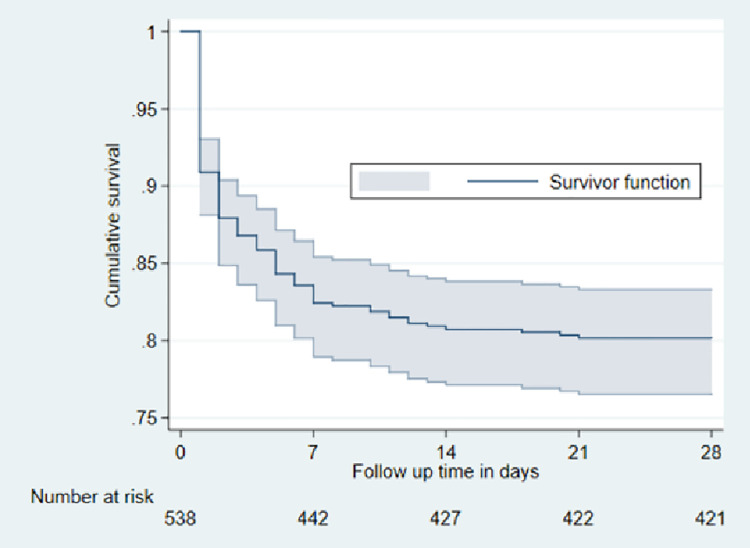
Results: The cumulative incidence of preterm neonatal mortality was 19.8% (95% C.I: 16.7-23.5) at 28 days from birth. Birth asphyxia (adjusted hazard ratio [aHR], 14.80; 95% CI: 5.21 to 42.02), not receiving kangaroo mother care (aHR, 9.50; 95% CI: 5.37 to 16.78), delayed initiation of breastfeeding (aHR, 9.49; 95% CI: 2.84 to 31.68), late antenatal care (ANC) booking (aHR, 1.81 to 2.52; 95% CI: 1.11 to 7.11) and no ANC attendance (aHR, 3.56; 95% CI: 1.51 to 8.43), vaginal breech delivery (aHR, 3.04; 95% CI: 1.37 to 5.18), very preterm births (aHR, 3.17; 95% CI: 1.24 to 8.13), respiratory distress syndrome (RDS) (aHR, 2.50; 95% CI: 1.11 to 5.64) and hypothermia at the time of admission to the neonatal unit (aHR, 1.98; 95% CI: 1.18 to 3.33) increased the risk of preterm neonatal mortality. Attending more than 4 ANC visits (aHR, 0.35; 95% CI: 0.12 to 0.96) reduced the risk of preterm neonatal mortality.
Conclusions: We observed a high cumulative incidence of mortality among preterm neonates born at a low-resource regional referral hospital in Uganda. The predictors of mortality among preterm neonates were largely modifiable factors occurring in the prenatal, natal and postnatal period (lack of ANC attendance, late ANC booking, vaginal breech delivery, birth asphyxia, respiratory distress syndrome, and hypothermia at the time of admission to the neonatal unit, not receiving kangaroo mother care and delayed initiation of breastfeeding). These findings suggest that investment in and enhancement of ANC attendance, intrapartum care, and the feasible essential newborn care interventions by providing the warm chain through kangaroo mother care, encouraging early initiation of breastfeeding, timely resuscitation for neonates when indicated and therapies reducing the incidence and severity of RDS could improve outcomes among preterm neonates in this setting.
Conflict of interest statement
The authors declare no competing interests.
Figures
References
-
- Dbstet A. WHO: recommended definitions, terminology and format for statistical tables related to the perinatal period and use of a new certificate for cause of perinatal deaths. Modifications recommended by FIGO as amended October 14, 1976. Acta Obstet Gynecol Scand. 1977;56(3):247–53. - PubMed
-
- Chawanpaiboon S, Vogel JP, Moller A-B, Lumbiganon P, Petzold M, Hogan D, et al.. Global, regional, and national estimates of levels of preterm birth in 2014: a systematic review and modelling analysis. The Lancet Global Health. 2019;7(1):e37—e46. doi: 10.1016/S2214-109X(18)30451-0 - DOI - PMC - PubMed
-
- MCEE W. MCEE-WHO methods and data sources for child causes of death 2000–2015. World Health Organization. 2016.
MeSH terms
LinkOut - more resources
Full Text Sources
Medical
