. 2021 Nov 1;62(14):3.
doi: 10.1167/iovs.62.14.3.

ERAP1, ERAP2, and Two Copies of HLA-Aw19 Alleles Increase the Risk for Birdshot Chorioretinopathy in HLA-A29 Carriers

Affiliations

ERAP1, ERAP2, and Two Copies of HLA-Aw19 Alleles Increase the Risk for Birdshot Chorioretinopathy in HLA-A29 Carriers

Sahar Gelfman et al. Invest Ophthalmol Vis Sci. .

Abstract

Purpose: Birdshot chorioretinopathy (BSCR) is strongly associated with HLA-A29. This study was designed to elucidate the genetic modifiers of BSCR in HLA-A29 carriers.

Methods: We sequenced the largest BSCR cohort to date, including 286 cases and 108 HLA-A29-positive controls to determine genome-wide common and rare variant associations. We further typed the HLA alleles of cases and 45,386 HLA-A29 controls of European ancestry to identify HLA alleles that associate with BSCR risk.

Results: Carrying a second allele that belongs to the HLA-Aw19 broad antigen family (including HLA-A29, -A30, -A31, and -A33) increases the risk for BSCR (odds ratio [OR] = 4.44; P = 2.2e-03). This result was validated by comparing allele frequencies to large HLA-A29-controlled cohorts (n = 45,386; OR > 2.5; P < 1.3e-06). We also confirm that ERAP1 and ERAP2 haplotypes modulate disease risk. A meta-analysis with an independent dataset confirmed that ERAP1 and ERAP2 haplotypes modulate the risk for disease at a genome-wide significant level: ERAP1-rs27432 (OR = 2.46; 95% confidence interval [CI], 1.85-3.26; P = 4.07e-10), an expression quantitative trait locus (eQTL) decreasing ERAP1 expression; and ERAP2-rs10044354 (OR = 1.95; 95% CI, 1.55-2.44; P = 6.2e-09), an eQTL increasing ERAP2 expression. Furthermore, ERAP2-rs2248374 that disrupts ERAP2 expression is protective (OR = 0.56; 95% CI, 0.45-0.70; P = 2.39e-07). BSCR risk is additively increased when combining ERAP1/ERAP2 risk genotypes with two copies of HLA-Aw19 alleles (OR = 13.53; 95% CI, 3.79-54.77; P = 1.17e-05).

Conclusions: The genetic factors increasing BSCR risk demonstrate a pattern of increased processing, as well as increased presentation of ERAP2-specific peptides. This suggests a mechanism in which exceeding a peptide presentation threshold activates the immune response in choroids of A29 carriers.


Conflict of interest statement

Disclosure: S. Gelfman, Regeneron Genetics Center (E); D. Monnet, None; A.J. Ligocki, Regeneron Pharmaceuticals (E); T. Tabary, None; A. Moscati, Regeneron Genetics Center (E); X. Bai, Regeneron Genetics Center (E); J. Freudenberg, Regeneron Genetics Center (E); B. Cooper, Regeneron Pharmaceuticals (E); J.A. Kosmicki, Regeneron Genetics Center (E); S. Wolf, Regeneron Genetics Center (E); M.A.R. Ferreira, Regeneron Genetics Center (E); J. Overton, Regeneron Genetics Center (E); J. Weyne, Regeneron Pharmaceuticals (E); E.A. Stahl, Regeneron Genetics Center (E); A. Baras, Regeneron Genetics Center (E); C. Romano, Regeneron Pharmaceuticals (E); J.H.M. Cohen, None; G. Coppola, Regeneron Genetics Center (E); A. Brézin, None

Figures

Figure 1.
Figure 1.
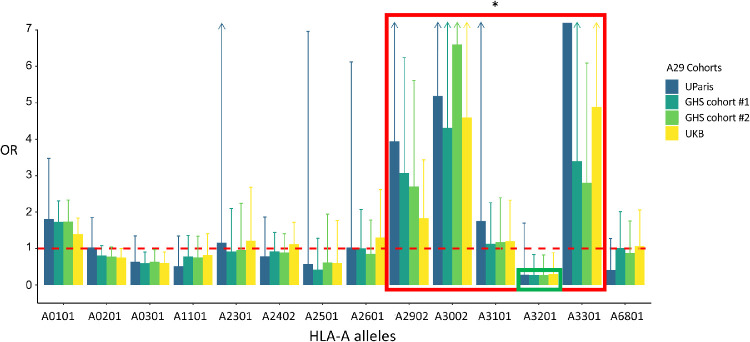
Aw19 enrichment in BSCR cases. Odds ratios for BSCR, comparing frequencies of 14 HLA-A alleles that are present in three or more cases (>1%, x-axis) in 286 UParis cases compared with 108 UParis controls (blue), GHS control cohort 1 (n = 4014, dark green), GHS control cohort 2 (n = 2829, bright green), and UKB controls (n = 38,543, yellow). Aw19 alleles show the highest ORs (red box) that replicates with large A29 control cohorts, with the exception of A32, which is depleted in cases (green box). *P < 0.01.
Figure 2.
Figure 2.
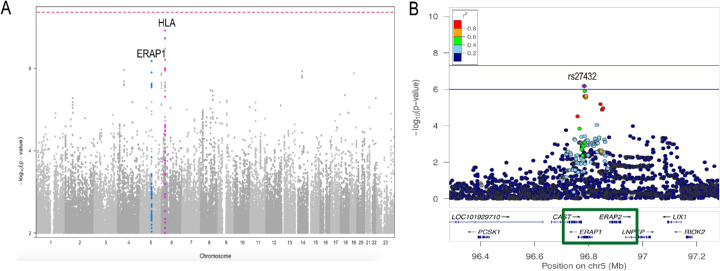
Manhattan and ERAP1 locus zoom plot of the A29-stratified French cohort. (A) Birdshot association analysis of 286 A29 cases and 108 A29 controls showing borderline associations (P < 1e-6) at several loci including HLA on chromosome six (pink) and ERAP1 on chromosome five (blue). (B) Locus zoom plot exhibiting the ERAP1ERAP2 locus and the top ERAP1–rs27432 risk variant.
Figure 3.
Figure 3.
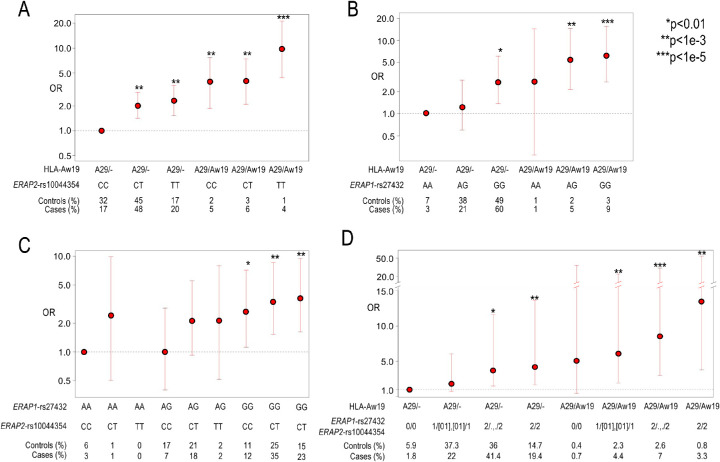
The combined risk of ERAP1, ERAP2, and two copies of Aw19. Utilizing 286 BSCR cases and 4014 controls from GHS cohort 1 to calculate additive risk while combining risk factors in ERAP1, ERAP2, and Aw19. (A) An additive genotype model of ERAP2 risk signal tagged by rs10044354 and single (A29/–) or double (A29/Aw19) Aw19 copies relative to lowest risk combination of rs10044354-CC and one copy of Aw19 allele (A29). (B) An additive genotype model of ERAP1 risk signal tagged by rs27432 and single (A29/–) or double (A29/Aw19) Aw19 copies relative to lowest risk combination of rs27432-AA and one copy of Aw19 allele (A29). (C) An additive genotype model of ERAP1 risk signal tagged by rs27432 and ERAP2 signal tagged by rs10044354 relative to lowest risk combination of rs27432-AA and rs10044354-CC. (D) An additive genotype model of ERAP1 and ERAP2 risk signals and single (A29/–) or double (A29/Aw19) Aw19 copies relative to lowest risk combination. The genotypes are combined as follows: 0 = ERAP1 and ERAP2 homozygous for protective allele; 1/[01], [01]/1 = either homozygous protective or heterozygous genotypes of both ERAP1 and ERAP2; 2/., ./2 = homozygous risk allele of either ERAP1 or ERAP2; 2/2 = homozygous risk allele of both ERAP1 and ERAP2.
Figure 4.
Figure 4.
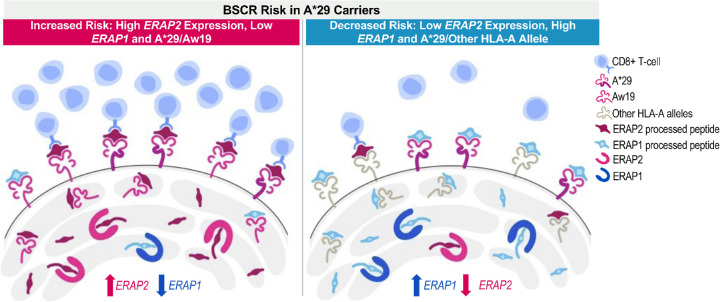
Peptide presentation threshold mechanism in BSCR. An increased expression of ERAP2 and a decreased expression of ERAP1, in addition to two copies of Aw19 alleles, increased the risk for BSCR (left), whereas decreased expression of ERAP2 and increased expression of ERAP1, in the presence of one copy of the A29 allele, decreased the risk for BSCR (right).

References

    1. Minos E, Barry RJ, Southworth S, et al.. Birdshot chorioretinopathy: current knowledge and new concepts in pathophysiology, diagnosis, monitoring and treatment. Orphanet J Rare Dis. 2016; 11: 61. - PMC - PubMed
    1. Shao EH, Menezo V, Taylor SR. Birdshot chorioretinopathy. Curr Opin Ophthalmol. 2014; 25: 488–494. - PubMed
    1. Menezo V, Taylor SR. Birdshot uveitis: current and emerging treatment options. Clin Ophthalmol. 2014; 8: 73–81. - PMC - PubMed
    1. Ryan SJ, Maumenee AE. Birdshot retinochoroidopathy. Am J Ophthalmol. 1980; 89: 31–45. - PubMed
    1. Nussenblatt RB, Mittal KK, Ryan S, Green WR, Maumenee AE. Birdshot retinochoroidopathy associated with HLA-A29 antigen and immune responsiveness to retinal S-antigen. Am J Ophthalmol. 1982; 94: 147–158. - PubMed