. 2021 Nov 2;11(1):21437.
doi: 10.1038/s41598-021-01043-6.

Highly efficient patterning technique for silver nanowire electrodes by electrospray deposition and its application to self-powered triboelectric tactile sensor

Affiliations

Highly efficient patterning technique for silver nanowire electrodes by electrospray deposition and its application to self-powered triboelectric tactile sensor

Jin Yeong Song et al. Sci Rep. .

Abstract

A patterned transparent electrode is a crucial component of state-of-the-art wearable devices and optoelectronic devices. However, most of the patterning methods using silver nanowires (AgNWs), which is one of the outstanding candidate materials for the transparent electrode, wasted a large amount of unused AgNWs during the patterning process. Here, we report a highly efficient patterning of AgNWs using electrospray deposition with grounded electrolyte solution (EDGE). During electrospray deposition, a patterned electrolyte solution collector attracted AgNWs by strong electrostatic attraction and selectively deposited them only on the patterned collector, minimizing AgNW deposited elsewhere. The enhanced patterning efficiency was verified through a comparison between the EDGE and conventional process by numerical simulation and experimental validation. As a result, despite the same electrospray deposition conditions for both cases except for the existence of the electrolyte solution collector, the coverage ratio of AgNWs fabricated by the EDGE process was at least six times higher than that of AgNWs produced by the conventional process. Furthermore, the EDGE process provided high design flexibility in terms of not only the material of the substrate, including a polymer and a ceramic but also the shape of the substrate, including a 2D flat and 3D curved surface. As an application of the EDGE process, a self-powered touch sensor exploiting the triboelectric effect was demonstrated. Thus, the EDGE process would be utilized in further application in wearable or implantable devices in the field of biomedicine, intelligent robots, and human-machine interface.


Conflict of interest statement

The authors declare no competing interests.

Figures

Figure 1
Figure 1
The schematic diagram of the EDGE process and multi-scale observation. (a) An oxygen plasma treatment to the PMMA substrate. (b) The electrospray deposition process of the AgNW solution with the patterned grounded electrolyte solution. (c) The patterned AgNW electrode by the EDGE process. (d) The comb-shaped AgNW electrode on a PMMA substrate by the EDGE process. (e) The enlarged image of the patterned AgNW electrode with a well-defined edge. (f) SEM image of the AgNW electrode. Scale bars are 500 µm (e) and 1 µm (f).
Figure 2
Figure 2
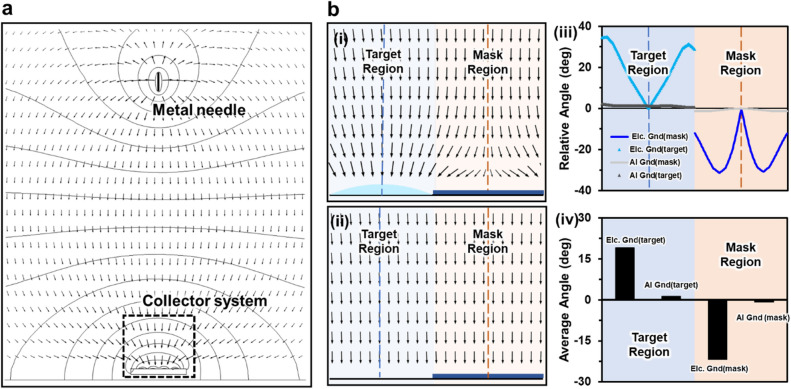
(a) Numerical simulation of the electric field in the EDGE process and conventional electrospray process with collector system. A magnified image of the electric field with EDGE collector system (b-(i)) and conventional electrospray collector system (b-(ii)). The relative angle (b-(iii) and the average relative angle of the electric field (b-(iv)) to the centerline above a collector system with and without a grounded electrolyte solution.
Figure 3
Figure 3
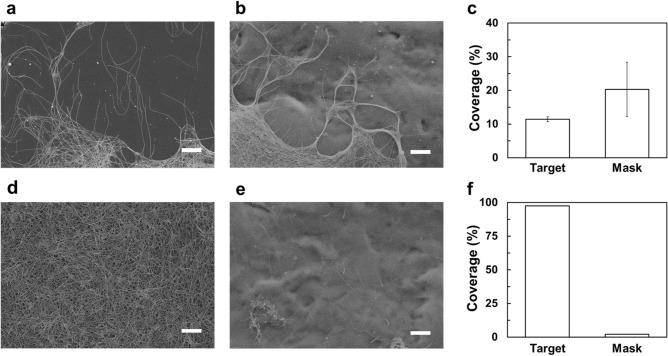
SEM images and the coverage ratio of the AgNWs deposited on the target region and the mask region by the conventional electrospray deposition process (ac) and the EDGE process (df), respectively. All scale bars are 5 µm.
Figure 4
Figure 4
The correlation of (a) wavelength and (b) sheet resistance with the transmittance of electrosprayed AgNW electrodes by the different electrospray deposition times from 10 to 40 min.
Figure 5
Figure 5
Patterned AgNW electrodes with a university emblem shape on the PMMA substrate (a), alphabet-matrix patterns on the PDMS substrate (b), and on the curved surface of the glass beaker (c). Scale bars are 3 mm (a) and 1 cm (b,c).
Figure 6
Figure 6
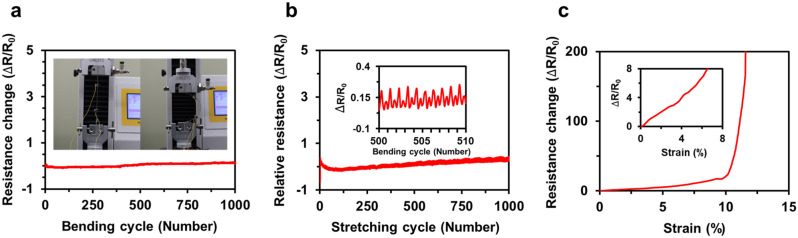
Relative resistance of AgNW electrodes fabricated through the EDGE process. (a) the cyclic bending test. Inset: a single cycle image of bending (b) the cyclic stretching test with trends of relative resistance. Inset: relative resistance with 10 cycles of stretching test, and (c) the tensile test of the AgNW electrode until the break. Inset: linear increase of relative resistance with the strain of 7%.
Figure 7
Figure 7
(a) A transparent self-powered tactile sensor highlighted by drawing a red-dashed box. (b) The electrical responses of the self-powered tactile sensor to touches with a finger. Inset: a single electrical response of the AgNWs electrode. (c) The self-powered tactile sensor system powered up a LED array with response to a touch of letter-shaped stamps.

References

    1. Han JH, et al. Highly conductive transparent and flexible electrodes including double-stacked thin metal films for transparent flexible electronics. ACS Appl. Mater. Interfaces. 2017;9:16343–16350. doi: 10.1021/acsami.7b04725. - DOI - PubMed
    1. Kim D, et al. Transparent flexible heater based on hybrid of carbon nanotubes and silver nanowires. Carbon. 2013;63:530–536. doi: 10.1016/j.carbon.2013.07.030. - DOI
    1. Jang H, et al. Graphene-based flexible and stretchable electronics. Adv. Mater. 2016;28:4184–4202. doi: 10.1002/adma.201504245. - DOI - PubMed
    1. Cho C-K, et al. Mechanical flexibility of transparent PEDOT:PSS electrodes prepared by gravure printing for flexible organic solar cells. Sol. Energy Mater Sol. Cells. 2011;95:3269–3275. doi: 10.1016/j.solmat.2011.07.009. - DOI
    1. Kang J, et al. High-performance graphene-based transparent flexible heaters. Nano Lett. 2011;11:5154–5158. doi: 10.1021/nl202311v. - DOI - PubMed

Publication types