


Insomnia symptoms during the early and late stages of the COVID-19 pandemic in China: a systematic review and meta-analysis
- PMID: 34732293
- PMCID: PMC8479411
- DOI: 10.1016/j.sleep.2021.09.014
Insomnia symptoms during the early and late stages of the COVID-19 pandemic in China: a systematic review and meta-analysis
Abstract
Background: Evidence suggests that the outbreak of the coronavirus disease 2019 (COVID-19) and the prevention/control measures for COVID-19 may cause insomnia during the acute phase of COVID-19 pandemic in China. However, it is unclear whether insomnia sustains during the later phases of the pandemic.
Methods: We searched PubMed/Medline, EMBASE, PsycINFO and China National Knowledge Infrastructure from the 27th December 2019 to the 2nd February 2021. As early stage studies on COVID-19 pandemic in China were defined as those conducted prior to April 1st, 2020, while late stage studies were those conducted after April 1st, 2020.
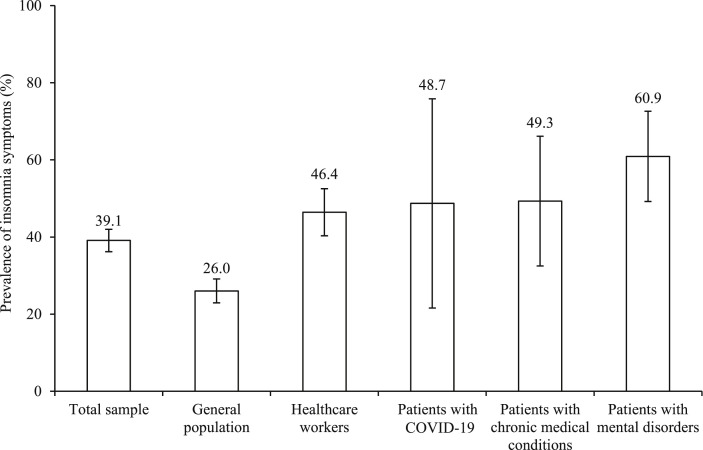
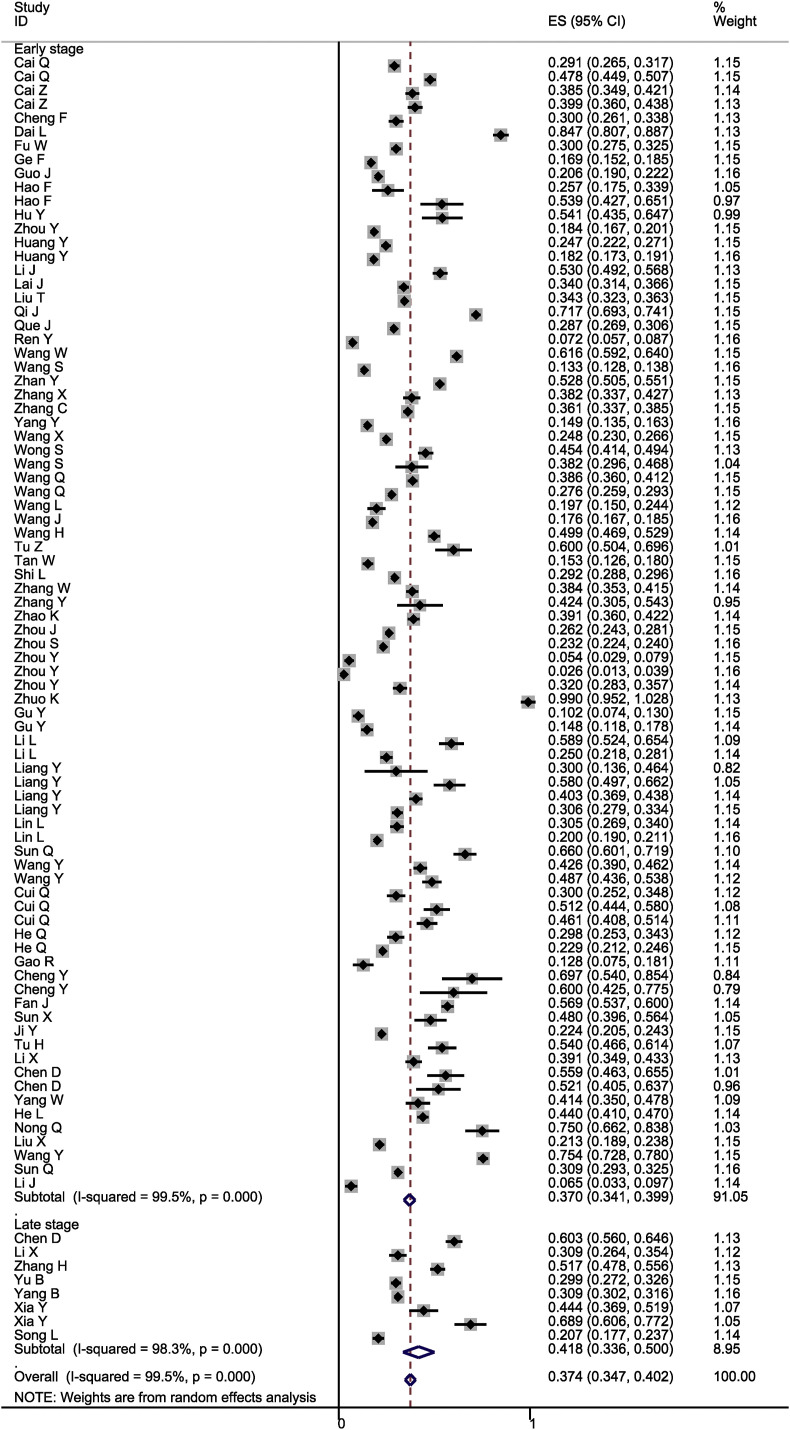
Results: A total of 98 studies with 193,889 participants were included. The pooled prevalence of insomnia symptoms among all populations was 39.1% (95% CI 36.2-42.0%); the pooled prevalence of insomnia symptoms during the early and late stages of COVID-19 in China were 37.0% (95% CI 34.1-39.9%) and 41.8% (95% CI 33.6-50.0%), respectively. Importantly, there was no significant difference regarding the prevalence of insomnia symptoms between the early and late stages of COVID-19. Meta-regression showed that healthcare workers, COVID-19 patients, patients with chronic medical conditions and patients with mental disorders had a higher prevalence of insomnia symptoms compared to the general population. This association remained significant in healthcare workers and patients with chronic medical conditions after adjusting for age, gender, areas of high or low prevalence of COVID-19 cases, anxiety and depression.
Conclusions: Over one third of our sample present insomnia symptoms during the early stage of COVID-19 pandemic in China. Interestingly, prevalence of insomnia symptoms sustains high during the late stage of the pandemic despite the control of the disease and the amelioration of its adverse effects. Our findings suggest that insomnia symptoms related to COVID-19 appear to persist of over time.
Keywords: COVID-19; China; Insomnia; Sleep.
Copyright © 2021 Elsevier B.V. All rights reserved.
Conflict of interest statement
Yun Li, Baixin Chen, Zhuoting Hong, Qimeng Sun, Yanyuan Dai, Maria Basta, Xiangdong Tang and Qingsong Qin have no conflicts of interest to disclose.
The ICMJE Uniform Disclosure Form for Potential Conflicts of Interest associated with this article can be viewed by clicking on the following link:
Figures
References
-
- Distribution of COVID-19 outbreaks. http://2019ncov.chinacdc.cn/2019-nCoV/ [Internet]. [cited 2021 Feb 1]. Available from:
-
- Statement on the second meeting of the international health regulations (2005) Emergency Committee regarding the outbreak of novel coronavirus (2019-nCoV) 2020. https://www.who.int/news/item/30-01-2020-statement-on-the-second-meeting... [Internet] [cited 2021 Feb 1]. Available from:
-
- Full Text: Fighting COVID-19: China in Action. http://www.chinatoday.com.cn/ctenglish/2018/zdtj/202006/t20200608_800209... [Internet]. [cited 2021 Feb 1]. Available from:
-
- All temporary treament centers were closed. http://www.gov.cn/xinwen/2020-03/11/content_5489757.htm [Internet]. [cited 2021 Feb 1]. Available from:
Publication types
MeSH terms
LinkOut - more resources
Full Text Sources
Medical
Research Materials
Miscellaneous
