. 2021 Nov 3;11(1):21589.
doi: 10.1038/s41598-021-00799-1.

Individual's daily behaviour and intergenerational mixing in different social contexts of Kenya

Affiliations

Individual's daily behaviour and intergenerational mixing in different social contexts of Kenya

Emanuele Del Fava et al. Sci Rep. .

Abstract

We investigated contact patterns in diverse social contexts in Kenya and the daily behaviours that may play a pivotal role in infection transmission to the most vulnerable leveraging novel data from a 2-day survey on social contacts and time use (TU) from a sample of 1407 individuals (for a total of 2705 person days) from rural, urban formal, and informal settings. We used TU data to build six profiles of daily behaviour based on the main reported activities, i.e., Homestayers (71.1% of person days), Workers (9.3%), Schoolers (7.8%), or locations at increasing distance from home, i.e., Walkers (6.6%), Commuters (4.6%), Travelers (0.6%). In the rural setting, we observed higher daily contact numbers (11.56, SD 0.23) and percentages of intergenerational mixing with older adults (7.5% of contacts reported by those younger than 60 years vs. less than 4% in the urban settings). Overall, intergenerational mixing with older adults was higher for Walkers (7.3% of their reported contacts), Commuters (8.7%), and Homestayers (5.1%) than for Workers (1.5%) or Schoolers (3.6%). These results could be instrumental in defining effective interventions that acknowledge the heterogeneity in social contexts and daily routines, either in Kenya or other demographically and culturally similar sub-Saharan African settings.


Conflict of interest statement

The authors declare no competing interests.

Figures
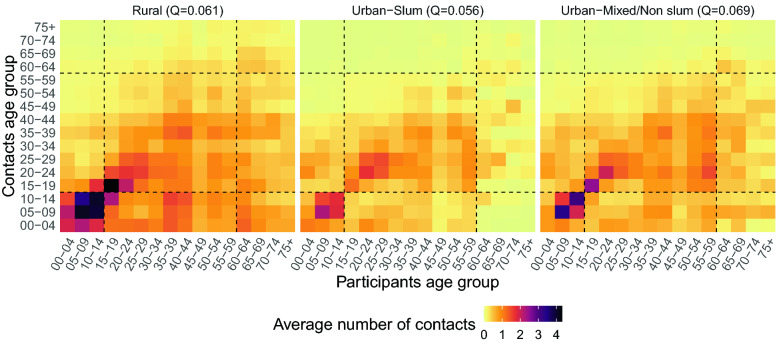
Figure 1
Figure 1
Average number of overall contacts between participants in age class i and contacted individuals in age class j, adjusting for reciprocity of contact at the population level, in each of the three settings. The dashed lines help identifying the contacts of children (0–14 years), teens and adults (15–59 years) and older adults (60+ years). At the top of each matrix, we report its assortativeness index Q.
Figure 2
Figure 2
Distribution of daily social contacts by setting (A), percentage (with 95% CI) of daily social contacts by location of contact (B), and percentage (with 95% CI) of daily social contacts by setting and age of participants with children (0–14 years), teens and adults (15–59 years) and older adults (60+ years) (C). For each bar, the respective denominator (N) is reported. All CIs are computed as Wilson CIs for a binomial proportion.
Figure 3
Figure 3
Description of the six TU profile groups by location (A), setting (B), and age group (C).
Figure 4
Figure 4
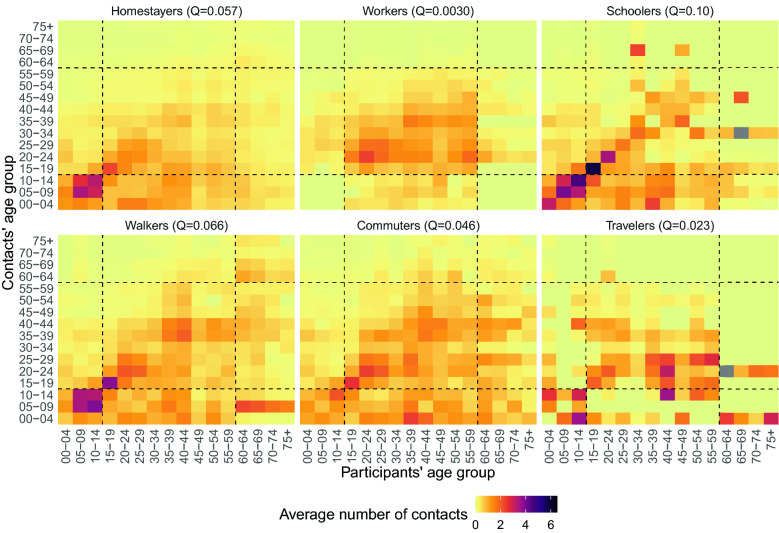
Average number of overall contacts between participants in age class i and contacted individuals in age class j, adjusting for reciprocity of contact at the population level, stratified by TU profile. The dashed lines help identifying the contacts of children (0–14 years), teens and adults (15–59 years) and older adults (60 + years). At the top of each matrix, we report its assortativeness index Q.
Figure 5
Figure 5
Distribution of daily social contacts by TU profile (A), percentage (with 95% CI) of daily social contacts by location of contact (B), and percentage (with 95% CI) of daily social contacts by TU profile group and age of participants with children (0–14 years), teens and adults (15–59 years) and older adults (60+ years) (C). For each bar, the respective denominator (N) is reported. All CIs are computed as Wilson CIs for a binomial proportion.

References

    1. Wallinga J, Teunis P, Kretzschmar M. Using data on social contacts to estimate age-specific transmission parameters for respiratory-spread infectious agents. Am. J. Epidemiol. 2006;164:936–944. doi: 10.1093/aje/kwj317. - DOI - PubMed
    1. Mossong J, et al. Social contacts and mixing patterns relevant to the spread of infectious diseases. PLoS Med. 2008;5:e74. - PMC - PubMed
    1. Diekmann O, Heesterbeek JAP, Metz JAJ. On the definition and the computation of the basic reproduction ratio R0 in models for infectious diseases in heterogeneous populations. J. Math. Biol. 1990;28:365–382. doi: 10.1007/BF00178324. - DOI - PubMed
    1. Zhang J, et al. The impact of relaxing interventions on human contact patterns and SARS-CoV-2 transmission in China. Sci. Adv. 2021;7:eabe2584. doi: 10.1126/sciadv.abe2584. - DOI - PMC - PubMed
    1. Marziano V, et al. Retrospective analysis of the Italian exit strategy from COVID-19 lockdown. Proc. Natl. Acad. Sci. 2021;118:e2019617118. doi: 10.1073/pnas.2019617118. - DOI - PMC - PubMed

Publication types

MeSH terms