


Cross-HLA targeting of intracellular oncoproteins with peptide-centric CARs
- PMID: 34732890
- PMCID: PMC8599005
- DOI: 10.1038/s41586-021-04061-6
Cross-HLA targeting of intracellular oncoproteins with peptide-centric CARs
Retraction in
-
Retraction Note: Cross-HLA targeting of intracellular oncoproteins with peptide-centric CARs.Nature. 2023 Nov;623(7988):872. doi: 10.1038/s41586-023-06731-z. Nature. 2023. PMID: 37938785 Free PMC article. No abstract available.
Abstract
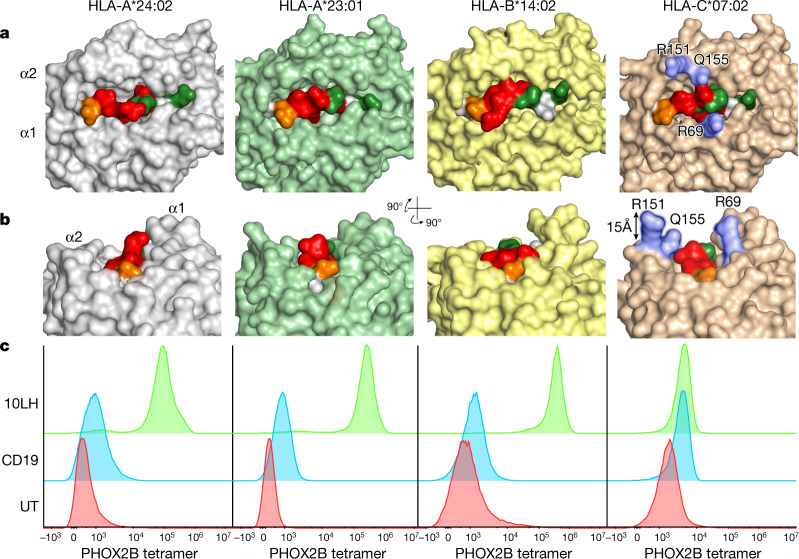
The majority of oncogenic drivers are intracellular proteins, thus constraining their immunotherapeutic targeting to mutated peptides (neoantigens) presented by individual human leukocyte antigen (HLA) allotypes1. However, most cancers have a modest mutational burden that is insufficient to generate responses using neoantigen-based therapies2,3. Neuroblastoma is a paediatric cancer that harbours few mutations and is instead driven by epigenetically deregulated transcriptional networks4. Here we show that the neuroblastoma immunopeptidome is enriched with peptides derived from proteins that are essential for tumourigenesis and focus on targeting the unmutated peptide QYNPIRTTF, discovered on HLA-A*24:02, which is derived from the neuroblastoma dependency gene and master transcriptional regulator PHOX2B. To target QYNPIRTTF, we developed peptide-centric chimeric antigen receptors (CARs) using a counter-panning strategy with predicted potentially cross-reactive peptides. We further hypothesized that peptide-centric CARs could recognize peptides on additional HLA allotypes when presented in a similar manner. Informed by computational modelling, we showed that PHOX2B peptide-centric CARs also recognize QYNPIRTTF presented by HLA-A*23:01 and the highly divergent HLA-B*14:02. Finally, we demonstrated potent and specific killing of neuroblastoma cells expressing these HLAs in vitro and complete tumour regression in mice. These data suggest that peptide-centric CARs have the potential to vastly expand the pool of immunotherapeutic targets to include non-immunogenic intracellular oncoproteins and widen the population of patients who would benefit from such therapy by breaking conventional HLA restriction.
© 2021. The Author(s).
Conflict of interest statement
J.M.M. and M.Y. have equity stake in Tantigen Bio Inc. and HuLA Therapeutics. Both companies have interest in commercializing technologies described herein. B.R.K. is an employee of and has equity interests in Myrio Therapeutics. R.P. and N.L.C. are employees of Myrio Therapeutics. J.M.M., M.Y. and B.R.K. are co-inventors on a patent filed regarding the PHOX2B PC-CAR.
Figures




Comment in
-
CAR keys to unlock the intracellular immunopeptidome.Sci Immunol. 2022 Jan 7;7(67):eabn9189. doi: 10.1126/sciimmunol.abn9189. Epub 2022 Jan 7. Sci Immunol. 2022. PMID: 34995093
-
A roadmap for driving CAR T cells toward the oncogenic immunopeptidome.Cancer Cell. 2022 Jan 10;40(1):20-22. doi: 10.1016/j.ccell.2021.12.011. Cancer Cell. 2022. PMID: 35016027
References
Publication types
MeSH terms
Substances
Grants and funding
LinkOut - more resources
Full Text Sources
Other Literature Sources
Medical
Molecular Biology Databases
Research Materials
