


Endoscopic treatment of periampullary duodenal duplication cysts in children: Four case reports and review of the literature
- PMID: 34733413
- PMCID: PMC8546566
- DOI: 10.4253/wjge.v13.i10.529
Endoscopic treatment of periampullary duodenal duplication cysts in children: Four case reports and review of the literature
Abstract
Background: Duodenal duplications are rare congenital anomalies of the gastrointestinal tract. As the periampullary variant is much rarer, literature is scant and only few authors have reported their experience in diagnosis and treatment, particularly with operative endoscopy.
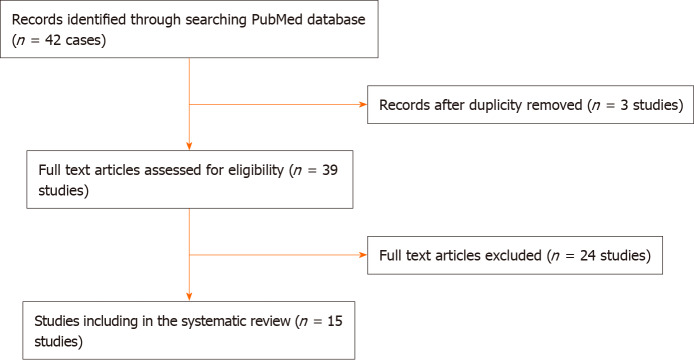
Case sumary: To report our experience with the endoscopic treatment in a series of children with periampullary duodenal duplication cysts, focusing on the importance of obtaining an accurate preoperative anatomic assessment of the malformations. The pediatric periampullary duodenal duplication cyst literature is reviewed. We conducted a systematic review according to the PRISMA guidelines. The PubMed database was searched for original studies on "duodenal duplication", "periampullary duplication" or "endoscopic management" published since 1990, involving patients younger than 18 years of age. Eligible study designs were case report, case series and reviews. We analyzed the data and reported the results in table and text. Fifteen eligible articles met the inclusion criteria with 16 patients, and analysis was extended to our additional 4 cases. Median age at diagnosis was 13.5 years. Endoscopic treatment was performed in 10 (50%) patients, with only 2 registered complications.
Conclusion: Periampullary duodenal duplication cysts in pediatric patients are very rare. Our experience suggests that an accurate preoperative assessment is critical. In the presence of sludge or stones inside the duplication, endoscopic retrograde cholangio-pancreatography is mandatory to demonstrate a communication with the biliary tree. Endoscopic treatment resulted in a safe, minimally invasive and effective treatment. In periampullary duodenal duplication cyst endoscopically treated children, long-term follow-up is still necessary considering the potential malignant transformation at the duplication site.
Keywords: Case report; Double wall sign; Duodenal duplication; Endoscopic treatment; Endoscopic ultrasound; Periampullary duodenal duplication cyst.
©The Author(s) 2021. Published by Baishideng Publishing Group Inc. All rights reserved.
Conflict of interest statement
Conflict-of-interest statement: Authors certify that there is no conflict of interest related to the manuscript.
Figures
References
-
- Rockx MA, McAlister VC. Endoscopic fenestration of a duodenal duplication cyst to resolve recurrent pancreatitis. JOP. 2007;8:795–798. - PubMed
-
- Chen JJ, Lee HC, Yeung CY, Chan WT, Jiang CB, Sheu JC. Meta-analysis: the clinical features of the duodenal duplication cyst. J Pediatr Surg. 2010;45:1598–1606. - PubMed
-
- Tröbs RB, Hemminghaus M, Cernaianu G, Liermann D. Stone-containing periampullary duodenal duplication cyst with aberrant pancreatic duct. J Pediatr Surg. 2009;44:e33–e35. - PubMed
Publication types
LinkOut - more resources
Full Text Sources
Research Materials
Miscellaneous
