


The link between brain acidosis, breathing and seizures: a novel mechanism of action for the ketogenic diet in a model of infantile spasms
- PMID: 34734183
- PMCID: PMC8557655
- DOI: 10.1093/braincomms/fcab189
The link between brain acidosis, breathing and seizures: a novel mechanism of action for the ketogenic diet in a model of infantile spasms
Abstract
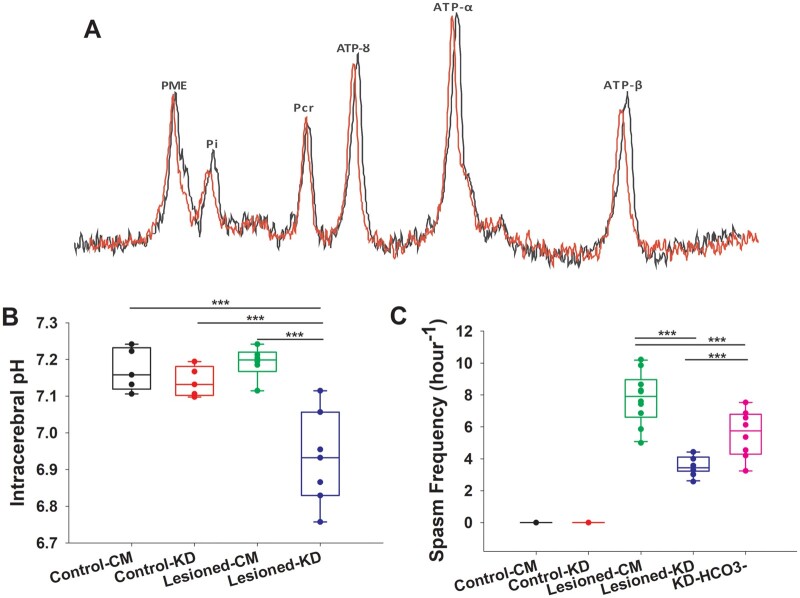
Infantile spasms (IS) syndrome is a catastrophic, epileptic encephalopathy of infancy that is often refractory to current antiepileptic therapies. The ketogenic diet (KD) has emerged as an alternative treatment for patients with medically intractable epilepsy, though the prospective validity and mechanism of action for IS remains largely unexplored. We investigated the KD's efficacy as well as its mechanism of action in a rodent model of intractable IS. The spasms were induced using the triple-hit paradigm and the animals were then artificially reared and put on either the KD (4:1 fats: carbohydrate + protein) or a control milk diet (CM; 1.7:1). 31Phosphorus magnetic resonance spectroscopy (31P MRS) and head-out plethysmography were examined in conjunction with continuous video-EEG behavioural recordings in lesioned animals and sham-operated controls. The KD resulted in a peripheral ketosis observed both in the blood and urine. The KD led to a robust reduction in the frequency of spasms observed, with approximately a 1.5-fold increase in the rate of survival. Intriguingly, the KD resulted in an intracerebral acidosis as measured with 31P MRS. In addition, the respiratory profile of the lesioned rats on the KD was significantly altered with slower, deeper and longer breathing, resulting in decreased levels of expired CO2. Sodium bicarbonate supplementation, acting as a pH buffer, partially reversed the KD's protective effects on spasm frequency. There were no differences in the mitochondrial respiratory profiles in the liver and brain frontal cortex measured between the groups, supporting the notion that the effects of the KD on breathing are not entirely due to changes in intermediary metabolism. Together, our results indicate that the KD produces its anticonvulsant effects through changes in respiration leading to intracerebral acidosis. These findings provide a novel understanding of the mechanisms underlying the anti-seizure effects of the KD in IS. Further research is required to determine whether the effects of the KD on breathing and intracerebral acid-base balance are seen in other paediatric models of epilepsy.
Keywords: acidosis; epilepsy; plethysmography; respiration; spectroscopy.
© The Author(s) (2021). Published by Oxford University Press on behalf of the Guarantors of Brain. All rights reserved. For permissions, please email: journals.permissions@oup.com.
Figures




Comment on
-
New developments for dietary treatment of epilepsy after a century of history for the ketogenic diet.Brain Commun. 2021 Oct 7;3(4):fcab234. doi: 10.1093/braincomms/fcab234. eCollection 2021. Brain Commun. 2021. PMID: 34704031 Free PMC article.
References
-
- Karvelas G, Lortie A, Scantlebury MH, Duy PT, Cossette P, Carmant L.. A retrospective study on aetiology based outcome of infantile spasms. Seizure. 2009;18(3):197–201. - PubMed
-
- Riikonen R. A long-term follow-up study of 214 children with the syndrome of infantile spasms. Neuropediatrics. 1982;13(1):14–23. - PubMed
-
- Riikonen R. Infantile spasms: Outcome in clinical studies. Pediatr Neurol. 2020;108:54–64. - PubMed
-
- Krijgh EJC, Catsman-Berrevoets CE, Neuteboom RF.. Early seizure freedom is a prognostic factor for survival in patients with West syndrome. Neuropediatrics. 2018;49(4):279–282. - PubMed
-
- Darke K, Edwards SW, Hancock E, et al. Developmental and epilepsy outcomes at age 4 years in the UKISS trial comparing hormonal treatments to vigabatrin for infantile spasms: A multi-centre randomised trial. Arch Dis Child. 2010;95(5):382–386. - PubMed
Publication types
LinkOut - more resources
Full Text Sources