Review
. 2021 Dec;78(24):7943-7965.
doi: 10.1007/s00018-021-03990-9. Epub 2021 Nov 3.

The base excision repair process: comparison between higher and lower eukaryotes

Affiliations
Review

The base excision repair process: comparison between higher and lower eukaryotes

Nagham Nafiz Hindi et al. Cell Mol Life Sci. 2021 Dec.

Abstract

The base excision repair (BER) pathway is essential for maintaining the stability of DNA in all organisms and defects in this process are associated with life-threatening diseases. It is involved in removing specific types of DNA lesions that are induced by both exogenous and endogenous genotoxic substances. BER is a multi-step mechanism that is often initiated by the removal of a damaged base leading to a genotoxic intermediate that is further processed before the reinsertion of the correct nucleotide and the restoration of the genome to a stable structure. Studies in human and yeast cells, as well as fruit fly and nematode worms, have played important roles in identifying the components of this conserved DNA repair pathway that maintains the integrity of the eukaryotic genome. This review will focus on the components of base excision repair, namely, the DNA glycosylases, the apurinic/apyrimidinic endonucleases, the DNA polymerase, and the ligases, as well as other protein cofactors. Functional insights into these conserved proteins will be provided from humans, Saccharomyces cerevisiae, Drosophila melanogaster, and Caenorhabditis elegans, and the implications of genetic polymorphisms and knockouts of the corresponding genes.

Keywords: Cancers; Genome instability; Neurodegenerative diseases; Organismal differences; Oxidative DNA damage and repair; Sub-pathways.


Conflict of interest statement

All the authors declared that there are no competing interests.

Figures
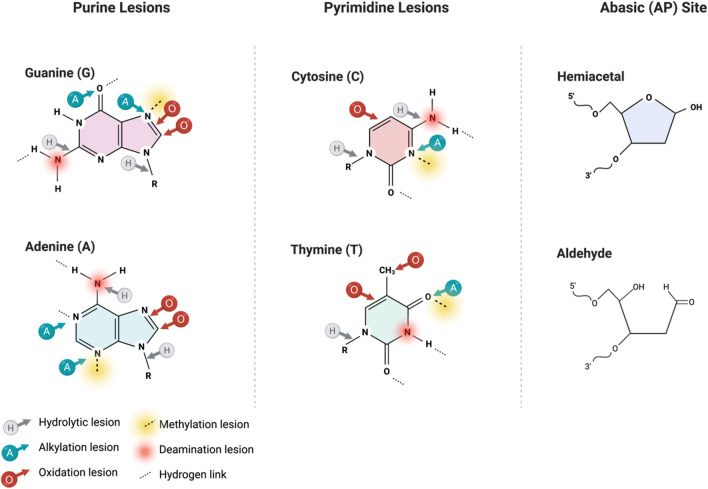
Fig. 1
Fig. 1
Summary of DNA base lesions. Common sites of spontaneous hydrolysis (grey arrow marked H), alkylation (blue arrow marked A), oxidation (red arrow marked O), methylation (yellow shaded dashed line), and deamination (red shaded circle) within guanine, adenine, cytosine, and thymine. DNA glycosylases and various BER proteins recognize these damaged bases and the subsequent abasic site lesion. The figure was generated with a license from BioRender.com
Fig. 2
Fig. 2
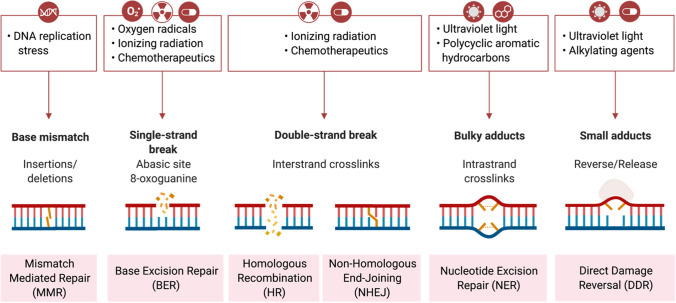
Common causes and repair mechanisms of DNA damage in eukaryotes. Several DNA damaging agents may lead to different types of DNA lesions. Each can be corrected by a particular genome repair mechanism, including mismatch repair, base-excision repair, homologous recombination repair, non-homologous end-joining, nucleotide excision repair, or direct damage reversal. The figure was generated with a license from BioRender.com
Fig. 3
Fig. 3
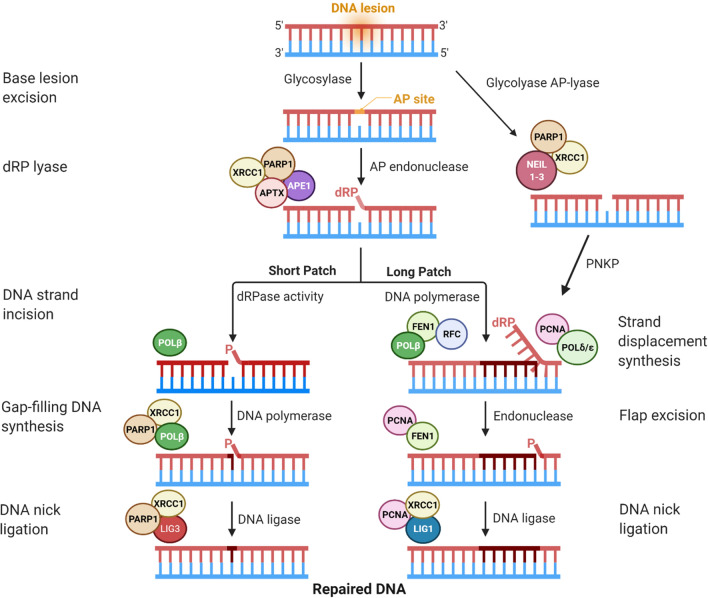
A simplified scheme illustrates the Short Patch and Long Patch base excision repair (BER) pathways in eukaryotes. Lesion-specific DNA glycosylases (e.g., UNG1) recognize and remove the damaged base resulting in an abasic site. An APE1 incision follows this to create a single-strand break with 3′-hydroxyl and 5′-dRP ends. The POLβ-dRP lyase activity excises the latter, and POLβ simultaneously fills the gap with either single-nucleotide (left BER, Short Patch) or 2 to 11 nucleotides with FEN1/RFC coupling (right BER, Long Patch). The choice between Short Patch BER or Long Patch BER depends on the state of the 5′dRP end. NEIL-DNA glycosylases (NEIL1-3) contain a β,δ-elimination activity that results in a single-nucleotide gap with a 3′-phosphate end. PNKP will then remove the 3′-phosphate, and the pathway may proceed via Long Patch Repair. Finally, ligation of the DNA-strand nicks is performed through a LIG3-XRCC1-PARP1 complex to complete the Short Patch BER. The polymerase activity will be switched to POLδ/ε when the 5′-dRP termini resist POLβ activity, which can add 2 to 11 nucleotides in the gap. This pathway leaves a flap recognized and removed via FEN1 endonuclease activity that forms a complex with PCNA (right branch). The Long Patch BER is completed when the remaining DNA backbone nick is sealed by DNA LIGI, also associated with PCNA and XRCC1. Orange haze depicts the modified base, and nascent nucleotide(s) are shown in dark red. AP site apurinic/apyrimidinic site, APE1 AP-endonuclease 1, dRP 5′-deoxyribose phosphate, POL DNA polymerase, XRCC1 X-ray cross-complementing protein 1, LIG1-3 DNA ligase I and 3, PCNA proliferating cell nuclear antigen, RFC replication factor C, FEN1 Flap endonuclease, PARP1 poly (ADP-ribose) polymerase, PNKP polynucleotide kinase phosphatase, APTX aprataxin, NEIL1-3 endonuclease VIII-like glycosylases 1, 2, and 3. The figure was generated with a license from BioRender.com

References

    1. Tubbs A, Nussenzweig A. Endogenous DNA damage as a source of genomic instability in cancer. Cell. 2017;168(4):644–656. doi: 10.1016/j.cell.2017.01.002. - DOI - PMC - PubMed
    1. Matkarimov BT, Saparbaev MK. DNA repair and mutagenesis in vertebrate mitochondria: evidence for asymmetric DNA strand inheritance. Adv Exp Med Biol. 2020;1241:77–100. doi: 10.1007/978-3-030-41283-8_6. - DOI - PubMed
    1. Tremblay S, Wagner JR. Dehydration, deamination and enzymatic repair of cytosine glycols from oxidized poly(dG-dC) and poly(dI-dC) Nucleic Acids Res. 2008;36(1):284–293. doi: 10.1093/nar/gkm1013. - DOI - PMC - PubMed
    1. Boiteux S, Coste F, Castaing B. Repair of 8-oxo-7,8-dihydroguanine in prokaryotic and eukaryotic cells: Properties and biological roles of the Fpg and OGG1 DNA N-glycosylases. Free Radic Biol Med. 2017;107:179–201. doi: 10.1016/j.freeradbiomed.2016.11.042. - DOI - PubMed
    1. Slyskova J, et al. Base and nucleotide excision repair facilitate resolution of platinum drugs-induced transcription blockage. Nucleic Acids Res. 2018;46(18):9537–9549. doi: 10.1093/nar/gky764. - DOI - PMC - PubMed

Substances

LinkOut - more resources