


Pathogens with potential impact on reproduction in captive and free-ranging European bison (Bison bonasus) in Poland - a serological survey
- PMID: 34736464
- PMCID: PMC8567710
- DOI: 10.1186/s12917-021-03057-8
Pathogens with potential impact on reproduction in captive and free-ranging European bison (Bison bonasus) in Poland - a serological survey
Abstract
Background: The European bison is an endangered species, and as such it is extremely important to monitor herds for pathogens which can lead to reproductive failure. The aim of the present study was to determine the current prevalence of antibodies to pathogens known to potentially influence reproduction in European bison. Serum samples from 183 bison, originating from different parts of Poland, were tested using commercial ELISA tests for antibodies to Chlamydia spp., Coxiella burnetti, Leptospira interrogans, Neospora caninum and Toxoplasma gondii; the findings were compared between captive and main free-ranging herds, and with regard to the influence of demographic factors such as age and sex. The prevalence of seropositivity was also checked with regard to location and the animal species sharing it.
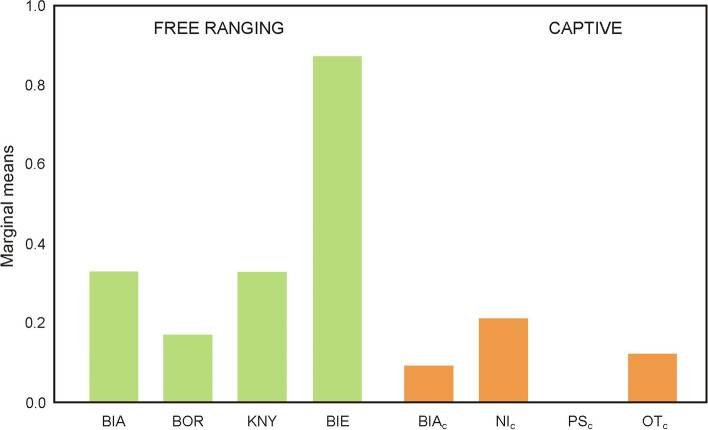
Results: Chlamydia spp. antibodies were present in 48 out of 130 (36.9%) tested samples. Coxiella burnetii was found in one sample out of 178 (0.58%). N. caninum in 36 out of 172 (20.9%) and T. gondii in 23 out of 172 (13.4%). No sample was positive for leptospirosis. Neither sex nor age appeared to have a significant effect on the occurrence of antibodies to the identified species. The prevalence of Chlamydia spp. in the samples varied significantly according to location; however, similar frequency ranges were observed between free ranging and captive herds. In contrast, antibodies to N. caninum were more common in free-ranging herds than captive herds, with the highest frequency observed in the Bieszczady Mountains.
Conclusions: Chlamydia spp., N. caninum and T. gondii might have a similar impact on the reproductive potential of European bison as they have on cattle. The high occurrence of antibodies to N. caninum in bison from the Bieszczady Mountains may be associated with the relatively high density of the wolf population in the area.
Keywords: Chlamydia spp.; Coxiella burnetii; ELISA; European bison; Leptospira interrogans; Neospora caninum; Toxoplasma gondii; reproductive system; serology; zoonosis.
© 2021. The Author(s).
Conflict of interest statement
The authors declare that they have no competing interests.
Figures

References
-
- Olech W, Klich D, Perzanowski K. Development of a new Action Plan for the European bison. Oryx. 2019;53:214.
-
- Pucek Z. Postępy i zagrożenia restytucji żubra. Kosmos. 1994;43:47–169.
-
- Raczyński J. Księga rodowodowa żubrów. 2020.
-
- Klich D, Olech W, Cielniak K. A complex project for the conservation of European bison in Poland by State Forests. Eur Bison Conserv Newslett. 2017;10:11–20.
-
- Klich D, Olech W, Łopucki R, Danik K. Community attitudes to the European bison Bison bonasus in areas where its reintroduction is planned and in areas with existing populations in northeastern Poland. Eur J Wildl Res. 2018. 10.1007/s10344-018-1219-5.
MeSH terms
Substances
Grants and funding
LinkOut - more resources
Full Text Sources
Medical
Miscellaneous
