Molecular and Pathology Features of Colorectal Tumors and Patient Outcomes Are Associated with Fusobacterium nucleatum and Its Subspecies animalis
- PMID: 34737207
- PMCID: PMC8755593
- DOI: 10.1158/1055-9965.EPI-21-0463
Molecular and Pathology Features of Colorectal Tumors and Patient Outcomes Are Associated with Fusobacterium nucleatum and Its Subspecies animalis
Abstract
Background: Fusobacterium nucleatum (F. nucleatum) activates oncogenic signaling pathways and induces inflammation to promote colorectal carcinogenesis.
Methods: We characterized F. nucleatum and its subspecies in colorectal tumors and examined associations with tumor characteristics and colorectal cancer-specific survival. We conducted deep sequencing of nusA, nusG, and bacterial 16s rRNA genes in tumors from 1,994 patients with colorectal cancer and assessed associations between F. nucleatum presence and clinical characteristics, colorectal cancer-specific mortality, and somatic mutations.
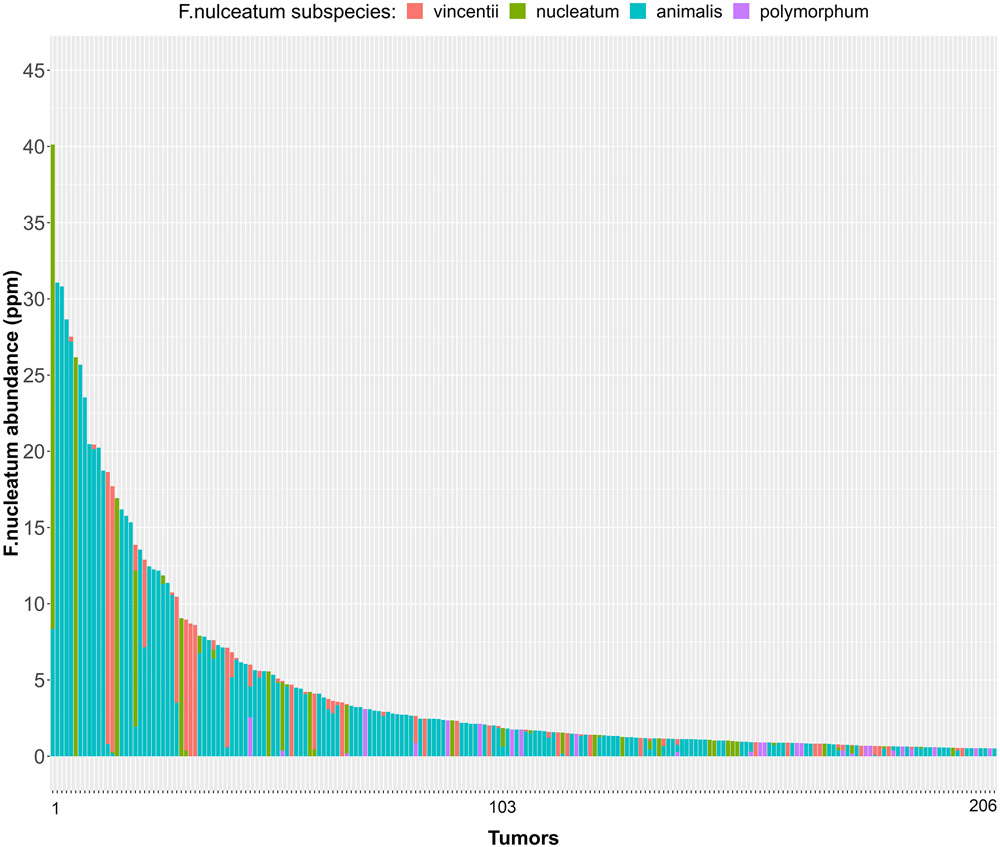
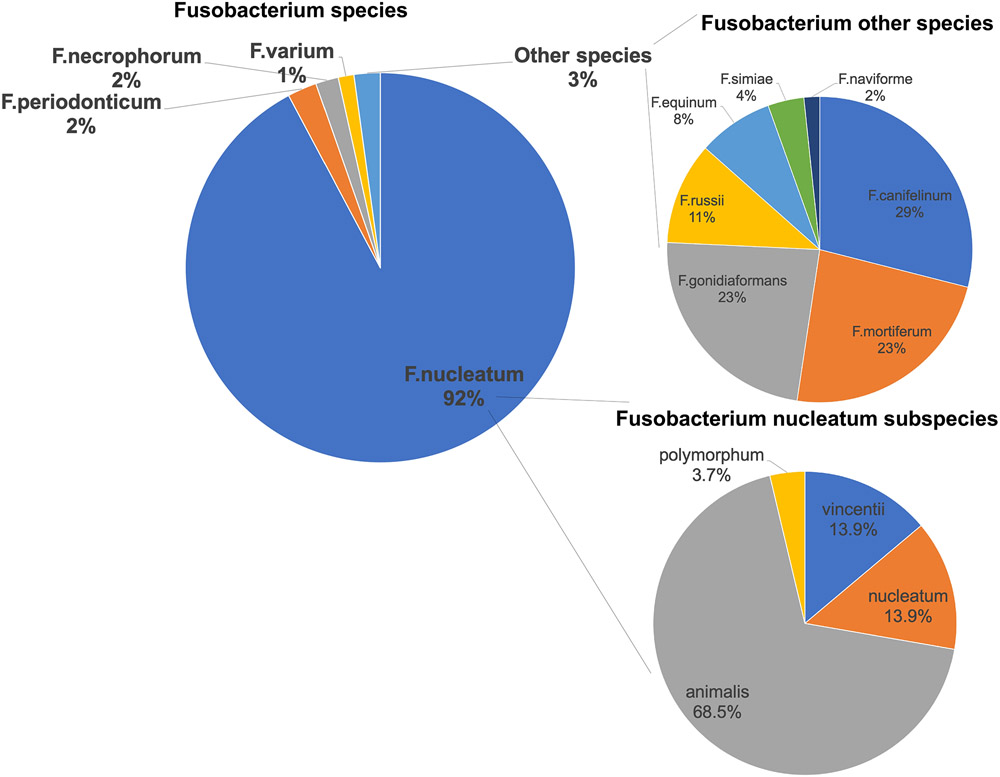
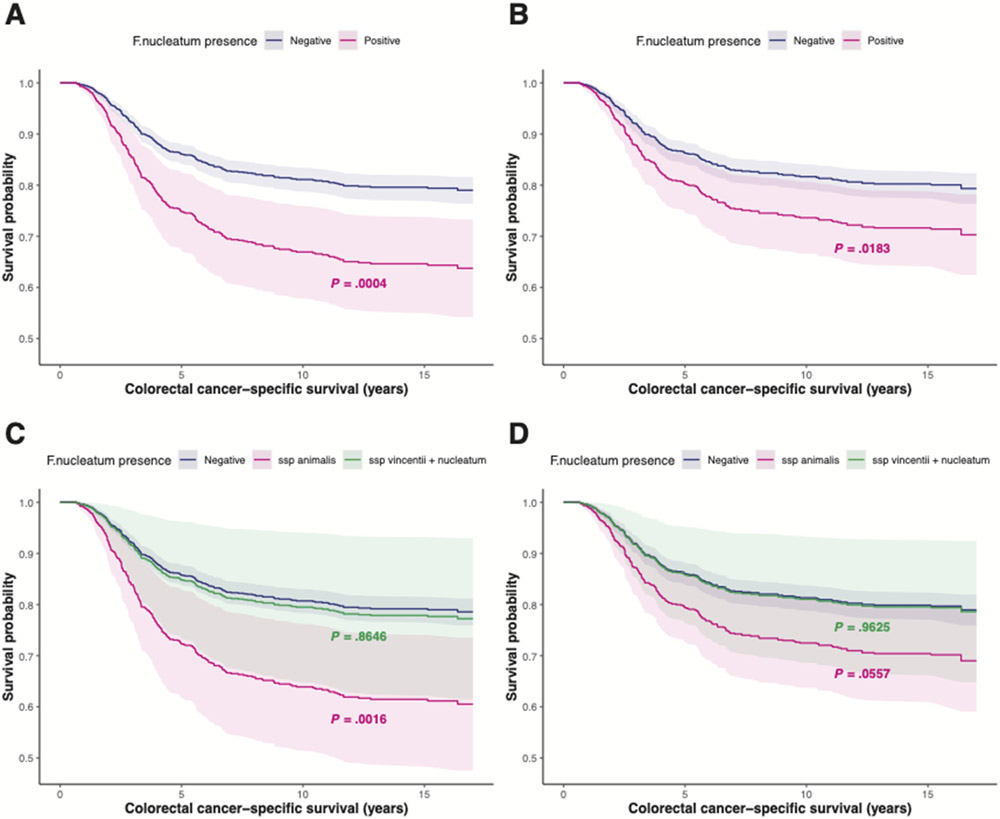
Results: F. nucleatum, which was present in 10.3% of tumors, was detected in a higher proportion of right-sided and advanced-stage tumors, particularly subspecies animalis. Presence of F. nucleatum was associated with higher colorectal cancer-specific mortality (HR, 1.97; P = 0.0004). This association was restricted to nonhypermutated, microsatellite-stable tumors (HR, 2.13; P = 0.0002) and those who received chemotherapy [HR, 1.92; confidence interval (CI), 1.07-3.45; P = 0.029). Only F. nucleatum subspecies animalis, the main subspecies detected (65.8%), was associated with colorectal cancer-specific mortality (HR, 2.16; P = 0.0016), subspecies vincentii and nucleatum were not (HR, 1.07; P = 0.86). Additional adjustment for tumor stage suggests that the effect of F. nucleatum on mortality is partly driven by a stage shift. Presence of F. nucleatum was associated with microsatellite instable tumors, tumors with POLE exonuclease domain mutations, and ERBB3 mutations, and suggestively associated with TP53 mutations.
Conclusions: F. nucleatum, and particularly subspecies animalis, was associated with a higher colorectal cancer-specific mortality and specific somatic mutated genes.
Impact: Our findings identify the F. nucleatum subspecies animalis as negatively impacting colorectal cancer mortality, which may occur through a stage shift and its effect on chemoresistance.
©2021 American Association for Cancer Research.
Conflict of interest statement
Conflict of interests:
Daniel Buchanan served as a consultant on the Tumour Agnostic (dMMR) Advisory Board of Merck Sharp and Dohme in 2017 and 2018 for Pembrolizumab. Reiko Nishihara’s current employer is Pfizer, Inc. Her contribution to this work was prior to employment at Pfizer, Inc. M. Giannakis receives research funding from Bristol-Myers Squibb and Merck. Nickolas Papadopoulos is a co-founder of, holds equity in, and is a consultant to Thrive Earlier Detection and Personal Genome Diagnostics. He is on the Thrive Earlier Detection Board of Directors and is a consultant to and holds equity in NeoPhore. Sysmex, Qiagen, Invitae, Personal Genome Diagnostics, PapGene, Thrive Earlier Detection, Horizon Discovery, Thermo FIsher, and other companies, have licensed previously described technologies from Johns Hopkins University. Nickolas Papadopoulos is an inventor on some of these technologies. Licenses to these technologies are or will be associated with equity or royalty payments to the inventors, as well as to Johns Hopkins University. The terms of all these arrangements are being managed by Johns Hopkins University in accordance with its conflict-of-interest policies.
Figures
Comment in
-
Selected Articles from This Issue.Cancer Epidemiol Biomarkers Prev. 2022 Jan;31(1):1. doi: 10.1158/1055-9965.EPI-31-1-HI. Cancer Epidemiol Biomarkers Prev. 2022. PMID: 35017191 No abstract available.
References
-
- Parkin DM. The global health burden of infection-associated cancers in the year 2002. Int J Cancer. 2006;118:3030–44. - PubMed
-
- Plummer M, de Martel C, Vignat J, Ferlay J, Bray F, Franceschi S. Global burden of cancers attributable to infections in 2012: a synthetic analysis. Lancet Glob Health. 2016;4:e609–16. - PubMed
-
- Helmink BA, Khan MAW, Hermann A, Gopalakrishnan V, Wargo JA. The microbiome, cancer, and cancer therapy. Nat Med. 2019;25:377–88. - PubMed
Publication types
MeSH terms
Substances
Grants and funding
- R01 CA248857/CA/NCI NIH HHS/United States
- U24 CA074783/CA/NCI NIH HHS/United States
- U01 CA137088/CA/NCI NIH HHS/United States
- U24 CA074794/CA/NCI NIH HHS/United States
- U01 CA164930/CA/NCI NIH HHS/United States
- U01 CA167551/CA/NCI NIH HHS/United States
- 27140/CRUK_/Cancer Research UK/United Kingdom
- R01 CA076366/CA/NCI NIH HHS/United States
- R35 CA197735/CA/NCI NIH HHS/United States
- U01 CA074794/CA/NCI NIH HHS/United States
- R01 CA176272/CA/NCI NIH HHS/United States
- U01 CA074783/CA/NCI NIH HHS/United States
- R35 CA253185/CA/NCI NIH HHS/United States
LinkOut - more resources
Full Text Sources
Medical
Research Materials
Miscellaneous