


Role of Eosinophils in Intestinal Inflammation and Fibrosis in Inflammatory Bowel Disease: An Overlooked Villain?
- PMID: 34737752
- PMCID: PMC8560962
- DOI: 10.3389/fimmu.2021.754413
Role of Eosinophils in Intestinal Inflammation and Fibrosis in Inflammatory Bowel Disease: An Overlooked Villain?
Abstract
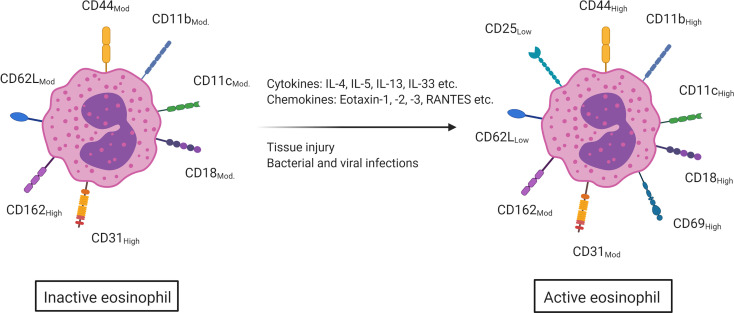
Eosinophils are leukocytes which reside in the gastrointestinal tract under homeostatic conditions, except for the esophagus which is normally devoid of eosinophils. Research on eosinophils has primarily focused on anti-helminth responses and type 2 immune disorders. In contrast, the search for a role of eosinophils in chronic intestinal inflammation and fibrosis has been limited. With a shift in research focus from adaptive to innate immunity and the fact that the eosinophilic granules are filled with inflammatory mediators, eosinophils are becoming a point of interest in inflammatory bowel diseases. In the current review we summarize eosinophil characteristics and recruitment as well as the current knowledge on presence, inflammatory and pro-fibrotic functions of eosinophils in inflammatory bowel disease and other chronic inflammatory conditions, and we identify research gaps which should be covered in the future.
Keywords: IBD; eosinophils; fibrosis; gastrointestinal disorders; inflammation.
Copyright © 2021 Jacobs, Ceulemans, Wauters, Breynaert, Vermeire, Verstockt and Vanuytsel.
Conflict of interest statement
CB reports consultancy fees from Ablynx. SV reports financial support for research from MSD, AbbVie, Takeda, Pfizer, J&J, lecture fees from MSD AbbVie, Takeda, Ferring, Centocor, Hospira, Pfizer, J&J, Genentech/Roche, consultancy fees from MSD, AbbVie, Takeda, Ferring, Centocor, Hospira, Pfizer, J&J, Genentech/Roche, Celgene, Mundipharma, Celltrion, Second Genome, Prometheus, Shire, Prodigest, Gilead and Galapagos. BV reports financial support for research from Pfizer lecture fees from Abbvie, Biogen, Chiesi, Falk, Ferring, Galapagos, Janssen, MondayNightIBD, MSD, Pfizer, R-Biopharm, Takeda and Truvion, consultancy fees from Applied Strategic, Atheneum, Bristol Myers Squibb, Guidepont, Ipsos, Janssen, Progenity, Sandoz and Takeda. TV reports financial support for research from Danone and MyHealth, has served on the Speaker bureau for Abbott, Fresenius Kabi, Kyowa Kirin, Menarini, Remedus, Takeda and Will Pharma, consultancy fees from Baxter, Dr. Falk Pharma, Takeda, Tramedico, Truvion, VectivBio and Zealand Pharma. The remaining authors declare that the research was conducted in the absence of any commercial or financial relationships that could be construed as a potential conflict of interest.
Figures

References
Publication types
MeSH terms
Substances
LinkOut - more resources
Full Text Sources
