. 2021 Dec;7(4):1039-1051.
doi: 10.1016/j.aninu.2021.02.001. Epub 2021 May 24.

Effect of organic acids-essential oils blend and oat fiber combination on broiler chicken growth performance, blood parameters, and intestinal health

Affiliations

Effect of organic acids-essential oils blend and oat fiber combination on broiler chicken growth performance, blood parameters, and intestinal health

Deborah I Adewole et al. Anim Nutr. 2021 Dec.

Abstract

This study evaluated the effect of organic acids-essential oils blend with or without oat hulls (OH) on growth performance, organ weights, blood parameters, gut morphology, microbiota, and short-chain fatty acids (SCFA) in broiler chickens. Day-old broiler chickens were randomly allocated to 4 dietary treatments consisting of 1) a corn-soybean meal-wheat based diet (BAS), 2) BAS + 0.05% bacitracin methylene disalicylate (BMD), 3) BAS + protected organic acids-essential oils at 300 g/1,000 kg of feed (OE), and 4) BAS + protected organic acids-essential oils at 300 g/1,000 kg of feed + 3% OH (OEOH), in 8 replicate groups. Feeding was in starter (d 0 to 14), grower (d 14 to 24), and finisher (d 24 to 36) phases. Body weight (BW), feed intake (FI), feed conversion ratio (FCR), and mortality were determined weekly. On d 36, 8 chickens per treatment were sampled for blood biochemistry, organ weights, cecal SCFA production, and microbiota. Treatments had no effect on FI and FCR at all phases. Both OE and OEOH treatments reduced (P < 0.001) the body weight gain of birds at the starter phase. Birds fed the OEOH treatment had higher (P < 0.001) gizzard weight, while those offered the BMD diet showed a tendency (P = 0.08) to have higher cecal weight. Birds in the OEOH treatment recorded increased ileal villus height and villus height-to-crypt depth ratio, as well as reduced duodenal crypt depth, while birds in the OE treatment had increased jejunal villus height and villus height-to-crypt depth ratio. Both OEOH and OE treatments increased the number of goblet cells produced in the duodenum and jejunum. Treatments had no effect on SCFA concentrations. Birds in the OE treatment recorded the lowest concentration of blood urea (P = 0.05) and cholesterol (P < 0.05). Both OE and OEOH treatments increased (P < 0.05) the relative abundance of potentially beneficial bacteria in the genus Firmicutes_unclassified, Ruminococcus, Turicibacter, and Erysipelotrichaceae_unclassified, while reducing (P < 0.001) the relative abundance of potentially harmful Coprobacillus. Conclusively, both protected organic acids-essential oils blend and its combination with oat fibers show potential as tools to achieve antibiotics reduction in broiler production.

Keywords: Broiler chicken; Ceca microbiota; Essential oil; Oat hull; Organic acid.


Conflict of interest statement

The authors declare the following competing interest(s): Elizabeth Santin is a co-author in this manuscript. She is an employee at Jefo Nutrition Inc. that provided the organic acids-essential oils blend for this work.

Figures

Fig. 1
Fig. 1
Relative abundance of ceca microbial composition. (A) of the main bacteria phyla, and (B) phylum Tenericutes across the different treatments. Treatments include - BAS, basal diet; BMD, antibiotic diet; OE, diet containing 300 g of protected organic acids-essential oils blend/1,000 kg of feed; OEOH, diet containing 300 g of protected organic acids-essential oils blend/1,000 kg of feed +3% coarse oat hulls. The top of each graph assigned different lowercase letters (a,b) are significantly different. Treatment comparisons reported with (∗) indicate significance at the level P < 0.05.
Fig. 2
Fig. 2
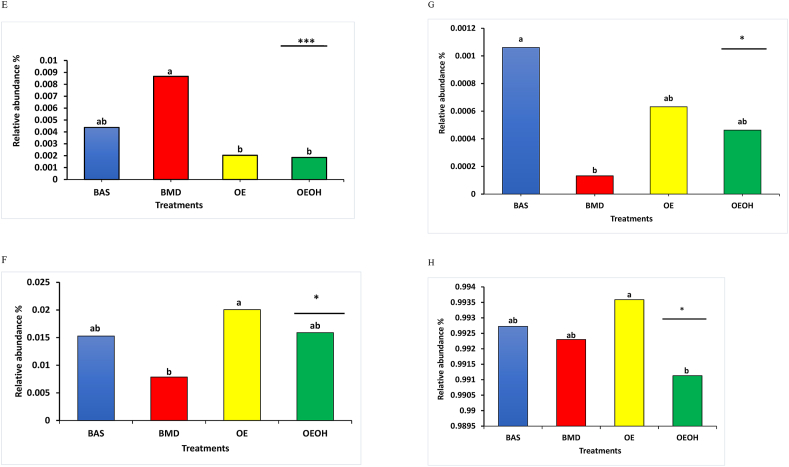
Relative abundance of ceca microbial composition. (A) At the genus level, (B) comparison of the relative abundance of Firmicutes_unclassified, (C) comparison of the relative abundance of Turicibacter, (D) comparison of the relative abundance of g_SMB53, (E) comparison of the relative abundance of Coprobacillus, (F) comparison of the relative abundance of RF39_unclassified, (G) comparison of the relative abundance of Erysipelotrichaceae, and (H) comparison of the relative abundance of Streptococcus across the different treatments. Treatments include: BAS, basal diet; BMD, antibiotic diet; OE, diet containing 300 g of protected organic acids-essential oils blend/1,000 kg of feed; OEOH, diet containing 300 g of protected organic acids-essential oils blend/1,000 kg of feed +3% coarse oat hulls. The top of each graph assigned different lowercase letters (a, b) are significantly different. Treatment comparisons reported with (∗) and (∗∗∗) indicate significance at the level P < 0.05 and P < 0.001, respectively. Treatment comparisons reported with P = 0.07 indicate a statistical trend.
Fig. 2
Fig. 2
Relative abundance of ceca microbial composition. (A) At the genus level, (B) comparison of the relative abundance of Firmicutes_unclassified, (C) comparison of the relative abundance of Turicibacter, (D) comparison of the relative abundance of g_SMB53, (E) comparison of the relative abundance of Coprobacillus, (F) comparison of the relative abundance of RF39_unclassified, (G) comparison of the relative abundance of Erysipelotrichaceae, and (H) comparison of the relative abundance of Streptococcus across the different treatments. Treatments include: BAS, basal diet; BMD, antibiotic diet; OE, diet containing 300 g of protected organic acids-essential oils blend/1,000 kg of feed; OEOH, diet containing 300 g of protected organic acids-essential oils blend/1,000 kg of feed +3% coarse oat hulls. The top of each graph assigned different lowercase letters (a, b) are significantly different. Treatment comparisons reported with (∗) and (∗∗∗) indicate significance at the level P < 0.05 and P < 0.001, respectively. Treatment comparisons reported with P = 0.07 indicate a statistical trend.
Fig. 3
Fig. 3
ANOVA determined no significant differences in the Shannon diversity index (P > 0.05; F value = 0.723). Cecal content was collected from 36-day-old broiler chickens. Treatments include: BAS, basal diet; BMD, antibiotic diet; OE, diet containing 300 g of protected organic acids-essential oils blend/1,000 kg of feed; OEOH, diet containing 300 g of protected organic acids-essential oils blend/1,000 kg of feed +3% coarse oat hulls.
Fig. 4
Fig. 4
Permutational analysis of variance (Permanova) determined significant differences (P < 0.05; R-squared = 0.1463) in beta-diversity among treatments. BAS, basal diet; BMD, antibiotic diet; OE, diet containing 300 g of protected organic acids-essential oils blend/1,000 kg of feed; OEOH, diet containing 300 g of protected organic acids-essential oils blend/1,000 kg of feed +3% coarse oat hulls. PCoA = principal coordinate analysis.

References

    1. Abdel-Fattah S.A., El-Sanhoury M.H., El-Mednay N.M., Abdel-Azeem F. Thyroid activity, some blood constituents, organs morphology and performance of broiler chicks fed supplemental organic acids. Int J Poultry Sci. 2008;7:215–222.
    1. Abdelli N., Pérez J.F., Vilarrasa E., Luna I.C., Melo-Duran D., D'angelo M., Solà-Oriol D. Targeted-release organic acids and essential oils improve performance and digestive function in broilers under a necrotic enteritis challenge. Animals. 2020;10:259. - PMC - PubMed
    1. Abdo Z.M. Efficacy of acetic acid in improving the utilization of low protein-low energy broiler diets. Egypt Poult Sci. 2004;24:123–141.
    1. Adewole D. Effect of dietary supplementation with coarse or extruded oat hulls on growth performance, blood biochemical parameters, ceca microbiota and short chain fatty acids in broiler chickens. Animals. 2020;10:1429. - PMC - PubMed
    1. Adewole D., MacIsaac J., Fraser G., Rathgeber B. Effect of oat hulls incorporated in the diet or fed as free choice on growth performance, carcass yield, gut morphology and digesta short chain fatty acids of broiler chickens. Sustainability. 2020;12:3744.

LinkOut - more resources