Review
. 2021 Nov 1;148(21):dev199861.
doi: 10.1242/dev.199861. Epub 2021 Nov 5.

It takes all kinds: heterogeneity among satellite cells and fibro-adipogenic progenitors during skeletal muscle regeneration

Affiliations
Review

It takes all kinds: heterogeneity among satellite cells and fibro-adipogenic progenitors during skeletal muscle regeneration

Brittany C Collins et al. Development. .

Abstract

Vertebrate skeletal muscle is composed of multinucleate myofibers that are surrounded by muscle connective tissue. Following injury, muscle is able to robustly regenerate because of tissue-resident muscle stem cells, called satellite cells. In addition, efficient and complete regeneration depends on other cells resident in muscle - including fibro-adipogenic progenitors (FAPs). Increasing evidence from single-cell analyses and genetic and transplantation experiments suggests that satellite cells and FAPs are heterogeneous cell populations. Here, we review our current understanding of the heterogeneity of satellite cells, their myogenic derivatives and FAPs in terms of gene expression, anatomical location, age and timing during the regenerative process - each of which have potentially important functional consequences.

Keywords: FAP; Fibro-adipogenic progenitor; Muscle; Regeneration; Satellite cell.


Conflict of interest statement

Competing interests The authors declare no competing or financial interests.

Figures
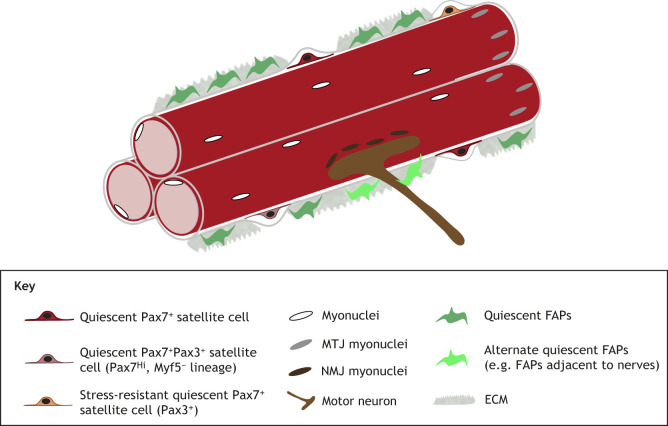
Fig. 1.
Fig. 1.
Populations of satellite cells, FAPs and myonuclei in uninjured skeletal muscle. Genetic studies support the existence of at least two subpopulations of quiescent satellite cells. Stem quiescent satellite cells have been identified by expression of high levels of Pax7 (Rocheteau et al., 2012) and by absence of expression of Myf5 (Kuang et al., 2007). Stem cells resistant to stress express Pax3 (Der Vartanian et al., 2019; Scaramozza et al., 2019). Myonuclei adjacent to neuromuscular junctions (NMJ) and myotendinous junctions (MTJ) are distinct from myonuclei along the main body of the myofiber (Jacobson et al., 2001; Koch et al., 2004; Petrany et al., 2020). There is currently no consensus on whether there are multiple subpopulations of quiescent FAPs. Muhl et al. (2020) identified FAP subpopulations localized to different muscle regions, including adjacent to the motor neurons. ECM, extracellular matrix.
Fig. 2.
Fig. 2.
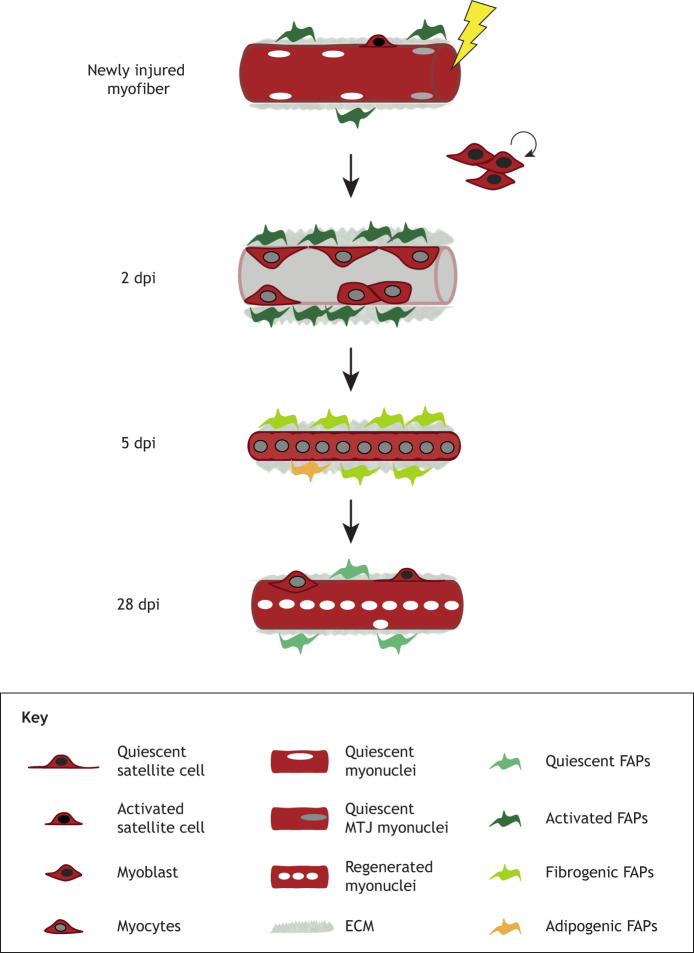
Populations of satellite cells, their myogenic derivatives and FAPs during skeletal muscle regeneration. In response to injury, quiescent satellite cells and FAPs are activated and these activated cells are distinct from their quiescent counterparts (e.g. McKellar et al., 2020 preprint). Activated satellite cells differentiate into myoblasts and then myocytes, which fuse to form regenerated myofibers with characteristic centralized nuclei. Activated FAPs differentiate into fibrogenic or adipogenic FAPs and presumably transition to a quiescent FAP phenotype when regeneration is largely complete at 28 dpi (e.g. McKellar et al., 2020 preprint). ECM, extracellular matrix; MTJ, myotendinous junctions.

References

    1. Archile-Contreras, A. C., Mandell, I. B. and Purslow, P. P. (2010). Phenotypic differences in matrix metalloproteinase 2 activity between fibroblasts from 3 bovine muscles. J. Anim. Sci. 88, 4006-4015. 10.2527/jas.2010-3060 - DOI - PubMed
    1. Bandura, D. R., Baranov, V. I., Ornatsky, O. I., Antonov, A., Kinach, R., Lou, X., Pavlov, S., Vorobiev, S., Dick, J. E. and Tanner, S. D. (2009). Mass cytometry: technique for real time single cell multitarget immunoassay based on inductively coupled plasma time-of-flight mass spectrometry. Anal. Chem. 81, 6813-6822. 10.1021/ac901049w - DOI - PubMed
    1. Barruet, E., Garcia, S. M., Striedinger, K., Wu, J., Lee, S., Byrnes, L., Wong, A., Xuefeng, S., Tamaki, S., Brack, A. S.et al. (2020). Functionally heterogeneous human satellite cells identified by single cell RNA sequencing. ELife 9, e51576. 10.7554/eLife.51576 - DOI - PMC - PubMed
    1. Baskin, K. K., Winders, B. R. and Olson, E. N. (2015). Muscle as a “Mediator” of systemic metabolism. Cell Metab. 21, 237-248. 10.1016/j.cmet.2014.12.021 - DOI - PMC - PubMed
    1. Beauchamp, J. R., Heslop, L., Yu, D. S. W., Tajbakhsh, S., Kelly, R. G., Wernig, A., Buckingham, M. E., Partridge, T. A. and Zammit, P. S. (2000). Expression of Cd34 and Myf5 defines the majority of quiescent adult skeletal muscle satellite cells. J. Cell Biol. 151, 1221-1234. 10.1083/jcb.151.6.1221 - DOI - PMC - PubMed

Publication types