. 2021 Nov:73:103652.
doi: 10.1016/j.ebiom.2021.103652. Epub 2021 Nov 2.

Antibacterial activity of apramycin at acidic pH warrants wide therapeutic window in the treatment of complicated urinary tract infections and acute pyelonephritis

Affiliations

Antibacterial activity of apramycin at acidic pH warrants wide therapeutic window in the treatment of complicated urinary tract infections and acute pyelonephritis

Katja Becker et al. EBioMedicine. 2021 Nov.

Abstract

Background: The clinical-stage drug candidate EBL-1003 (apramycin) represents a distinct new subclass of aminoglycoside antibiotics for the treatment of drug-resistant infections. It has demonstrated best-in-class coverage of resistant isolates, and preclinical efficacy in lung infection models. However, preclinical evidence for its utility in other disease indications has yet to be provided. Here we studied the therapeutic potential of EBL-1003 in the treatment of complicated urinary tract infection and acute pyelonephritis (cUTI/AP).

Methods: A combination of data-base mining, antimicrobial susceptibility testing, time-kill experiments, and four murine infection models was used in a comprehensive assessment of the microbiological coverage and efficacy of EBL-1003 against Gram-negative uropathogens. The pharmacokinetics and renal toxicology of EBL-1003 in rats was studied to assess the therapeutic window of EBL-1003 in the treatment of cUTI/AP.

Findings: EBL-1003 demonstrated broad-spectrum activity and rapid multi-log CFU reduction against a phenotypic variety of bacterial uropathogens including aminoglycoside-resistant clinical isolates. The basicity of amines in the apramycin molecule suggested a higher increase in positive charge at urinary pH when compared to gentamicin or amikacin, resulting in sustained drug uptake and bactericidal activity, and consequently in potent efficacy in mouse infection models. Renal pharmacokinetics, biomarkers for toxicity, and kidney histopathology in adult rats all indicated a significantly lower nephrotoxicity of EBL-1003 than of gentamicin.

Interpretation: This study provides preclinical proof-of-concept for the efficacy of EBL-1003 in cUTI/AP. Similar efficacy but lower nephrotoxicity of EBL-1003 in comparison to gentamicin may thus translate into a higher safety margin and a wider therapeutic window in the treatment of cUTI/API.

Funding: A full list of funding bodies that contributed to this study can be found in the Acknowledgements section.

Keywords: Anti-bacterial agents; delta pH; drug uptake; efficacy; nephrotoxicity; permeability; proton-motive force; urinary tract.


Conflict of interest statement

Declaration of Competing Interest Authors ECB, DC, and SNH are co-founders of and shareholders in Juvabis AG. All other authors declare no conflict of interest.

Figures
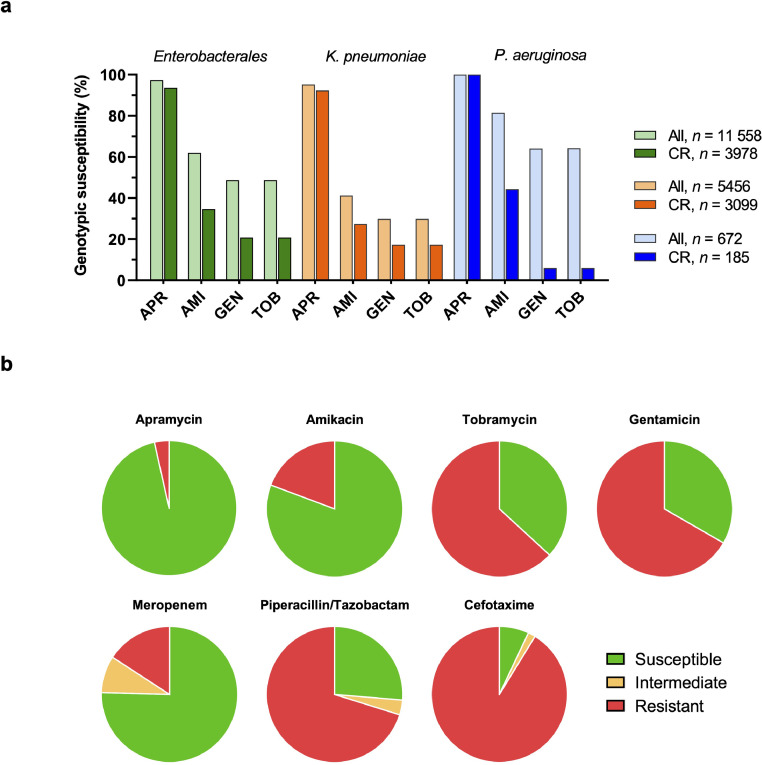
Fig 1
Fig. 1
Genotypic and phenotypic antimicrobial susceptibility of uropathogenic isolates. (a) Genotypic aminoglycoside susceptibility of 11 558 urinary Gram-negative isolates deposited in the National Database of Antibiotic Resistant Organisms (NDARO). Genotypic susceptibility was defined by the absence of resistance gene annotations known to affect the susceptibility to a specific drug. The Enterobacterales group comprised E. coli/Shigella, Klebsiella spp., Enterobacter spp., Citrobacter freundii, Morganella morganii, Serratia marcescens, and Providencia alcalifaciens. Genetic resistance determinants applied in the analysis are listed in Table S2. APR, apramycin; AMI, amikacin; GEN, gentamicin; TOB, tobramycin; CR, carbapenem resistance. (b) Phenotypic antimicrobial susceptibility of a panel of 57 contemporary non-susceptible uropathogenic isolates comprising E. coli (n = 20), K. pneumoniae (n = 10), K. oxytoca (n = 5), E. cloacae (n = 5), P. mirabilis (n = 8), and P. aeruginosa (n = 9). EUCAST 2021 interpretative criteria for Enterobacterales and P. aeruginosa were applied to the minimal inhibitory concentrations (MICs) listed in Table S4. For apramycin, epidemiologic cutoff-values (ECOFFs) of 16 mg/L for Enterobacterales and 32 mg/L for P. aeruginosa were used as interpretative criteria. MIC distributions are plotted in Fig. S1.
Fig 2
Fig. 2
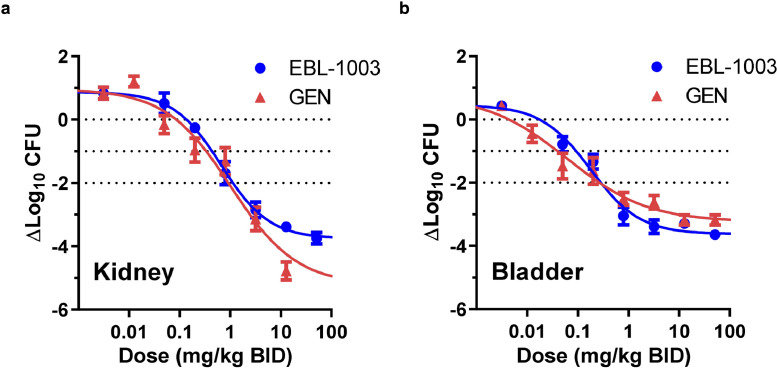
In-vivoefficacy of EBL-1003 (apramycin) in comparison to gentamicin in a murine cUTI model infected with the uropathogen E. coli J96. Female C3H/HeJ mice were infected with 9.13 × 108 CFU/mouse by transurethral injection in the bladder and treated subcutaneously with twice daily doses of EBL-1003 (MIC = 4 μg/mL) or gentamicin (GEN, MIC = 0.5–1 μg/mL) for three days starting 96 h post infection. (a) Dose-response multi-log CFU reduction in the kidney. One-way ANOVA and Dunnett's test of CFU reduction relative to start of treatment resulted in p< 0.05 for doses ≥0.8 mg/kg BID of EBL-1003 or gentamicin. (b) Dose-response multi-log CFU reduction in the bladder. One-way ANOVA and Dunnett's test of CFU reduction relative to start of treatment resulted in p< 0.05 for doses ≥0.2 mg/kg BID of EBL-1003 or gentamicin. Data blotted as mean ± SEM CFU reduction in n = 5 mice per dose group.
Fig 3
Fig. 3
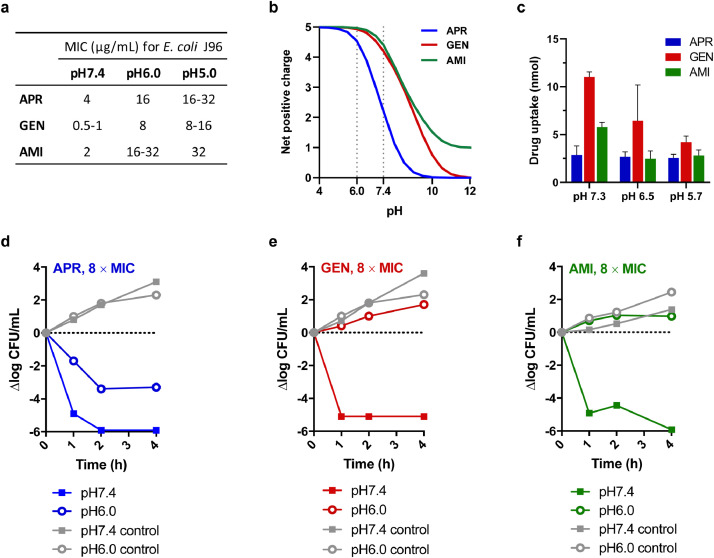
The effect of pH on the antibacterial activity, positive charge, drug uptake, and time-kill kinetics of apramycin, gentamicin, and amikacin in the uropathogen E. coli J96.(a) MICs for E. coli J96 at pH7.4, pH6.0, and pH5.0. (b) Net positive charge of apramycin, gentamicin, and amikacin when applying the Henderson-Hasselbalch equation to the pKa values of individual amines published previously. (c) Cytoplasmic uptake of apramycin, gentamicin and amikacin by E. coli J96 cells at pH 5.7, pH 6.5, and pH 7.3 quantified by LC/MS/MS following cellular fractionation of 3.9 × 109 cells. Data blotted as mean ± SD of n = 4 replicates. (d-f) Time-kill kinetics of apramycin (d), gentamicin (e), and amikacin (f) against E. coli J96 at a drug concentration of eight times the MIC at neutral pH: 32 μg/mL apramycin, 4 μg/mL gentamicin, and 16 μg/mL amikacin, respectively.
Fig 4
Fig. 4
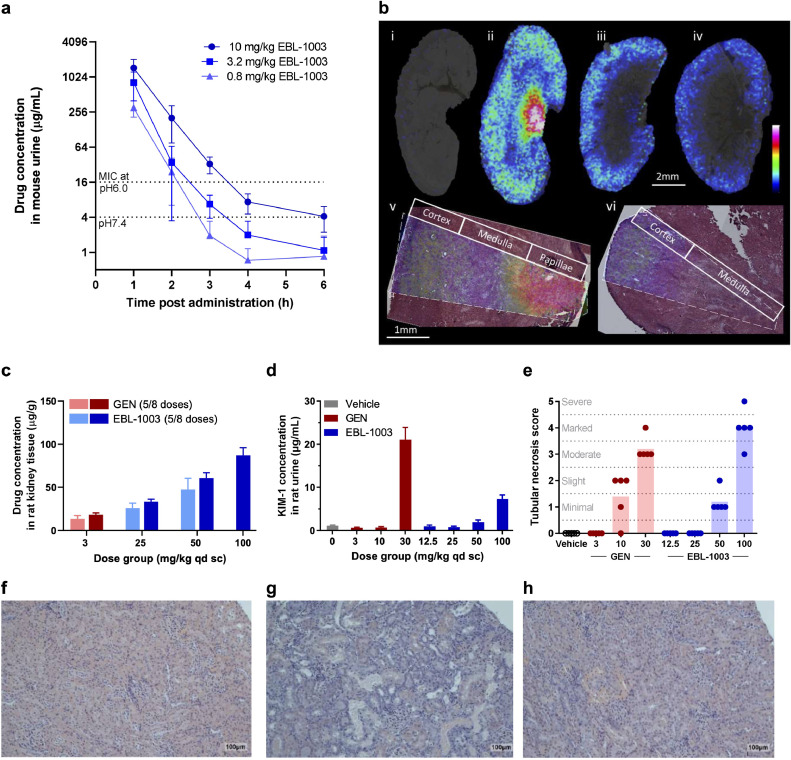
Drug exposure in urine and kidney and nephrotoxicity of EBL-1003 (apramycin) in comparison to gentamicin. (a) Concentration of apramycin in mouse urine up to 6 h after administration of EBL-1003. Data blotted as mean ± SD of n = 4 animals. (b) EBL-1003 distribution in mouse kidney at different time points post administration. i–iv, Ion distribution images of apramycin (m/z 540.29) in kidney sections from control (i), 1 h (ii), 2 h (iii), and 4 h (iv) post administration. v-vi, ion distribution of apramycin (m/z 540.29) overlaid on the H&E-stained analysed section from a kidney tissue section 1 h post administration (v) and 2 h post administration (vi). Images were acquired at a lateral resolution of 100 µm (i–iv) and 30 µm (v, vi). Data is normalized to internal standard (kanamycin, m/z 485.24). Data are shown using a rainbow scale scaled to 0-60% of max intensity. (c) Accumulation of apramycin in rat kidneys after repeated dosing of EBL-1003 over 5 to 8 days in comparison to gentamicin (GEN). Tissue concentration was determined 2 h after the final dose. Data blotted as mean ± SD of n = 3 rats receiving five doses each, and n = 5 rats receiving eight doses each. (d) KIM-1 concentration in rat urine after 14 days of repeat dosing. Data blotted as mean ± SD of n = 5 replicates. (e) Adult rat kidney histopathology scoring after 14 days of repeat dosing of gentamicin or EBL-1003. A score of zero is equivalent to “no finding”; 1, minimal; 2, slight; 3, moderate; 4, marked; 5, severe. (f–h) Histopathological cross sections of kidney cortex of adult rats treated with vehicle (f), 30 mg/kg gentamicin showing marked tubular necrosis and regeneration (g), or 50 mg/kg of EBL-1003 showing minimal tubular necrosis and regeneration (h). Tubular necrosis was characterized by cytoplasmic eosinophilia, nuclear pyknosis or karyorrhexis, and sloughing of affected epithelium into tubular lumina with attenuation of the tubular epithelial layer. Tubular regeneration was observed as basophilic lower epithelium with mitotic activity. Scale bar indicates 100 μm.

References

    1. Foxman B. The epidemiology of urinary tract infection. Nat Rev Urol. 2010;7(12):653–660. - PubMed
    1. Sihra N, Goodman A, Zakri R, Sahai A, Malde S. Nonantibiotic prevention and management of recurrent urinary tract infection. Nat Rev Urol. 2018;15(12):750–776. - PubMed
    1. Magill SS, Edwards JR, Bamberg W, Beldavs ZG, Dumyati G, Kainer MA. Multistate point-prevalence survey of health care-associated infections. N Engl J Med. 2014;370(13):1198–1208. - PMC - PubMed
    1. Klein RD, Hultgren SJ. Urinary tract infections: microbial pathogenesis, host-pathogen interactions and new treatment strategies. Nat Rev Microbiol. 2020;18(4):211–226. - PMC - PubMed
    1. Bader MS, Loeb M, Brooks AA. An update on the management of urinary tract infections in the era of antimicrobial resistance. Postgrad Med. 2017;129(2):242–258. - PubMed

MeSH terms