. 2021 Dec;297(6):101379.
doi: 10.1016/j.jbc.2021.101379. Epub 2021 Nov 2.

Caspase-6 promotes activation of the caspase-11-NLRP3 inflammasome during gram-negative bacterial infections

Affiliations

Caspase-6 promotes activation of the caspase-11-NLRP3 inflammasome during gram-negative bacterial infections

Min Zheng et al. J Biol Chem. 2021 Dec.

Abstract

The innate immune system acts as the first line of defense against infection. One key component of the innate immune response to gram-negative bacterial infections is inflammasome activation. The caspase-11 (CASP11)-nucleotide-binding oligomerization domain-like receptor pyrin domain-containing 3 (NLRP3) inflammasome is activated by cytosolic lipopolysaccharide, a gram-negative bacterial cell wall component, to trigger pyroptosis and host defense during infection. Although several cellular signaling pathways have been shown to regulate CASP11-NLRP3 inflammasome activation in response to lipopolysaccharide, the upstream molecules regulating CASP11 activation during infection with live pathogens remain unclear. Here, we report that the understudied caspase-6 (CASP6) contributes to the activation of the CASP11-NLRP3 inflammasome in response to infections with gram-negative bacteria. Using in vitro cellular systems with bone marrow-derived macrophages and 293T cells, we found that CASP6 can directly process CASP11 by cleaving at Asp59 and Asp285, the CASP11 auto-cleavage sites, which could contribute to the activation of CASP11 during gram-negative bacterial infection. Thus, the loss of CASP6 led to impaired CASP11-NLRP3 inflammasome activation in response to gram-negative bacteria. These results demonstrate that CASP6 potentiates activation of the CASP11-NLRP3 inflammasome to produce inflammatory cytokines during gram-negative bacterial infections.

Keywords: C. rodentium; E. coli; NLRP3; P. aeruginosa; caspase-11; caspase-6; cell death; gasdermin D; gram-negative bacteria; inflammasome; pyroptosis.


Conflict of interest statement

Conflict of interest The authors declare that they have no conflicts of interest with the contents of this article.

Figures
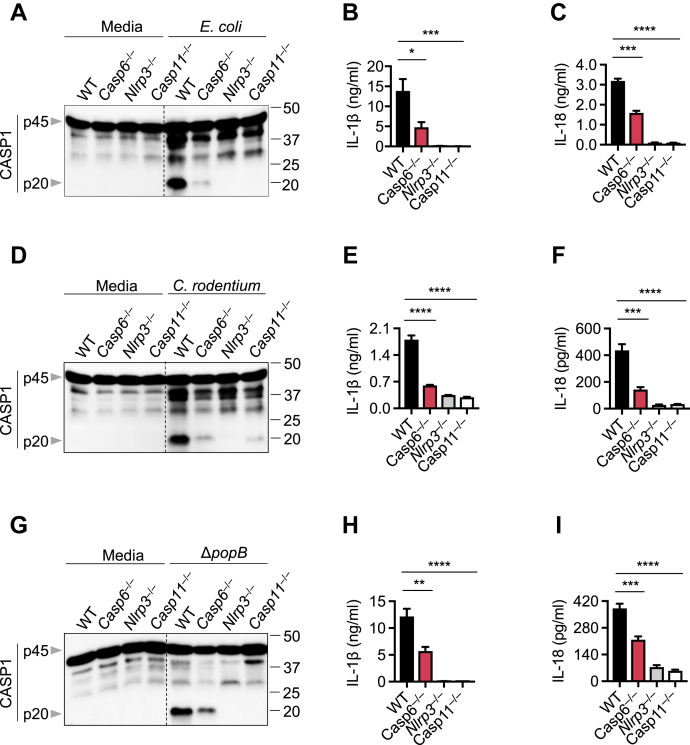
Figure 1
Figure 1
CASP6 contributes to CASP11-NLRP3 inflammasome activation. A, the immunoblot analysis of pro- (p45) and cleaved caspase-1 (p20; CASP1) in bone marrow-derived macrophages (BMDMs) after Escherichia coli infection at an MOI of 20 for 20 h. B and C, IL-1β (B) and IL-18 (C) release from BMDMs infected with E. coli at an MOI of 20 for 20 h. D, immunoblot analysis of pro- and cleaved CASP1 in BMDMs after Citrobacter rodentium infection at an MOI of 20 for 20 h. E and F, IL-1β (E) and IL-18 (F) release from BMDMs infected with C. rodentium at an MOI of 20 for 20 h. G, immunoblot analysis of pro- and cleaved CASP1 in BMDMs after Pseudomonas aeruginosa mutant strain ΔpopB infection at an MOI of 20 for 20 h. H and I, IL-1β (H) and IL-18 (I) release from BMDMs infected with ΔpopB at an MOI of 20 for 20 h. The data are representative of at least three independent experiments. The data are shown as mean ± SEM (B, C, E, F, H, and I). ∗p < 0.05, ∗∗p < 0.01, ∗∗∗p < 0.001, and ∗∗∗∗p < 0.0001 (one-way ANOVA). CASP, caspase; MOI, multiplicity of infection; NLRP, nucleotide-binding oligomerization domain-like receptor containing pyrin domain.
Figure 2
Figure 2
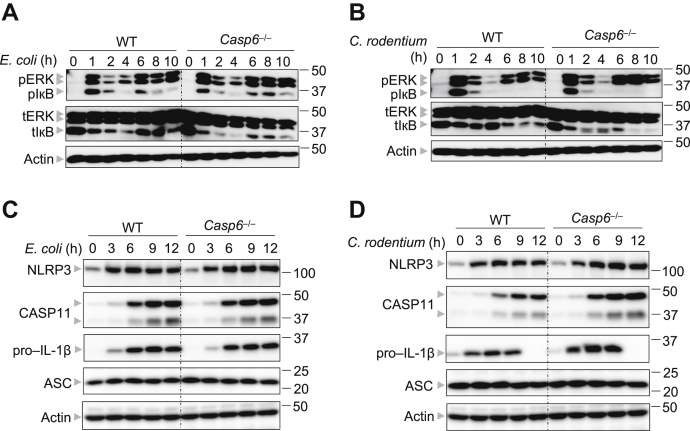
CASP6 is not involved in priming the CASP11-NLRP3 inflammasome during gram-negative bacterial infections. A, immunoblot analysis of phosphorylated ERK (pERK), phosphorylated IκB (pIκB), total ERK (tERK), and total IκB (tIκB) in bone marrow-derived macrophages (BMDMs) after Escherichia coli (20 MOI) infection for the indicated time. Actin was used as the internal control. B, immunoblot analysis of pERK, pIκB, tERK, and tIκB in BMDMs after Citrobacter rodentium (20 MOI) infection for the indicated time. Actin was used as the internal control. C, immunoblot analysis of NLRP3, CASP11, pro–IL-1β, and ASC in BMDMs after E. coli (20 MOI) infection for the indicated time. Actin was used as the internal control. D, immunoblot analysis of NLRP3, CASP11, pro–IL-1β, and ASC in BMDMs after C. rodentium (20 MOI) infection for the indicated time. Actin was used as the internal control. The data are representative of at least three independent experiments. ASC, apoptosis-associated speck-like protein containing a CARD; CASP, caspase; ERK, extracellular signal-regulated kinase; MOI, multiplicity of infection; NLRP, nucleotide-binding oligomerization domain-like receptor containing pyrin domain.
Figure 3
Figure 3
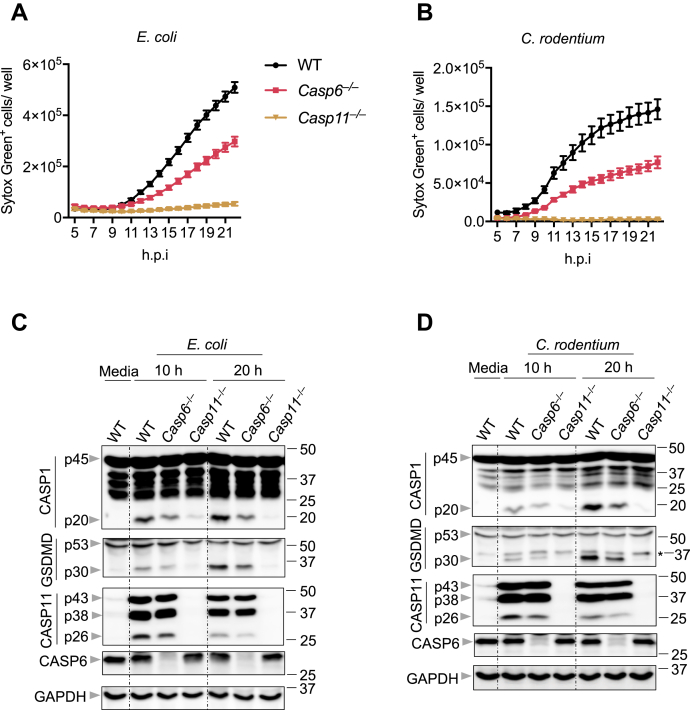
CASP6 regulates pyroptosis during gram-negative bacterial infections. A and B, real-time analysis of cell death in bone marrow-derived macrophages (BMDMs) using the IncuCyte imaging system and SYTOX Green nucleic acid staining after infection with Escherichia coli (20 MOI) (A) or Citrobacter rodentium (20 MOI) (B). quantification of the cell death at the indicated timepoints is shown. C, immunoblot analysis of pro- (p45) and cleaved caspase-1 (p20; CASP1), pro- (p53) and cleaved gasdermin D (p30; GSDMD), and pro- (p43) and cleaved caspase-11 (p38 and p26; CASP11) and caspase-6 (CASP6) in BMDMs after E. coli (20 MOI) infection for the indicated time. GAPDH was used as the internal control. D, immunoblot analysis of pro- and cleaved CASP1, pro- and cleaved GSDMD, and pro- and cleaved CASP11 and CASP6 in BMDMs after C. rodentium (20 MOI) infection for the indicated time. Asterisk indicates a nonspecific band. GAPDH was used as the internal control. The data are representative of at least three independent experiments. The data are shown as mean ± SEM (A and B). CASP, caspase; MOI, multiplicity of infection.
Figure 4
Figure 4
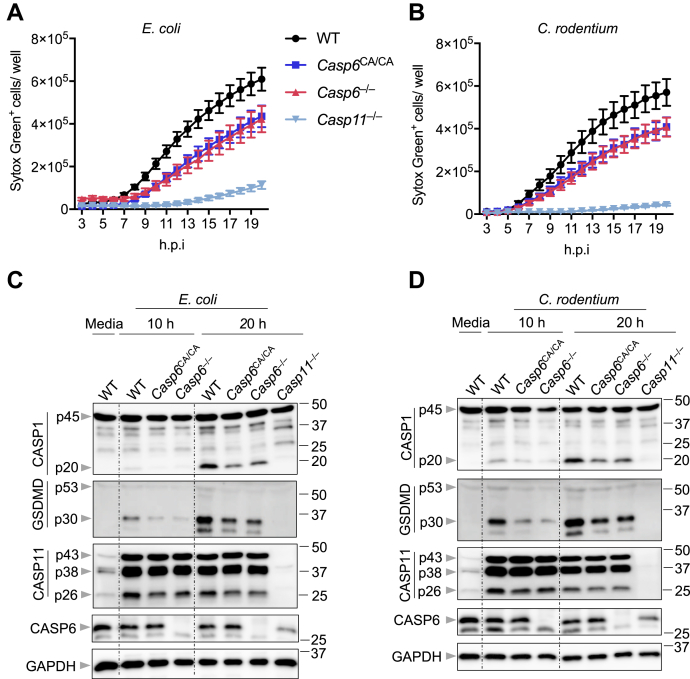
Catalytic activity of CASP6 contributes to CASP11-NLRP3 inflammasome activation during gram-negative bacterial infections. A and B, real-time analysis of cell death in bone marrow-derived macrophages (BMDMs) using the IncuCyte imaging system and SYTOX Green nucleic acid staining after infection with Escherichia coli (20 MOI) (A) or Citrobacter rodentium (20 MOI) (B). Quantification of the cell death at the indicated timepoints is shown. C, immunoblot analysis of pro- (p45) and cleaved caspase-1 (p20; CASP1), pro- (p53) and cleaved gasdermin D (p30; GSDMD), and pro- (p43) and cleaved caspase-11 (p38 and p26; CASP11) and caspase-6 (CASP6) in BMDMs after E. coli (20 MOI) infection for the indicated time. GAPDH was used as the internal control. D, immunoblot analysis of pro- and cleaved CASP1, pro- and cleaved GSDMD, and pro- and cleaved CASP11 and CASP6 in BMDMs after C. rodentium (20 MOI) infection for the indicated time. GAPDH was used as the internal control. The data are representative of at least three independent experiments. The data are shown as mean ± SEM (A and B). CASP, caspase; MOI, multiplicity of infection; NLRP, nucleotide-binding oligomerization domain-like receptor containing pyrin domain.
Figure 5
Figure 5
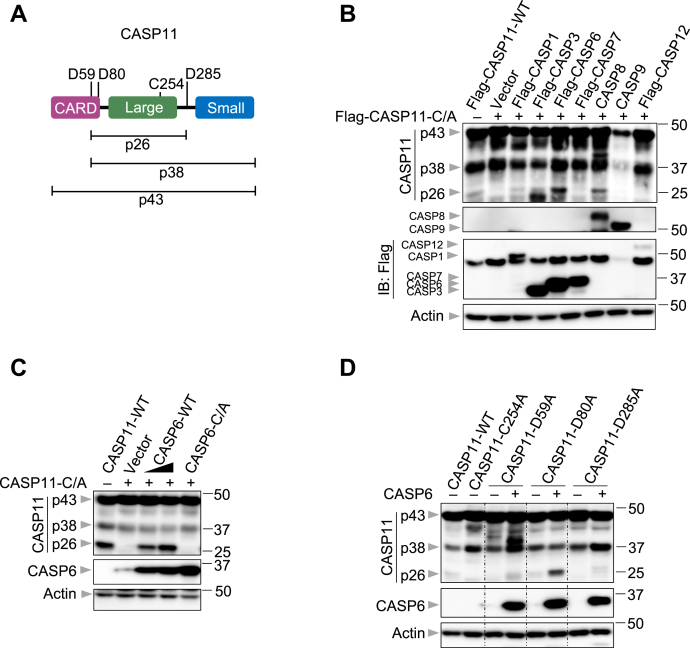
CASP6 cleaves CASP11 in cell lysates. A, schematic diagram of the cleavage and catalytic sites of caspase-11 (CASP11). p26, p38, and p43 indicate the fragments generated from the potential cleavage sites. B, immunoblot analysis of pro- (p43) and cleaved CASP11 (p38 and p26), caspase-8 (CASP8), caspase-9 (CASP9), caspase-12 (CASP12), caspase-1 (CASP1), caspase-7 (CASP7), caspase-6 (CASP6), and caspase-3 (CASP3) in 293T cells transfected with the indicated expression plasmids. Actin was used as the internal control. C, immunoblot analysis of pro- and cleaved CASP11 and CASP6 in 293T cells transfected with the indicated expression plasmids. Actin was used as the internal control. D, immunoblot analysis of pro- and cleaved CASP11 and CASP6 in 293T cells transfected with the indicated expression plasmids. Actin was used as the internal control. The data are representative of at least three independent experiments. CARD, caspase-activation and recruitment domain; CASP, caspase.

References

    1. Christgen S., Place D.E., Kanneganti T.D. Toward targeting inflammasomes: Insights into their regulation and activation. Cell Res. 2020;30:315–327. - PMC - PubMed
    1. Martinon F., Burns K., Tschopp J. The inflammasome: A molecular platform triggering activation of inflammatory caspases and processing of proIL-beta. Mol. Cell. 2002;10:417–426. - PubMed
    1. Sharma B.R., Kanneganti T.D. NLRP3 inflammasome in cancer and metabolic diseases. Nat. Immunol. 2021;22:550–559. - PMC - PubMed
    1. Aachoui Y., Leaf I.A., Hagar J.A., Fontana M.F., Campos C.G., Zak D.E., Tan M.H., Cotter P.A., Vance R.E., Aderem A., Miao E.A. Caspase-11 protects against bacteria that escape the vacuole. Science. 2013;339:975–978. - PMC - PubMed
    1. Hagar J.A., Powell D.A., Aachoui Y., Ernst R.K., Miao E.A. Cytoplasmic LPS activates caspase-11: Implications in TLR4-independent endotoxic shock. Science. 2013;341:1250–1253. - PMC - PubMed

Publication types

LinkOut - more resources