


Malnutrition and contributing factors among newborns delivered at the University of Gondar Hospital, Northwest Ethiopia: a cross-sectional study
- PMID: 34740934
- PMCID: PMC8573658
- DOI: 10.1136/bmjopen-2021-053577
Malnutrition and contributing factors among newborns delivered at the University of Gondar Hospital, Northwest Ethiopia: a cross-sectional study
Abstract
Objectives: To estimate the prevalence of various indicators of malnutrition (stunting, wasting, low birth weight, concurrent stunting and wasting, overweight/obesity and double burden malnutrition) among newborns and to investigate factors associated with these nutritional disorders.
Methods: A hospital-based cross-sectional study was conducted from 10 March through to May 2020. A total of 419 newborns were recruited into the study to estimate the prevalence of low birth weight and stunting. After excluding 28 newborns whose length was less than 45 cm, 394 newborn-mother dyads were approached to estimate wasting and overweight/obesity. A systematic random sampling technique was used to select participants. All independent variables were entered into the multivariable logistic regression model and variables that had significant associations were identified based on a p value.
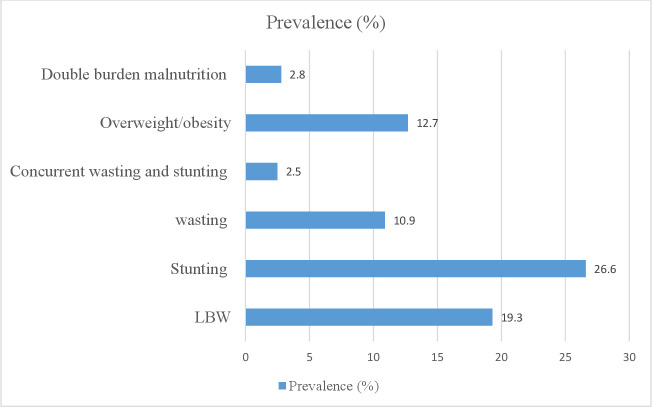
Results: A very small proportion of the newborns 2.5% (0.9% to 4.1%) were concurrently wasted and stunted. The prevalence rates of low birth weight and wasting were 20.8% (16.8% to 24.6%) and 10.9% (7.82% to 14.01%), respectively. The magnitude of overweight/obesity was 12.7% (9.3% to 15.9%) where 2.8% (1.1% to 4.4%) of newborns have the double burden of malnutrition. Having a father with a primary level of education 2.82 (1.19 to 6.65) and being stunted at birth 3.17 (1.6 to 6.0) were variables that were associated with increased odds of low birth weight. The odds of being overweight/obese are significantly higher among newborns born to mothers who are urban dwellers 0.35 (0.12 to 0.99).
Conclusions: The study underscores that malnutrition is a pressing public health concern that demands due emphasis. Fathers' educational status (low level) and being stunted are associated with a high burden of low birth weight. Mothers' residency (being urban) is associated with an elevated risk of overweight/obesity among newborns. Thus, improving the health literacy of fathers and preventing stunting at birth are recommended to mitigate low birth weight.
Keywords: community child health; fetal medicine; nutritional support.
© Author(s) (or their employer(s)) 2021. Re-use permitted under CC BY-NC. No commercial re-use. See rights and permissions. Published by BMJ.
Conflict of interest statement
Competing interests: None declared.
Figures
References
-
- Ijarotimi OS. Determinants of childhood malnutrition and consequences in developing countries. Curr Nutr Rep 2013;2:129–33. 10.1007/s13668-013-0051-5 - DOI
-
- Nandy S, Irving M, Gordon D, et al. Poverty, child undernutrition and morbidity: new evidence from India. Bull World Health Organ 2005;83:210–6. doi:/S0042-96862005000300014 - PMC - PubMed
-
- United Nations Children’s Fund (UNICEF) WHO, International Bank for Reconstruction and Development/The World Bank . Levels and trends in child malnutrition: key findings of the 2020 edition of the joint child malnutrition estimates. Geneva: World Health Organization, 20202020. https://www.who.int/publications/i/item/jme-2020-edition
Publication types
MeSH terms
LinkOut - more resources
Full Text Sources
Medical
