. 2021 Nov 5;11(1):564.
doi: 10.1038/s41398-021-01642-x.

Assigning the right credit to the wrong action: compulsivity in the general population is associated with augmented outcome-irrelevant value-based learning

Collaborators, Affiliations

Assigning the right credit to the wrong action: compulsivity in the general population is associated with augmented outcome-irrelevant value-based learning

Nitzan Shahar et al. Transl Psychiatry. .

Erratum in

Abstract

Compulsive behavior is enacted under a belief that a specific act controls the likelihood of an undesired future event. Compulsive behaviors are widespread in the general population despite having no causal relationship with events they aspire to influence. In the current study, we tested whether there is an increased tendency to assign value to aspects of a task that do not predict an outcome (i.e., outcome-irrelevant learning) among individuals with compulsive tendencies. We studied 514 healthy individuals who completed self-report compulsivity, anxiety, depression, and schizotypal measurements, and a well-established reinforcement-learning task (i.e., the two-step task). As expected, we found a positive relationship between compulsivity and outcome-irrelevant learning. Specifically, individuals who reported having stronger compulsive tendencies (e.g., washing, checking, grooming) also tended to assign value to response keys and stimuli locations that did not predict an outcome. Controlling for overall goal-directed abilities and the co-occurrence of anxious, depressive, or schizotypal tendencies did not impact these associations. These findings indicate that outcome-irrelevant learning processes may contribute to the expression of compulsivity in a general population setting. We highlight the need for future research on the formation of non-veridical action-outcome associations as a factor related to the occurrence and maintenance of compulsive behavior.


Conflict of interest statement

The authors declare no competing interests.

Figures
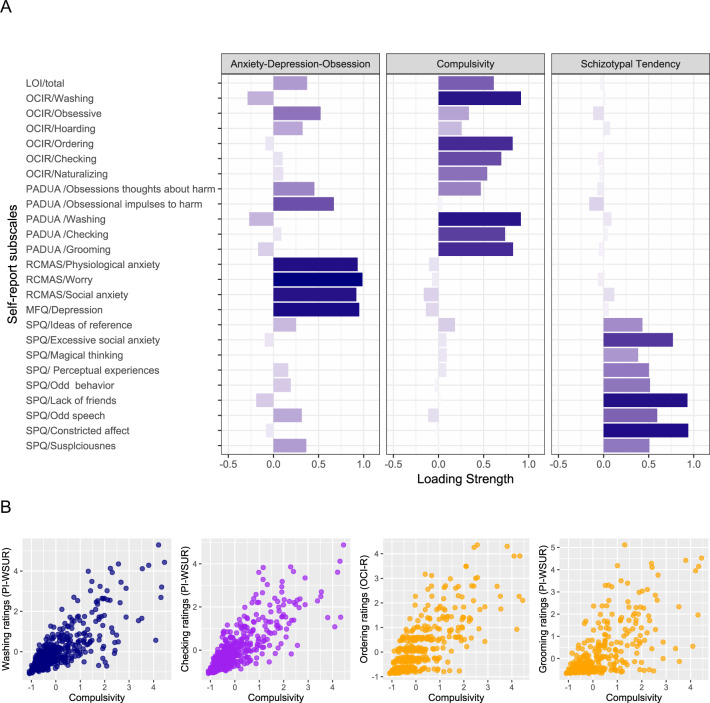
Fig. 1
Fig. 1. The three factors revealed from a dimension reduction analysis performed on self-report estimates.
A Factor loadings showed that obsessional thinking loaded primarily on the first factor, along with depression, anxiety, and worry subscales. The compulsive behavior subscale primarily loaded on the second factor, and schizotypal tendencies predominantly loaded on the third factor. B Illustration of the association between the compulsive factor and individual items from the self-report measures. The x axis on all four scatter plots indicates the latent score for each individual on the compulsivity factor. The y axis illustrates the subscale score of a single estimate including (from left to right): (I) Compulsive washing (the average rating across the ten items of the washing subscale in the PI-WSUR questionnaire; an example item is, “I wash my hands more often and longer than necessary.”). (II) Compulsive checking (the average rating across the ten items of the checking subscale in the PI-WSUR questionnaire; an example item is, “I tend to keep on checking things more often than necessary”). (III) Compulsive ordering behavior (the average rating across the three items of the ordering subscale in the OCI-R questionnaire; an example item is, “I get upset if objects are not arranged properly”). (IV) Compulsive dressing/grooming (the average rating across the three items of the grooming subscale in the PI-WSUR questionnaire; an example item is, “I feel obliged to follow a particular order in dressing, undressing, and washing myself”).
Fig. 2
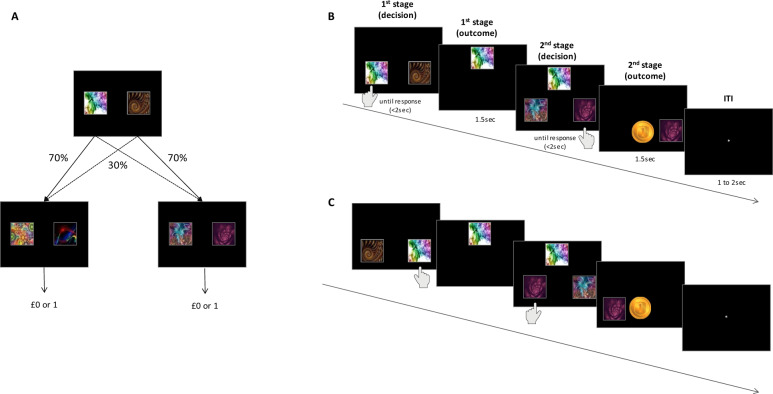
Fig. 2. Two-step task illustration.
A Participants navigated between the two stages of the task in order to reap rewards. The second stage included two pairs of fractal images, which led probabilistically to a reward. To attain these rewards, participants made choices during the first stage, which probabilistically determined the fractals presented during the second stage. B Illustration of trial sequences, showing a choice made in the first stage, followed by feedback, and a second-stage selection that was followed by a reward (1 play pound). C A fractal to response key pairing was allocated randomly in each trial. Panel (C) illustrates a trial sequence, in which the same fractals were selected as in panel (B), but now with different effectors. Although fractal identity predicted relevant outcomes (second-stage fractals, and reward), the position of the fractal and the response key used to report a selection were always outcome-irrelevant. Outcome-irrelevant learning was inferred from a participant’s tendency to assign value to response keys despite their irrelevance to any individual decision (see Fig. 3 for outcome-irrelevant estimate plots). Model-based control was estimated as the ability to select a first-stage action based on the task’s transition probability and subjective action values of second-stage fractals [14, 31] (see Supplementary Fig. S3 for model-based estimate plots).
Fig. 3
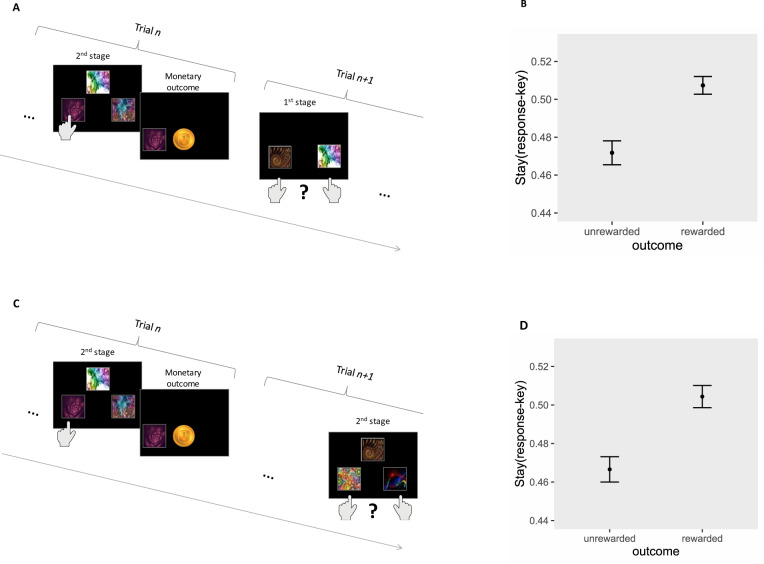
Fig. 3. Outcome-irrelevant learning.
The figure illustrates two sequential trial analyses (previously reported in Shahar et al.), demonstrating outcome-irrelevant value learning. These analyses examined a tendency to repeat a response key selection from trial n to trial n + 1, as a function of reward. A, B First-stage score—In this analysis, we show the influence of reward delivery on a tendency to re-select a response key during the first stage of the n + 1 trial, which was previously selected in the second stage of the n trial. For example, if the individual selected a fractal with a left response key press in the second stage of trial n, the left response key is more/less likely to be selected in the first stage of the following trial as a function of the reward/unrewarded outcome in trial n, respectively, as shown in panel (B). C, D Second-stage score I—In this analysis, we demonstrate the influence of reward delivery on a tendency to re-select a response key in the second stage of the n + 1 trial, which was previously selected during the second stage of the n trial. This analysis included only trials in which a different pair of fractals was offered in the n and n + 1 trial. For example, if the individual selected a fractal with a left response key press in the second stage of trial n, the left response key is more/less likely to be selected in the second stage of the following trial as a function of reward/unrewarded outcome in trial n, as shown in panel (D) (for second-stage score II, see Supplementary Iinformation).
Fig. 4
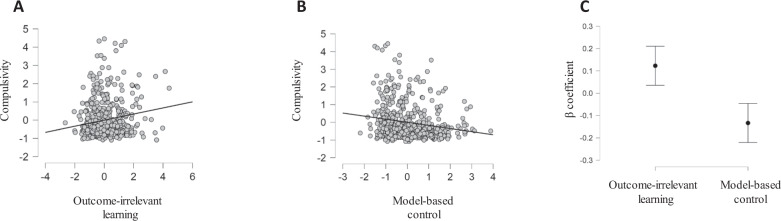
Fig. 4. Association of outcome-irrelevant learning and model-based control with compulsivity.
A Scatterplot showing the association between outcome-irrelevant learning and compulsivity. B Scatterplot showing the association between model-based control and compulsivity. C Posterior mean coefficients with 95% credible intervals taken from a Bayesian regression analysis exploring the effects of outcome-irrelevant learning and model-based control on compulsivity. Overall, the results show that outcome-irrelevant learning is positively related to compulsivity, even when controlling for the impact of model-based control (note that estimates are presented as standardized scores. Outcome-irrelevant learning estimates reflect the compound scores across five closely related task-based estimates, model-based control estimates reflect the compound scores across three closely related task-based estimates, and compulsivity reflects a factor that mainly loaded on self-report items of washing, checking, ordering, and grooming).

References

    1. Salkovskis PM. Obsessional-compulsive problems: a cognitive-behavioural analysis. Behav Res Ther. 1985;23:571–83. doi: 10.1016/0005-7967(85)90105-6. - DOI - PubMed
    1. Ruscio AM, Stein DJ, Chiu WT, Kessler RC. The epidemiology of obsessive-compulsive disorder in the National Comorbidity Survey replication. Mol Psychiatry. 2010;15:53–63. doi: 10.1038/mp.2008.94. - DOI - PMC - PubMed
    1. Torres AR, Fontenelle LF, Shavitt RG, Hoexter MQ, Pittenger C, Miguel EC. Epidemiology, comorbidity, and burden of OCD. Oxford University Press. https://oxfordmedicine.com/view/10.1093/med/9780190228163.001.0001/med-9.... Accessed 13 Dec 2019. - DOI
    1. American Psychiatry Association. Diagnostic and Statistical Manual of Mental Disorders (DSM-5®). Washington, DC: Author, 2013.
    1. Goods NAR, Rees CS, Egan SJ, Kane RT. The relationship between magical thinking, inferential confusion and obsessive–compulsive symptoms. Cogn Behav Ther. 2014;43:342–50. doi: 10.1080/16506073.2014.941393. - DOI - PubMed

Publication types