. 2022 Mar;33(1):66-80.
doi: 10.1007/s00335-021-09932-x. Epub 2021 Nov 5.

The Rat Genome Database (RGD) facilitates genomic and phenotypic data integration across multiple species for biomedical research

Affiliations

The Rat Genome Database (RGD) facilitates genomic and phenotypic data integration across multiple species for biomedical research

M L Kaldunski et al. Mamm Genome. 2022 Mar.

Abstract

Model organism research is essential for discovering the mechanisms of human diseases by defining biologically meaningful gene to disease relationships. The Rat Genome Database (RGD, ( https://rgd.mcw.edu )) is a cross-species knowledgebase and the premier online resource for rat genetic and physiologic data. This rich resource is enhanced by the inclusion and integration of comparative data for human and mouse, as well as other human disease models including chinchilla, dog, bonobo, pig, 13-lined ground squirrel, green monkey, and naked mole-rat. Functional information has been added to records via the assignment of annotations based on sequence similarity to human, rat, and mouse genes. RGD has also imported well-supported cross-species data from external resources. To enable use of these data, RGD has developed a robust infrastructure of standardized ontologies, data formats, and disease- and species-centric portals, complemented with a suite of innovative tools for discovery and analysis. Using examples of single-gene and polygenic human diseases, we illustrate how data from multiple species can help to identify or confirm a gene as involved in a disease and to identify model organisms that can be studied to understand the pathophysiology of a gene or pathway. The ultimate aim of this report is to demonstrate the utility of RGD not only as the core resource for the rat research community but also as a source of bioinformatic tools to support a wider audience, empowering the search for appropriate models for human afflictions.


Conflict of interest statement

On behalf of all authors, the corresponding author states that there is no conflict of interest.

Figures
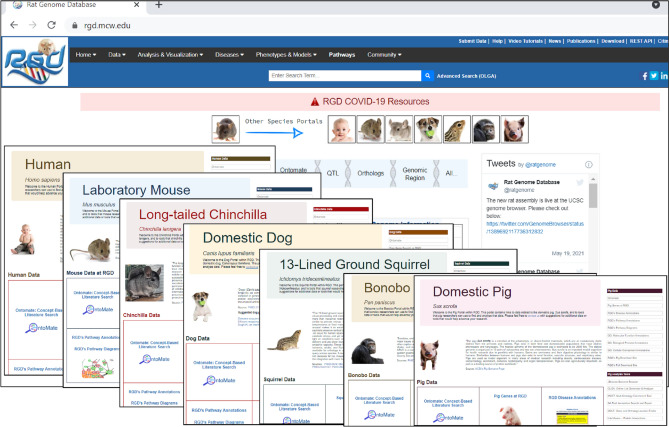
Fig. 1
Fig. 1
Species-specific landing pages: the RGD homepage offers links to species-centric portals, which provide consolidated access to data and tools
Fig. 2
Fig. 2
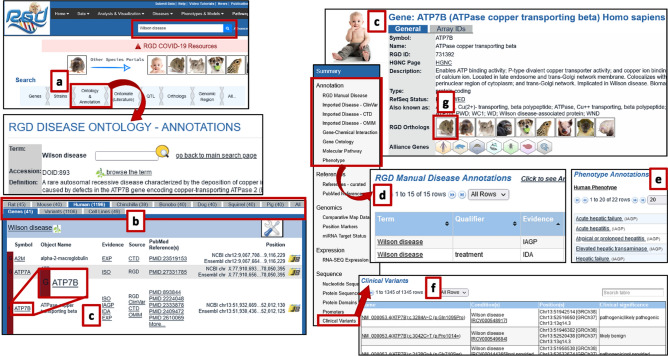
Integrated phenotypic and genotypic data annotations for human Wilson disease: a RGD’s general search bar or Ontology & Annotation search finds disease data; b ontology report page for Wilson disease contains data for all of RGD’s species; c selecting Human in the species list opens Wilson disease annotated genes, and the human ATP7B gene symbol links to the gene report page; d annotations to Wilson disease found on the gene report page; e phenotype annotations; f clinical variants; and g clickable icons for finding the gene report page for other species such as mouse
Fig. 3
Fig. 3
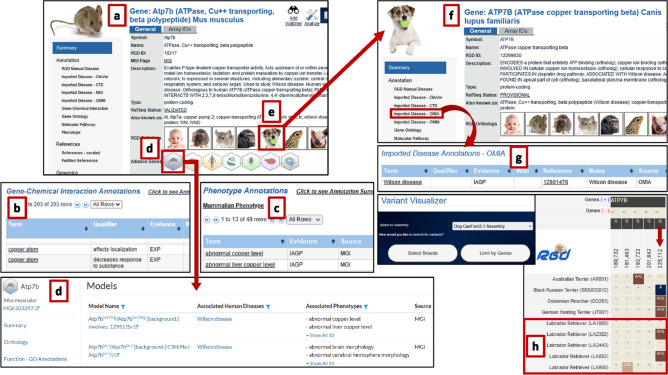
Multispecies data identify multiple Atp7b models for Wilson disease: a the mouse gene report page provides access to annotations such as b ChEBI gene–chemical interactions, c phenotype annotations; d external links to Alliance of Genome Resources website; e multispecies links such as the dog icon that will open the f gene report page for dog, which shows g manually curated annotations imported from OMIA; and h RGD’s Variant Visualizer tool with data for an extensive list of breeds, some of which have possibly damaging variants and have been shown to develop Wilson disease
Fig. 4
Fig. 4
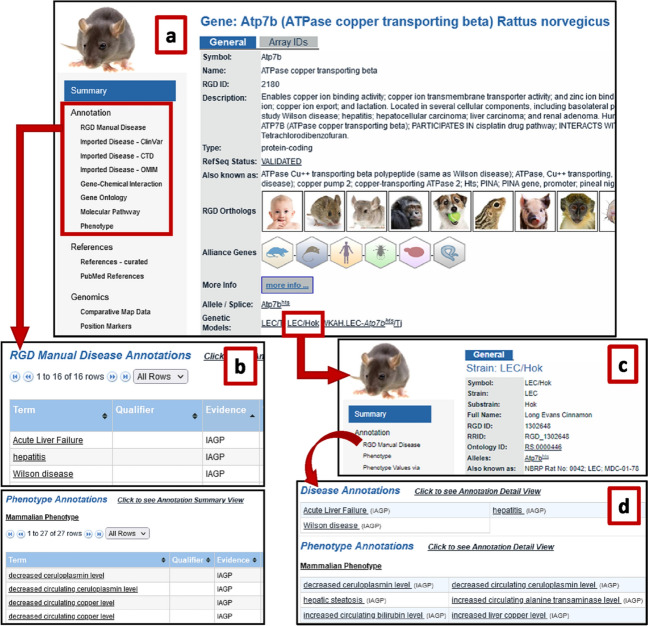
A spontaneous mutation in the LEC/Hok rat makes the strain a model for Wilson disease: a the gene report page for Atp7b in rat; b manual disease annotations for the gene; c. phenotype annotations for the gene; c genetic rat model with a mutation in Atp7b; and its d disease and phenotype annotations
Fig. 5
Fig. 5
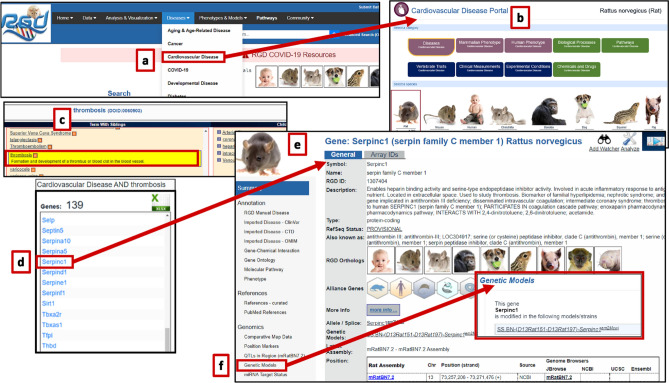
Cardiovascular Disease Portal page for data linking Serpinc1 to thrombosis in multiple species: a Main menu Diseases and b the subsequent Cardiovascular Disease Portal; c disease ontology is used to narrow the disease term to thrombosis; d a more focused disease term results in a shorter list of 139 genes in rat, and Serpinc1 is selected; e the gene symbol is a link that opens the report page for that gene in the selected species; f the rat gene report page also provides information for Genetic Models, including in this case SS.BN-(D13Rat151-D13Rat197)-Serpinc1em2Mcwi (RGD:12,790,721). For more detailed steps, see Online Resource 1
Fig. 6
Fig. 6
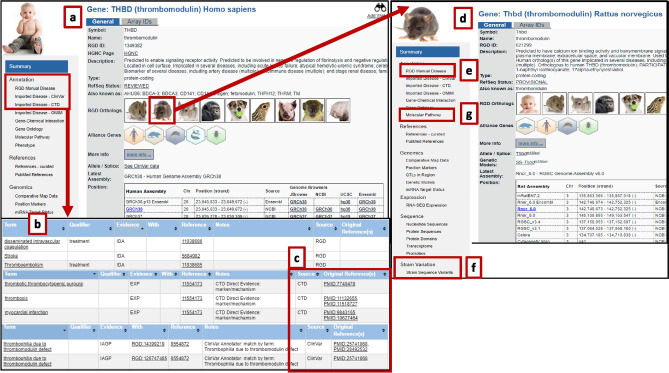
Cardiovascular disease portal page used to find data linking THBD to thrombosis in multiple species: a The human thrombomodulin (THBD) gene page shows b manually curated and imported annotations; c links to the original publications/originating databases; d selecting the rat species icon will open the gene page for rat with; e manual disease annotations; f gene variations in rat strains; and g molecular pathway annotations and links to the Pathway Ontology. For more detailed steps, see Online Resource 2
Fig. 7
Fig. 7
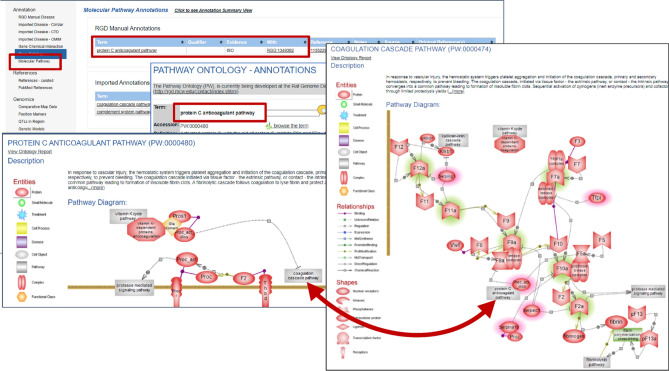
Molecular pathway annotations and interactive pathway diagrams for Serpinc1 and Thbd: Molecular Pathway Annotations are clickable links that open the Pathway Ontology—Annotations page, from which one can open the protein C anticoagulant pathway and the coagulation cascade pathway diagram. The two pathways are bidirectionally linked
Fig. 8
Fig. 8
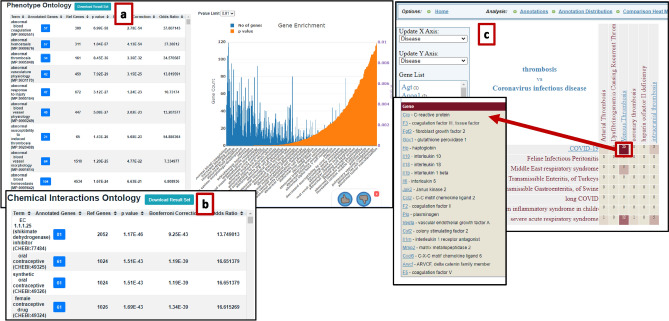
Using functional analysis tools from the RGD toolkit to interrogate the thrombosis gene list: Within the Cardiovascular Disease Portal, with the specific disease selection for thrombosis, one finds 139 genes annotated in rat, as detailed in Fig. 5 and Online Resource 1. a Selecting “mouse” and choosing “MP: Phenotype Ontology” enrichment launches an analysis that utilizes MOET; b selecting “rat” and “CHEBI: Chemical/Drug Enrichment” alters the results accordingly; c downloading the gene list into Excel and entering it into the Gene Annotator (GA) Tool will return all annotations in any ontology selected and provide a feature of the GA tool that can generate a comparative heatmap of the genes in the intersections between and within ontologies. Here, we show the resultant heatmap of genes for the intersection of disease ontology child terms for thrombosis and Coronavirus infectious disease. For more detailed steps, see Online Resource 3

References

    1. Abu-Farha M, Al-Sabah S, Hammad MM, Hebbar P, Channanath AM, John SE, Taher I, Almaeen A, Ghazy A, Mohammad A, Abubaker J, Arefanian H, Al-Mulla F, Thanaraj TA. Prognostic genetic markers for thrombosis in COVID-19 patients: a focused analysis on D-dimer, homocysteine and thromboembolism. Front Pharmacol. 2020;11:587451. - PMC - PubMed
    1. Aitman TJ, Critser JK, Cuppen E, Dominiczak A, Fernandez-Suarez XM, Flint J, Gauguier D, Geurts AM, Gould M, Harris PC, Holmdahl R, Hubner N, Izsvak Z, Jacob HJ, Kuramoto T, Kwitek AE, Marrone A, Mashimo T, Moreno C, Mullins J, Mullins L, Olsson T, Pravenec M, Riley L, Saar K, Serikawa T, Shull JD, Szpirer C, Twigger SN, Voigt B, Worley K. Progress and prospects in rat genetics: a community view. Nat Genet. 2008;40:516–522. - PubMed
    1. Alliance of Genome Resources Consortium Alliance of genome resources portal: unified model organism research platform. Nucleic Acids Res. 2020;48:D650–d658. - PMC - PubMed
    1. Amberger JS, Bocchini CA, Schiettecatte F, Scott AF, Hamosh A. OMIM.org: Online Mendelian Inheritance in Man (OMIM(R)), an online catalog of human genes and genetic disorders. Nucleic Acids Res. 2015;43:D789–798. - PMC - PubMed
    1. Andres-Leon E, Gonzalez Pena D, Gomez-Lopez G, Pisano DG (2015) miRGate: a curated database of human, mouse and rat miRNA-mRNA targets. Database 2015:bav035 - PMC - PubMed

Publication types

LinkOut - more resources