


Comprehensive insight into triclosan-from widespread occurrence to health outcomes
- PMID: 34741734
- PMCID: PMC8571676
- DOI: 10.1007/s11356-021-17273-0
Comprehensive insight into triclosan-from widespread occurrence to health outcomes
Abstract
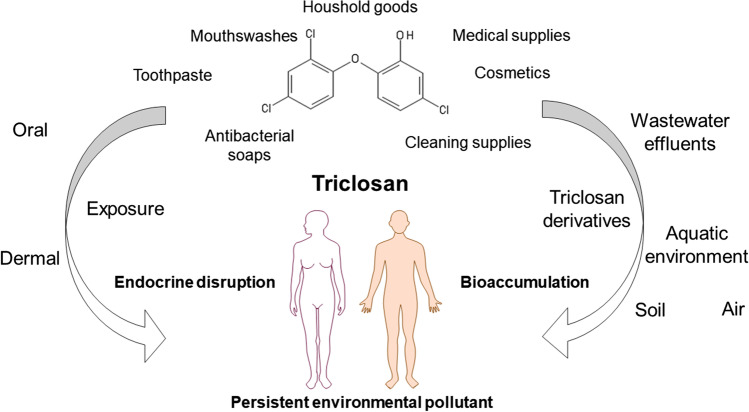
Humans are exposed to the variety of emerging environmental pollutant in everyday life. The special concern is paid to endocrine disrupting chemicals especially to triclosan which could interfere with normal hormonal functions. Triclosan could be found in numerous commercial products such as mouthwashes, toothpastes and disinfectants due to its antibacterial and antifungal effects. Considering the excessive use and disposal, wastewaters are recognized as the main source of triclosan in the aquatic environment. As a result of the incomplete removal, triclosan residues reach surface water and even groundwater. Triclosan has potential to accumulate in sediment and aquatic organisms. Therefore, the detectable concentrations of triclosan in various environmental and biological matrices emerged concerns about the potential toxicity. Triclosan impairs thyroid homeostasis and could be associated with neurodevelopment impairment, metabolic disorders, cardiotoxicity and the increased cancer risk. The growing resistance of the vast groups of bacteria, the evidenced toxicity on different aquatic organisms, its adverse health effects observed in vitro, in vivo as well as the available epidemiological studies suggest that further efforts to monitor triclosan toxicity at environmental levels are necessary. The safety precaution measures and full commitment to proper legislation in compliance with the environmental protection are needed in order to obtain triclosan good ecological status. This paper is an overview of the possible negative triclosan effects on human health. Sources of exposure to triclosan, methods and levels of detection in aquatic environment are also discussed.
Keywords: Adverse health effects; Antimicrobial agent; Emerging environmental pollutant; Endocrine disrupting chemical; Environmental pollution; Personal care product; Triclosan.
© 2021. The Author(s), under exclusive licence to Springer-Verlag GmbH Germany, part of Springer Nature.
Conflict of interest statement
The authors declare no competing interests.
Figures
References
-
- Abd-Elhakim YM, Mohammed AT, Ali HA (2018) Impact of subchronic exposure to triclosan and/or fluoride on estrogenic activity in immature female rats: the expression pattern of calbindin-D9k and estrogen receptor α genes. J Biochem Mol Toxicol 32(2). 10.1002/jbt.22027 - PubMed
-
- Adithya S, Jayaraman RS, Krishnan A, Malolan R, Gopinath KP, Arun J, Kim W, Govarthanan M. A critical review on the formation, fate and degradation of the persistent organic pollutant hexachlorocyclohexane in water systems and waste streams. Chemosphere. 2021;271:129866. doi: 10.1016/j.chemosphere.2021.129866. - DOI - PubMed
Publication types
MeSH terms
Substances
LinkOut - more resources
Full Text Sources
