


Identifying Novel Causes of Cancers to Enhance Cancer Prevention: New Strategies Are Needed
- PMID: 34743211
- PMCID: PMC8902436
- DOI: 10.1093/jnci/djab204
Identifying Novel Causes of Cancers to Enhance Cancer Prevention: New Strategies Are Needed
Abstract
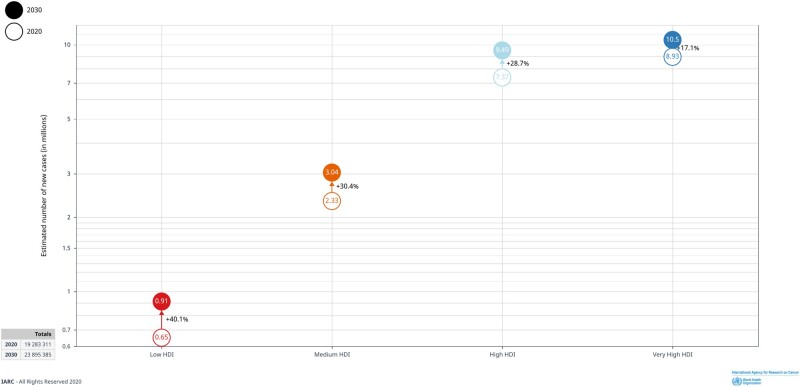
The burden of cancer from a clinical, societal, and economic viewpoint continues to increase in all parts of the world, along with much debate regarding how to confront this. Projected increases in cancer indicate a 50% increase in the number of cases over the next 2 decades, with the greatest proportional increase in low- and medium-income settings. In contrast to the historic high cancer burden due to viral and bacterial infections in these regions, future increases are expected to be due to cancers linked to westernization including breast, colorectum, lung, and prostate cancer. Identifying the reasons underlying these increases will be paramount to informing prevention efforts. Evidence from epidemiological and laboratory studies conducted in high-income countries over the last 70 years has led to the conclusion that approximately 40% of the cancer burden is explained by known risk factors-the 2 most important being tobacco and obesity in that order-raising the question of what is driving the rest of the cancer burden. International cancer statistics continue to show that approximately 80% of the cancer burden in high-income countries could be preventable in principle, implying that there are important environmental or lifestyle risk factors for cancer that have not yet been discovered. Emerging genomic evidence from population and experimental studies points to an important role for nonmutagenic promoters in driving cancer incidence rates. New research strategies and infrastructures that combine population-based and laboratory research at a global level are required to break this deadlock.
© The Author(s) 2021. Published by Oxford University Press.
Figures
References
-
- Bray F, Ferlay J, Soerjomataram I, et al.Global cancer statistics 2018: GLOBOCAN estimates of incidence and mortality worldwide for 36 cancers in 185 countries. CA Cancer J Clin. 2018;68(6):394–424. - PubMed
-
- Bray FC, Mery L, Piñeros M, Znaor A, Zanetti R, Ferlay J.. Cancer Incidence in Five Continents, Vol. XI. https://ci5.iarc.fr. Published 2017. Accessed October 1, 2021.
-
- Parkin DM, Khlat M.. Studies of cancer in migrants: rationale and methodology. Eur J Cancer. 1996;32a(5):761–771. - PubMed
-
- Ferlay J, Laversanne M, Ervik M, et al.Global Cancer Observatory: Cancer Tomorrow. Lyon, France: International Agency for Research on Cancer; 2020. https://gco.iarc.fr/tomorrow. Accessed October 27, 2021.
MeSH terms
Grants and funding
LinkOut - more resources
Full Text Sources
Medical
