


Management of initial carious lesions of hypomineralized molars (MIH) with silver diamine fluoride or silver-modified atraumatic restorative treatment (SMART): 1-year results of a prospective, randomized clinical trial
- PMID: 34743243
- PMCID: PMC8572062
- DOI: 10.1007/s00784-021-04236-5
Management of initial carious lesions of hypomineralized molars (MIH) with silver diamine fluoride or silver-modified atraumatic restorative treatment (SMART): 1-year results of a prospective, randomized clinical trial
Abstract
Objectives: This study evaluated and compared the effect of silver diamine fluoride (SDF) and silver-modified atraumatic restorative treatment (SMART) sealants for the treatment of initial carious lesions of permanent molars affected by molar incisor hypomineralization (MIH).
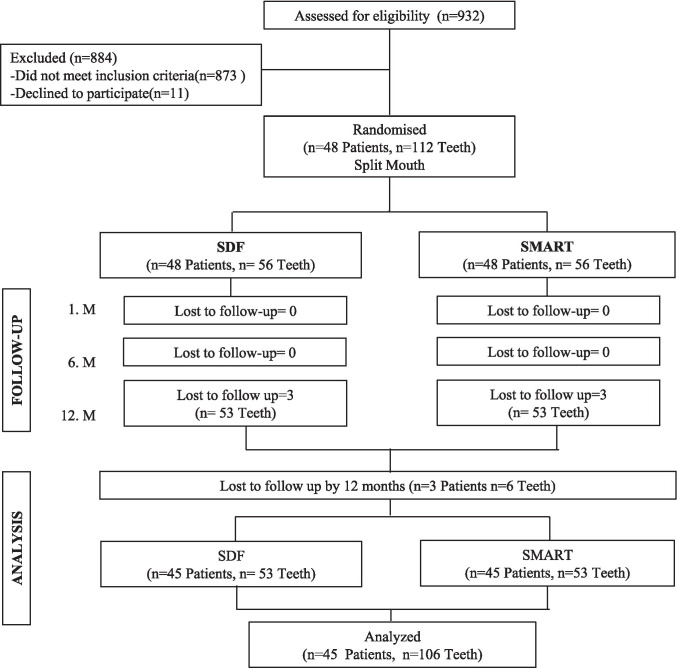
Methods: One hundred and twelve hypomineralized permanent molars with ICDAS 1 or 2 lesions were selected in 48 children. The teeth were randomized into SDF and SMART sealant groups (n = 56 teeth/group) in a split-mouth fashion. Hypersensitivity, formation of caries, and enamel breakdown were evaluated in both groups. Hypersensitivity was assessed by Schiff Cold Air Sensitivity Scale (SCASS), and clinical assessments of SMART sealants were performed according to modified USPHS criteria at 1, 6, and 12 months. The data were analyzed statistically using Fisher's exact test, Kaplan-Meier analysis, Mann-Whitney U test, and Friedman test.
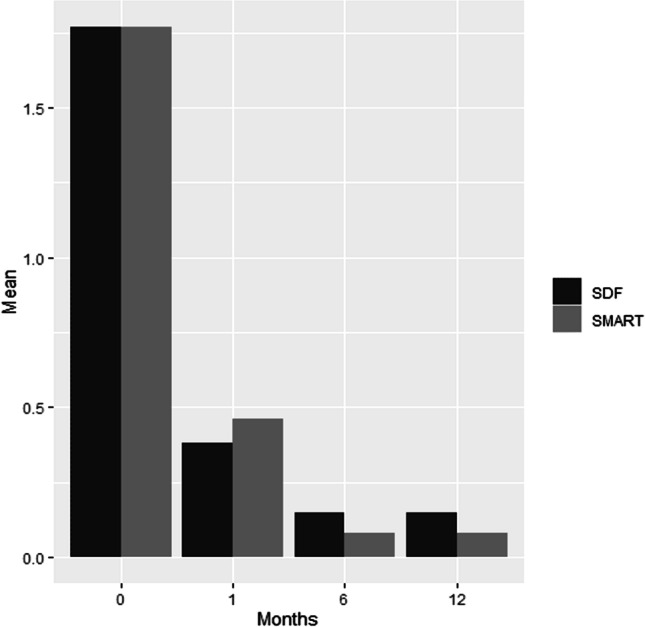
Results: Twenty-six hypomineralized molars with marked baseline hypersensitivity showed significantly lower SCASS scores at all evaluation periods (p < 0.001). There was no significant difference in hypersensitivity scores between the groups at the repeated applications of SDF at 1, 6, and 12 months. The cumulative survival rates of SMART sealants on occlusal and palatal surfaces were 88.7% and 58.8%, respectively.
Conclusions: In hypomineralized molars, both SDF and SMART sealants showed favorable short-term prevention against dental caries while providing effective desensitization. Marginal discoloration was the most common side effect of the SMART sealants as a result of SDF application.
Clinical significance: Both SDF and SMART sealants showed similar short-term effectiveness as non-aerosol procedures in arresting enamel caries and reducing hypersensitivity in hypomineralized molars.
Trial registration: Clinical Trials Registration Number: NCT03862014.
Keywords: Clinical trials; Dental caries; Molar incisor hypomineralization; Prevention; Silver diamine fluoride.
© 2021. The Author(s), under exclusive licence to Springer-Verlag GmbH Germany, part of Springer Nature.
Conflict of interest statement
The authors declare no competing interests.
Figures
References
-
- Weerheijm KL. Molar incisor hypomineralisation (MIH) Eur J Paediatr Dent. 2003;4:115–120. - PubMed
-
- Weerheijm KL, Duggal M, Mejare I, Papagiannoulis L, Koch G, Martens LC, Hallonsten AL. Judgement criteria for molar incisor hypomineralisation (MIH) in epidemiologic studies: a summary of the European meeting on MIH held in Athens, 2003. Eur J Paediatr Dent. 2003;4:110–113. - PubMed
-
- Da Costa-Silva CM, Ambrosano GM, Jeremias F, De Souza JF, Mialhe FL. Increase in severity of molar–incisor hypomineralization and its relationship with the colour of enamel opacity: a prospective cohort study. Int J Paediatr Dent. 2011;21:333–341. doi: 10.1111/j.1365-263X.2011.01128.x. - DOI - PubMed
Publication types
MeSH terms
Substances
Associated data
LinkOut - more resources
Full Text Sources
Medical
