. 2022 Jan;247(2):152-164.
doi: 10.1177/15353702211046927. Epub 2021 Nov 7.

Management of altered metabolic activity in Drosophila model of Huntington's disease by curcumin

Affiliations

Management of altered metabolic activity in Drosophila model of Huntington's disease by curcumin

Kumari Aditi et al. Exp Biol Med (Maywood). 2022 Jan.

Abstract

Huntington's disease (HD) is a devastating polyglutamine disorder characterized by extensive neurodegeneration and metabolic abnormalities at systemic, cellular and intracellular levels. Metabolic alterations in HD manifest as abnormal body weight, dysregulated biomolecule levels, impaired adipocyte functions, and defective energy state which exacerbate disease progression and pose acute threat to the health of challenged individuals in form of insulin resistance, cardiovascular disease, and energy crisis. To colossally mitigate disease symptoms, we tested the efficacy of curcumin in Drosophila model of HD. Curcumin is the bioactive component of turmeric (Curcuma longa Linn), well-known for its ability to modulate metabolic activities. We found that curcumin effectively managed abnormal body weight, dysregulated lipid content, and carbohydrate level in HD flies. In addition, curcumin administration lowered elevated reactive-oxygen-species levels in adult adipose tissue of diseased flies, and improved survival and locomotor function in HD flies at advanced disease stage. Altogether, these findings clearly suggest that curcumin efficiently attenuates metabolic derangements in HD flies and can prove beneficial in alleviating the complexities associated with HD.

Keywords: Body weight; Huntington’s disease; curcumin; lipid metabolism; neurodegenerative disease; reactive-oxygen-species.


Conflict of interest statement

DECLARATION OF CONFLICTING INTERESTS: The author(s) declared no potential conflicts of interest with respect to the research, authorship, and/or publication of this article.

Figures

Figure 1.
Figure 1.
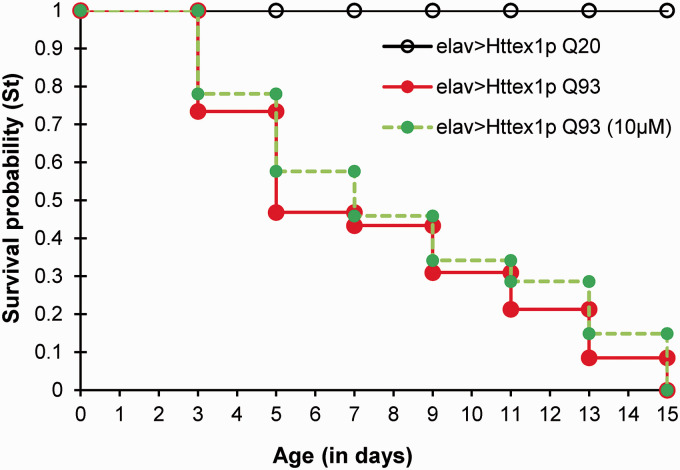
Curcumin slightly extends median survival in HD flies. Survival probability of flies with unexpanded (elav>Httex1p Q20) and expanded glutamine repeats (elav>Httex1pQ93) fed without and with 10 µM concentration of curcumin from larval stages. Slight but notable improvement was observed in the median survival time of 10 µM curcumin-fed diseased flies, as compared to the unfed controls. Median survival (50%) is ∼5 days for elav>Httex1pQ93 which increased upto ∼7 days for 10 µM curcumin-fed diseased flies. Interestingly, 75% death time for diseased condition is just ∼11 days whereas it extends upto ∼13 days for 10 µM curcumin-fed diseased flies. Survival data was analyzed using Kaplan-Meier method followed by log-rank test [elav>Httex1p Q93 vs. elav>Httex1p Q93 (10 µM), P =0.3049]. For each condition, n = 100 (20 flies/replicate, 5 replicates/condition). (A color version of this figure is available in the online journal.)
Figure 2.
Figure 2.
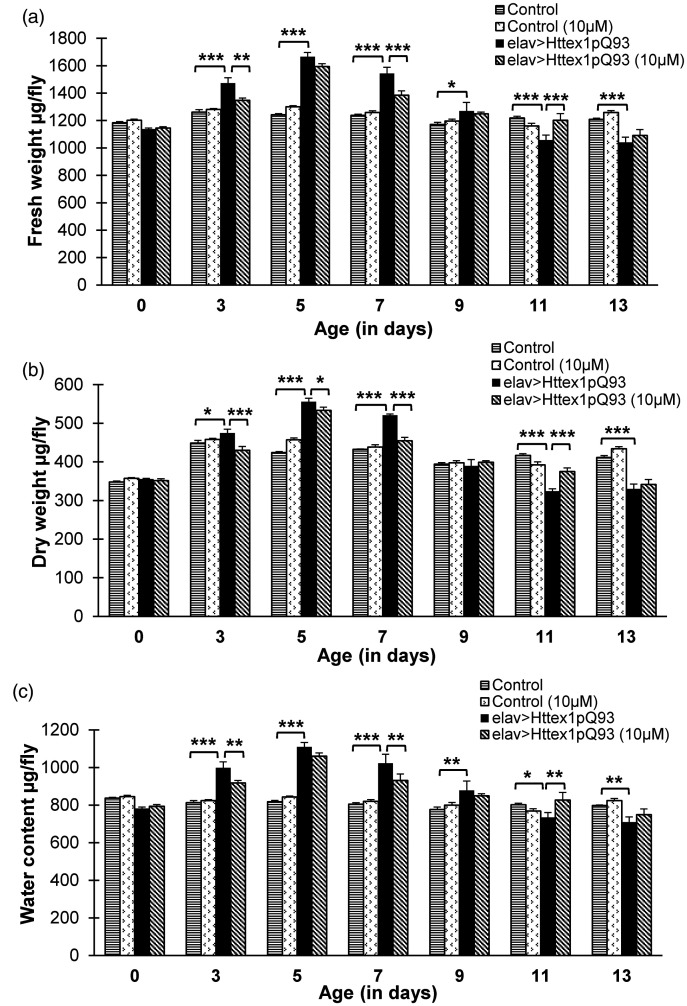
Dietary curcumin modulates body weight, dry mass, and water content. Curcumin administration significantly regulates abnormally high and low body weight (a) at day 3, 7, and 11 (b) dry mass at day 3, 5, and 7 in diseased flies (c) dysregulated water content is managed at day 3, 7, and 13 in diseased flies upon curcumin feeding. Data was analyzed using multi-factor ANOVA followed by Tukey HSD post hoc test and Test of Simple Effects. Values are represented as mean ± S.E.M. Tukey HSDα0.05, *** P < 0.001; ** P < 0.01; * P <0.05. For each condition, n =50 (10 flies/replicate, 5 replicates/condition).
Figure 3.
Figure 3.
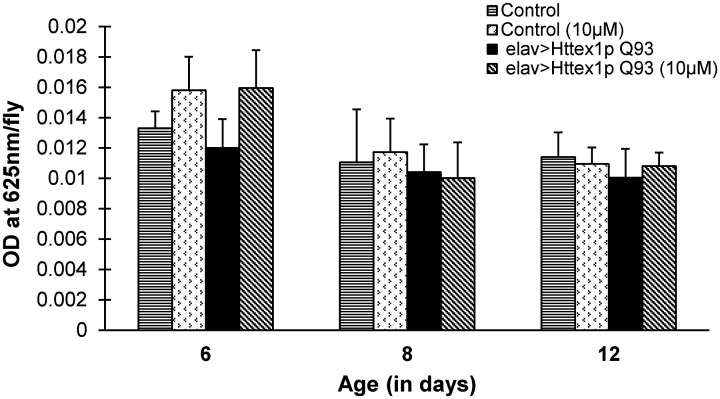
Feeding behavior of HD flies remain unchanged by curcumin supplementation in the food. Feeding of control (elav>Httex1p Q20) and diseased (elav>Httex1p Q93) female adult flies reared on control or 10 µM curcumin supplemented diet was measured using colorimetric dye intake assay. No difference was observed in food intake of 6-, 8-, and 12-day-old control and diseased females supplemented without or with effective concentration of curcumin. Data was analyzed using multi-factor ANOVA, F2, 36 = 0.110, P =0.896. Values are represented as mean ± S.E.M and for each group, n =20 flies (10 flies/replicate, 2 replicates/condition).
Figure 4.
Figure 4.
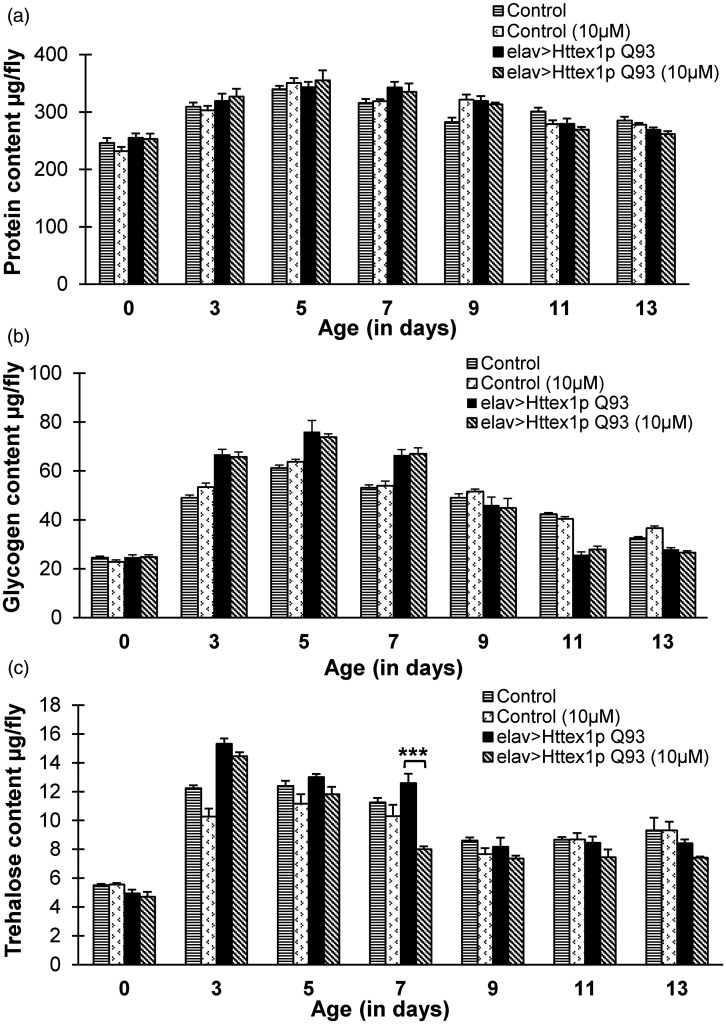
Curcumin regulates circulating sugar trehalose in diseased flies. There is no notable effect of curcumin on the levels of (a) protein and (b) glycogen in HD flies. On the contrary, (c) significant reduction in otherwise increased levels of circulating sugar trehalose is observed in curcumin-fed diseased flies at day 7. Data was analyzed using multi-factor ANOVA followed by Tukey HSD post hoc test and Test of Simple Effects. Values are represented as mean ± S.E.M. Tukey HSDα0.05, *** P < 0.001; ** P < 0.01; * P <0.05. For each condition, n =20 (4 flies/replicate, 5 replicates/condition) for protein, glycogen, and trehalose content quantification.
Figure 5.
Figure 5.
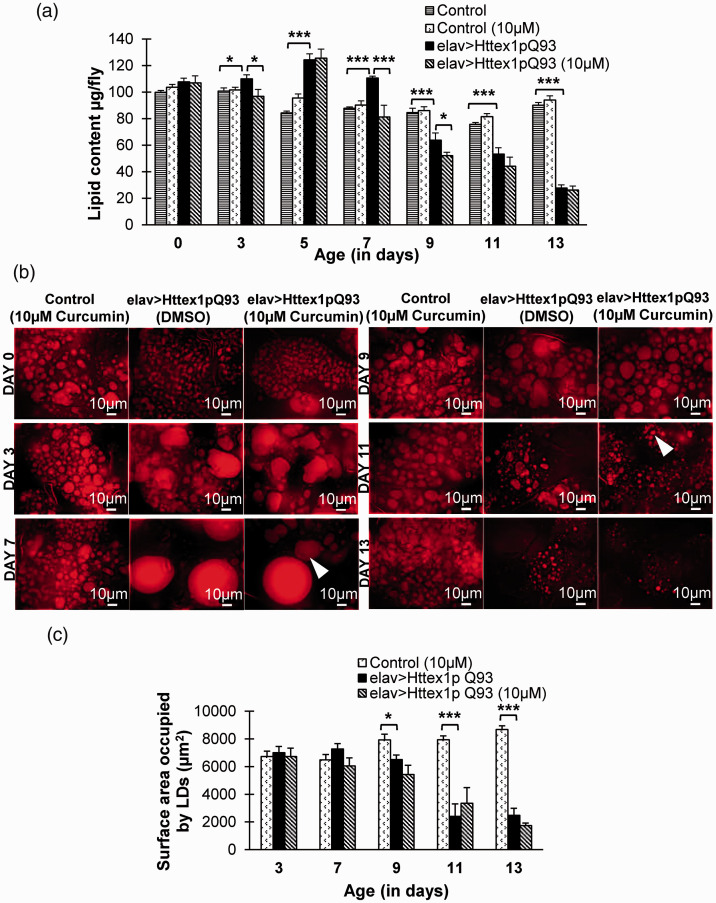
Curcumin modulates total lipid content. (a) Dietary curcumin significantly decreases abnormally high lipid levels in diseased flies at day 3 and 7 which becomes comparable to those of age-matched flies with unexpanded glutamines. However, the lipid levels further decline significantly at day 9 in curcumin-fed diseased flies. (b) At sub-cellular level, curcumin intake improves distribution of intracellular lipid in lipid droplets (LDs) in abdominal adipose tissue of diseased flies at day 7 and 11. Arrowheads indicate presence of smaller LDs at day 7 and moderately improved LD distribution at day 11. Scale bar represents 10 µm. (c) Quantification of total surface area occupied by LDs suggests a considerable reduction in bigger LDs at day 7 and subsequent improvement in distribution at day 11 by curcumin intake. Lipid content data was analyzed using multi-factor ANOVA followed by Tukey HSD post hoc test and Test of Simple Effects and LD quantification were analyzed using two-way ANOVA. Values are represented as mean ± S.E.M. Tukey HSDα0.05, *** P < 0.001; ** P < 0.01; * P < 0.05. For each condition, n =50 (10 flies/replicate, 5 replicates/condition) for total lipid content and n =5 for LD quantification. (A color version of this figure is available in the online journal.)
Figure 6.
Figure 6.
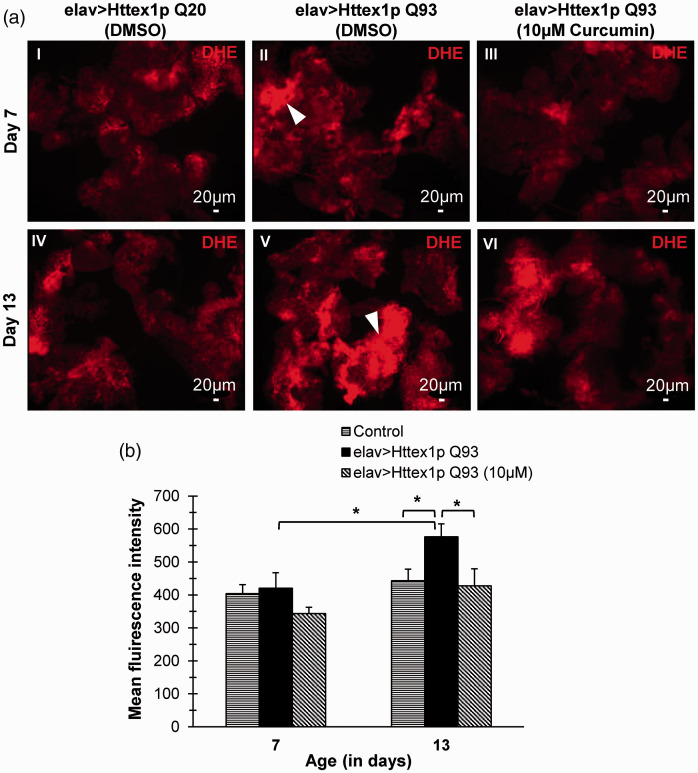
Curcumin reduces elevated ROS levels in adipose tissue of diseased flies. (a, I-VI) Evaluation of ROS production in abdominal fat body of 7- and 13-day-old control females (elav>Httex1p Q20; panels I, IV), diseased (elav>Httex1p Q93; panels II, V), and diseased flies supplemented with 10 µM curcumin (panel III, VI). Adult fat body from 7- and 13-day-old diseased condition displayed increased levels of ROS as compared to age-matched control flies. Interestingly, curcumin intake in diseased condition suppressed elevated levels of ROS in diseased condition. Arrowheads show areas in adult fat body producing higher ROS levels than neighboring cells. Red = dihydroethidium (DHE), scale bars represent 20 µm. (b) Quantification of mean fluorescence intensity of DHE staining in adult fat body of 7- and 13-day-old control, diseased and curcumin-fed flies revealed significant increase in ROS intensity in day 13 diseased condition as compared to day 7 diseased or age-matched control flies. Furthermore, there was a significant effect of curcumin treatment on ROS intensity levels (F1, 24 = 8.782, P =0.007). Curcumin feeding results in significant decrease in elevated ROS levels in day 13 old diseased flies which becomes comparable to those of age-matched control flies. Data was analyzed using two-way ANOVA followed by Tukey HSD post hoc test. Values are represented as mean ± S.E.M. Tukey HSDα0.05, **P <0.01. For each condition, n =7 female flies. (A color version of this figure is available in the online journal.)
Figure 7.
Figure 7.
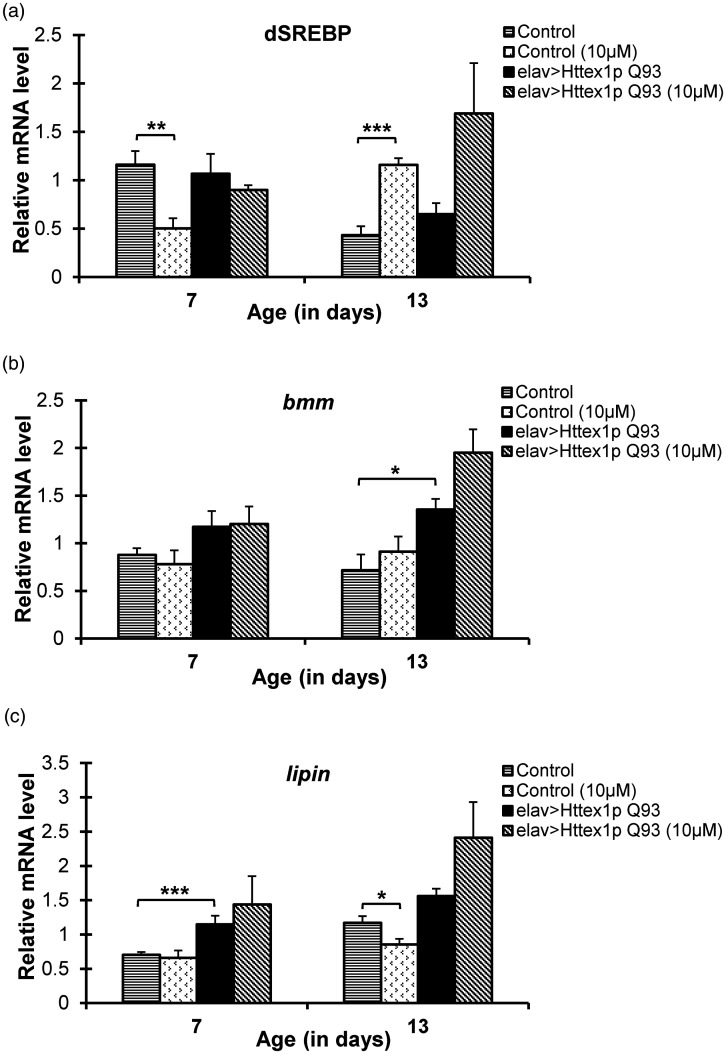
dSREBP, bmm, and lipin expression remain unmodulated in HD flies upon curcumin supplementation. (a) dSREBP or HLH106 mRNA levels in 7- and 13-day-old control (elav>Httex1p Q20) and diseased (elav>Httex1p Q93) flies reared on control or 10 µM curcumin supplemented diet was monitored using quantitative RT-PCR. Control flies exhibited significant decrease in dSREBP mRNA levels at day 7 followed by significant increase at day 13, whereas diseased flies did not display any change in the expression of dSREBP gene at both the ages without or with 10 µM curcumin supplementation. (b) bmm mRNA levels remain unchanged in 7- and 13-day-old Q20 and diseased flies reared without and with 10 µM curcumin. (c) No change in lipin mRNA levels was seen in 7- or 13-day-old diseased flies reared on 10 µM curcumin diet. Q20 flies showed significant decrease in lipin mRNA at day 13 upon curcumin feeding. Data was analyzed using Mann-Whitney U test. Values are represented as mean ± S.E.M. *** P < 0.001; ** P < 0.01. Sample size: 6 flies/replicate, 6 replicates/condition.

References

    1. The Huntington’s Disease Collaborative Research Group. A novel gene containing a trinucleotide repeat that is expanded and unstable on Huntington’s disease chromosome. Cell 1993; 72:971–83 - PubMed
    1. Sanberg PR, Fibiger HC, Mark RF. Body weight and dietary factors in Huntington’s disease patients compared with matched controls. Med J Aust 1981; 1:407–9 - PubMed
    1. Gines S, Seong IS, Fossale E, Ivanova E, Trettel F, Gusella JF, Wheeler VC, Persichetti F, MacDonald ME. Specific progressive cAMP reduction implicates energy deficit in presymptomatic Huntington's disease knock-in mice. Hum Mol Genet 2003; 12:497–508 - PubMed
    1. Björkqvist M, Petersén A, Bacos K, Isaacs J, Norlén P, Gil J, Popovic N, Sundler F, Bates GP, Tabrizi SJ, Brundin P, Mulder H. Progressive alterations in the hypothalamic-pituitary-adrenal axis in the R6/2 transgenic mouse model of Huntington’s disease. Hum Mol Genet 2006; 15:1713–21 - PubMed
    1. Popovic V, Svetel M, Djurovic M, Petrovic S, Doknic M, Pekic S, Miljic D, Milic N, Glodic J, Dieguez C, Casanueva FF, Kostic V. Circulating and cerebrospinal fluid ghrelin and leptin: potential role in altered body weight in Huntington’s disease. Eur J Endocrinol 2004; 151:451–5 - PubMed

Publication types

MeSH terms