


Intensive Care in Sub-Saharan Africa: A National Review of the Service Status in Ethiopia
- PMID: 34744155
- PMCID: PMC8986632
- DOI: 10.1213/ANE.0000000000005799
Intensive Care in Sub-Saharan Africa: A National Review of the Service Status in Ethiopia
Abstract
Background: The burden of critical illness in low-income countries is high and expected to rise. This has implications for wider public health measures including maternal mortality, deaths from communicable diseases, and the global burden of disease related to injury. There is a paucity of data pertaining to the provision of critical care in low-income countries. This study provides a review of critical care services in Ethiopia.
Methods: Multicenter structured onsite surveys incorporating face-to-face interviews, narrative discussions, and on-site assessment were conducted at intensive care units (ICUs) in September 2020 to ascertain structure, organization, workforce, resources, and service capacity. The 12 recommended variables and classification criteria of the World Federation of Societies of Intensive and Critical Care Medicine (WFSICCM) taskforce criteria were utilized to provide an overview of service and service classification.
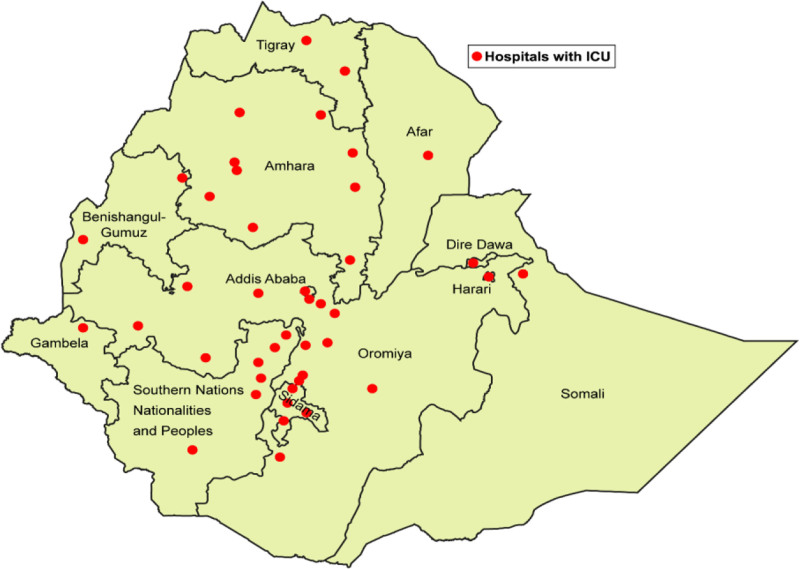
Results: A total of 51 of 53 (96%) ICUs were included, representing 324 beds, for a population of 114 million; this corresponds to approximately 0.3 public ICU beds per 100,000 population. Services were concentrated in the capital Addis Ababa with 25% of bed capacity and 51% of critical care physicians. No ICU had piped oxygen. Only 33% (106) beds had all of the 3 basic recommended noninvasive monitoring devices (sphygmomanometer, pulse oximetry, and electrocardiography). There was limited capacity for ventilation (n = 189; 58%), invasive monitoring (n = 9; 3%), and renal dialysis (n = 4; 8%). Infection prevention and control strategies were lacking.
Conclusions: This study highlights major deficiencies in quantity, distribution, organization, and provision of intensive care in Ethiopia. Improvement efforts led by the Ministry of Health with input from the acute care workforce are an urgent priority.
Copyright © 2022 The Author(s). Published by Wolters Kluwer Health, Inc. on behalf of the International Anesthesia Research Society.
Conflict of interest statement
The authors declare no conflicts of interest.
Figures
Comment in
-
The State of Critical Care Provision in Low-Resource Environments.Anesth Analg. 2022 May 1;134(5):926-929. doi: 10.1213/ANE.0000000000005885. Anesth Analg. 2022. PMID: 35427266 No abstract available.
-
Critical Care: Regionalization Is Necessary.Anesth Analg. 2022 Nov 1;135(5):e39-e40. doi: 10.1213/ANE.0000000000006199. Epub 2022 Oct 21. Anesth Analg. 2022. PMID: 36269995 No abstract available.
References
-
- FMOH. Health sector transformation plan. Addis Ababa: Federal Ministry of Health of Ethiopia, 2019. Accessed June 3, 2021. https://www.moh.gov.et/ejcc/am/node/152.
-
- Kifle F, Belihu KD, Beljege BZ, et al. . Perioperative care capacity in East Africa: results of an Ethiopian national cross-sectional survey. Int J Surg Glob Health. 2021;4:e57.
MeSH terms
Grants and funding
LinkOut - more resources
Full Text Sources
Other Literature Sources
Medical
