. 2022 Jan:115:4-13.
doi: 10.1016/j.tranpol.2021.10.022. Epub 2021 Nov 1.

Containing the spatial spread of COVID-19 through the trucking network

Affiliations

Containing the spatial spread of COVID-19 through the trucking network

Agustina Calatayud et al. Transp Policy (Oxf). 2022 Jan.

Abstract

The trucking industry is the backbone of domestic supply chains. In the context of the COVID-19 pandemic, road transportation has been essential to guarantee the supply of basic goods to confined urban areas. However, the connectivity of the trucking network can also act as an efficient virus spreader. This paper applies network science to uncover the characteristics of the trucking network in one major Latin American country -Colombia- and provides evidence on freight networks' ability to spread contagious diseases spatially. Network metrics, official COVID-19 records at the municipality level, and a zero-inflated negative binomial model are used to test the association between network topology and confirmed COVID-19 cases. Results suggest that: (i) the number of COVID-19 cases in a municipality is linked to its level and type of network centrality; and (ii) being a port-city and a primary economic hub in the trucking network is associated with a higher probability of contracting earlier a pandemic. Based on these results, a risk-based approach is proposed to help policymakers implement containment measures.

Keywords: COVID-19; Latin America; Risk management policies; Transport networks; Trucking.


Figures

Fig. 1
Fig. 1
Colombian road network.
Fig. 2
Fig. 2
Trucking network in Colombia. Notes: The nodes' size reflects the number of inbound trucks, and the size of the links represents the number of trips between pairs of nodes (i.e., weight). Colors identify the community's nodes. (For interpretation of the references to color in this figure legend, the reader is referred to the Web version of this article.)
Fig. 3
Fig. 3
Trucking network in Colombia and accumulated COVID-19 cases. Notes: The blue color intensity relates to the number of confirmed cases until May 6, 2020. Deep blue means higher number of cases, with Bogotá reporting the highest number. Node sizes are according to the number of truck trips they generate. Link size represents the number of truck trips between pairs of nodes. (For interpretation of the references to color in this figure legend, the reader is referred to the Web version of this article.)
Fig. 4
Fig. 4
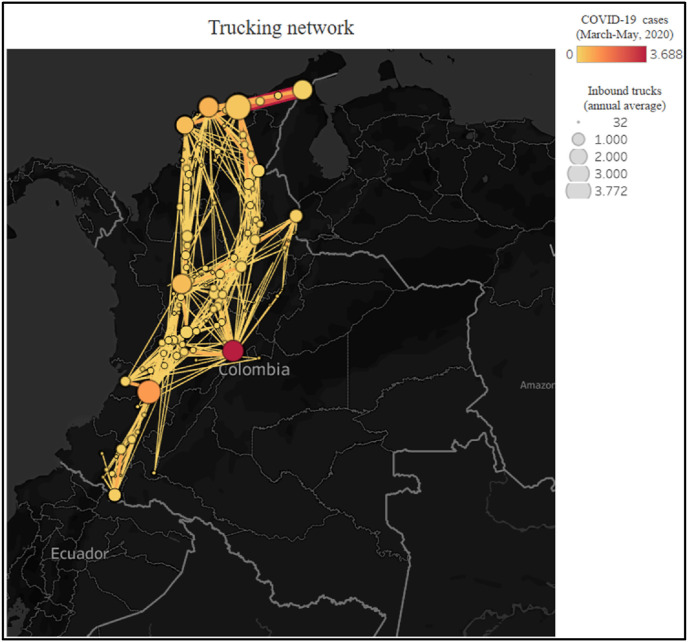
Colombia's trucking network (2010–2016, sample annual average). Notes: Nodes' size according to their total degree centrality. Links' size according to their total weight. The color intensity of the nodes corresponds to the number of COVID-19 confirmed cases; red meaning a higher number of cases. (For interpretation of the references to color in this figure legend, the reader is referred to the Web version of this article.)

References

    1. Apostolopoulos Y., Lemke M., Sönmez S. Risks endemic to long-haul trucking in North America: strategies to protect and promote driver well-being. New Solut. 2014;24(1):57–81. doi: 10.2190/NS.24.1.c. - DOI - PubMed
    1. Apostolopoulos Y., Sönmez S. Population Mobility and Infectious Disease. 2007. Population mobility and infectious disease. - DOI
    1. Apostolopoulos Y., Sönmez S., Hege A., Lemke M. Work strain, social isolation and mental health of long-haul truckers. Occup. Ther. Ment. Health. 2016;32(1):50–69. doi: 10.1080/0164212X.2015.1093995. - DOI
    1. Apostolopoulos Y., Sönmez S., Lemke M.K., Rothenberg R.B. Mapping U.S. long-haul truck drivers' multiplex networks and risk topography in inner-city neighborhoods. Health and Place. 2015 doi: 10.1016/j.healthplace.2015.03.008. - DOI - PMC - PubMed
    1. Badr H.S., Du H., Marshall M., Dong E., Squire M.M., Gardner L.M. Association between mobility patterns and COVID-19 transmission in the USA: a mathematical modelling study. Lancet Infect. Dis. 2020 doi: 10.1016/S1473-3099(20)30553-3. - DOI - PMC - PubMed

LinkOut - more resources