


Factor Structure, Validity, and Reliability of the STarT Back Screening Tool in Italian Obese and Non-obese Patients With Low Back Pain
- PMID: 34744912
- PMCID: PMC8563832
- DOI: 10.3389/fpsyg.2021.740851
Factor Structure, Validity, and Reliability of the STarT Back Screening Tool in Italian Obese and Non-obese Patients With Low Back Pain
Abstract
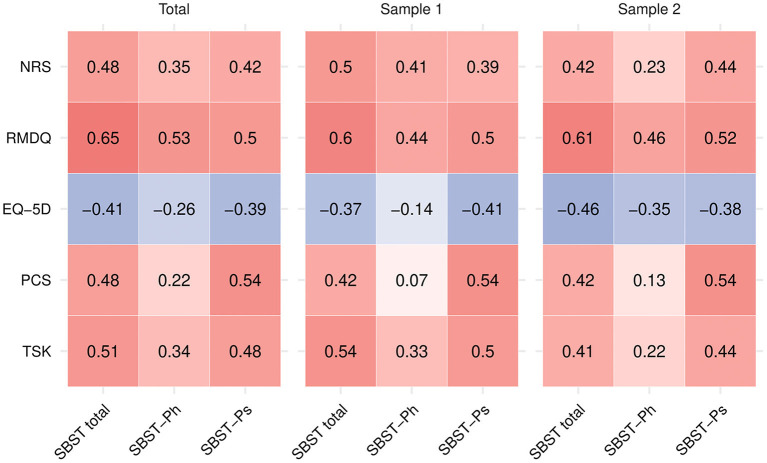
Background: The STarT Back Screening Tool (SBST) is a self-report questionnaire developed for prognostic purposes which evaluates risk factors for disability outcomes in patients with chronic low back pain. Previous studies found that its use enables to provide a cost-effective stratified care. However, its dimensionality has been assessed only using exploratory approaches, and reports on its psychometric properties are conflicting. Objective: The objective of this study was to assess the factorial structure and the psychometric properties of the Italian version of the STarT Back Screening Tool (SBST). Materials and Methods: Patients with medical diagnosis of low back pain were enrolled from a rehabilitation unit of a tertiary care hospital specialized in obesity care (Sample 1) and from a clinical internship center of an osteopathic training institute (Sample 2). At baseline and after 7 days patients were asked to fill a battery of self-report questionnaires. The factorial structure, internal consistency, test-retest reliability, and construct validity of the SBST were assessed. Results: One hundred forty-six patients were enrolled (62 from Sample 1 and 84 from Sample 2). The confirmatory factor analysis showed that the fit of the original two-correlated factors model was adequate (CFI = 0.98, TLI = 0.99, RMSEA = 0.03). Cronbach's α of the total scale (α = 0.64) and of the subscales (physical subscale α = 0.55; psychological subscale α = 0.61) was below the cutoffs, partly because of the low correlation of item 2 with the other items. Test-retest reliability was adequate (ICC = 0.84). The SBST had moderate correlations with comparisons questionnaires, except for the Roland-Morris Disability Questionnaire, which had a high correlation (r = 0.65). Discussion: The SBST has adequate psychometric properties and can be used to assess prognostic factors for disability in low back pain patients.
Keywords: STarT back screening tool; back pain; obesity; prognosis; rehabilitation; reliability; risk factors; validity.
Copyright © 2021 Giusti, Varallo, Abenavoli, Manzoni, Aletti, Capodaglio, Castelnuovo and Maggiani.
Conflict of interest statement
The authors declare that the research was conducted in the absence of any commercial or financial relationships that could be construed as a potential conflict of interest.
Figures

References
-
- Ami N. B., Weisman A., Yona T., Shashua A., Hill J., Pincus T. (2020). STarT back tool retained its predicting abilities in patients with acute and sub-acute low back pain after a transcultural adaptation and validation to Hebrew. Musculoskelet. Sci. Pract. 46:102134. 10.1016/j.msksp.2020.102134 - DOI - PubMed
-
- Castelnuovo G., Giusti E. M., Manzoni G. M., Saviola D., Gatti A., Gabrielli S., et al. (2016). Psychological considerations in the assessment and treatment of pain in neurorehabilitation and psychological factors predictive of therapeutic response: evidence and recommendations from the Italian consensus conference on pain in neurorehabilitation. Front. Psychol. 7:468. 10.3389/fpsyg.2016.00468 - DOI - PMC - PubMed
-
- Cecchi F., Negrini S., Pasquini G., Paperini A., Conti A. A., Chiti M., et al. (2012). Predictors of functional outcome in patients with chronic low back pain undergoing back school, individual physiotherapy or spinal manipulation. Eur. J. Phys. Rehabil. Med. 48, 371–378. - PubMed
LinkOut - more resources
Full Text Sources
Miscellaneous
