. 2021 Oct 21:12:747541.
doi: 10.3389/fmicb.2021.747541. eCollection 2021.

Modulating Drought Stress Response of Maize by a Synthetic Bacterial Community

Affiliations

Modulating Drought Stress Response of Maize by a Synthetic Bacterial Community

Jaderson Silveira Leite Armanhi et al. Front Microbiol. .

Abstract

Plant perception and responses to environmental stresses are known to encompass a complex set of mechanisms in which the microbiome is involved. Knowledge about plant physiological responses is therefore critical for understanding the contribution of the microbiome to plant resilience. However, as plant growth is a dynamic process, a major hurdle is to find appropriate tools to effectively measure temporal variations of different plant physiological parameters. Here, we used a non-invasive real-time phenotyping platform in a one-to-one (plant-sensors) set up to investigate the impact of a synthetic community (SynCom) harboring plant-beneficial bacteria on the physiology and response of three commercial maize hybrids to drought stress (DS). SynCom inoculation significantly reduced yield loss and modulated vital physiological traits. SynCom-inoculated plants displayed lower leaf temperature, reduced turgor loss under severe DS and a faster recovery upon rehydration, likely as a result of sap flow modulation and better water usage. Microbiome profiling revealed that SynCom bacterial members were able to robustly colonize mature plants and recruit soil/seed-borne beneficial microbes. The high-resolution temporal data allowed us to record instant plant responses to daily environmental fluctuations, thus revealing the impact of the microbiome in modulating maize physiology, resilience to drought, and crop productivity.

Keywords: PGP; SynCom; drought stress; maize; plant growth-promoting; plant microbiome; plant phenotyping; synthetic microbial community.


Conflict of interest statement

The authors declare that the research was conducted in the absence of any commercial or financial relationships that could be construed as a potential conflict of interest.

Figures
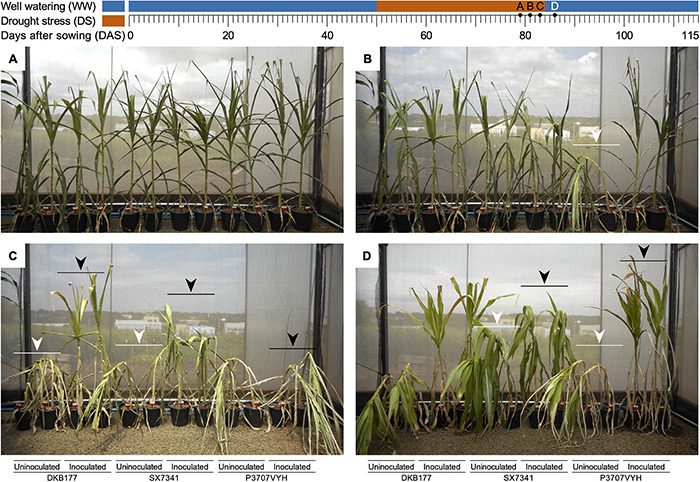
FIGURE 1
FIGURE 1
A SynCom containing beneficial microbes induces a physiological response against DS in three commercial maize hybrids. (A) Plants kept in SDS for 29 days (79 DAS) had their leaves rolled inward, and older leaves fell for all hybrids, regardless of whether they were inoculated. (B) P3707VYH was the less tolerant hybrid in the absence of SynCom, completely bent after 31 days of SDS (81 DAS), in contrast to the inoculated hybrid (white arrow). (C) Uninoculated DKB177 and SX7341 were completely bent (83 DAS), as shown by the white arrows. In the presence of SynCom, plants were maintained in a straight position (DKB177) and partially or completely bent (SX7341 and P3707VYH, respectively), as shown by the black arrows. (D) Inoculated plants (SX7341 and particularly P3707VYH) straightened 2 days after rewatering (86 DAS; black arrows), while uninoculated plants were not capable of completely recovering their structure (white arrows). Detailed results are shown in Supplementary Figure 3 and Supplementary Movie 1. WW, well watering; DS, drought stress; DAS, days after sowing; SDS, severe drought stress.
FIGURE 2
FIGURE 2
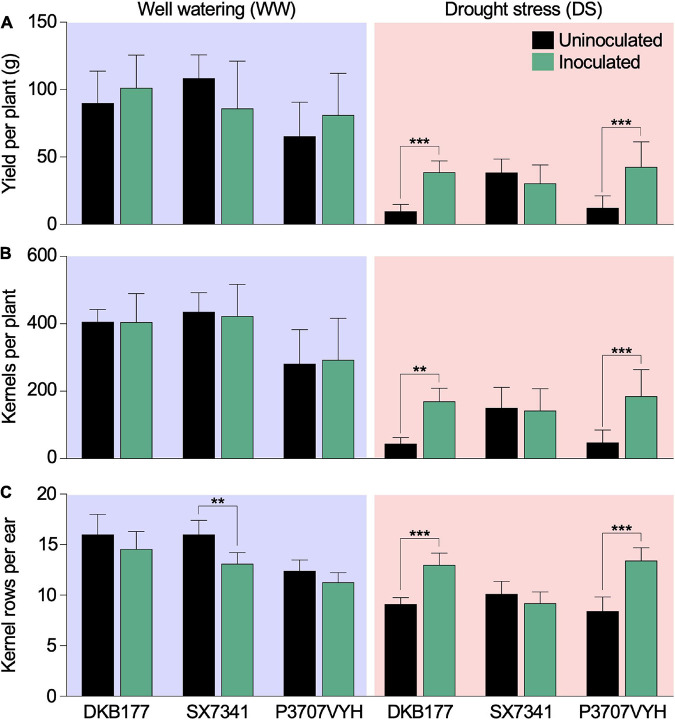
Synthetic community (SynCom) inoculation reduces the yield loss of commercial maize hybrids under DS. During DS, inoculated DKB177 and P3707VYH plants displayed higher (A) yield per plant (3.93× and 3.45×, respectively), (B) number of kernels per plant (3.87× and 3.85×, in that same order) and (C) number of kernel rows per ear (42 and 59%, respectively) under DS. Additional yield results are shown in Supplementary Figure 5. Values expressed as the mean ± SD. n ≥ 7 plants per treatment. WW, well watering; DS, drought stress; SD, standard deviation. **P ≤ 0.01 and ***P ≤ 0.001.
FIGURE 3
FIGURE 3
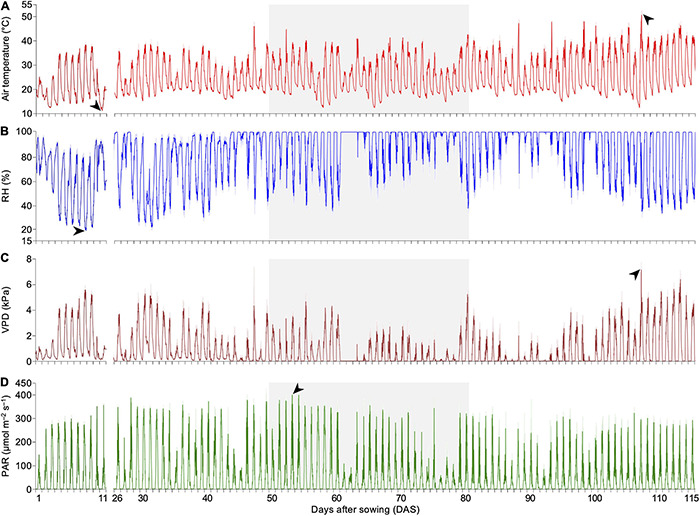
Fluctuation of environmental parameters detected by the non-invasive real-time phenotyping platform. (A) Air temperature, with minimum and maximum observed at 11 DAS at 5:30 am (11.35 ± 0.05°C) and 107 DAS at 2:00 pm (51.38 ± 1.93°C), respectively (black arrows). (B) RH, with a minimum of 18.85 ± 0.15% at 8 DAS at 4:30 pm (black arrow). (C) VPD, found to reach a peak of 7.17 ± 0.60 kPa at 107 DAS at 2:15 pm (black arrow), following the high air temperature variation at that moment. (D) PAR, with a maximum peak of 400.53 ± 1.94 μmol m–2 s–1 observed at 53 DAS at 12:00 pm (black arrow). Gray background highlights period of DS treatment. Data points were missing from 12 to 25 DAS due to an unexpected disruption of the automated measuring routine. DAS, days after sowing; RH, air relative humidity; VPD, vapor-pressure deficit; PAR, photosynthetically active radiation; DS, drought stress.
FIGURE 4
FIGURE 4
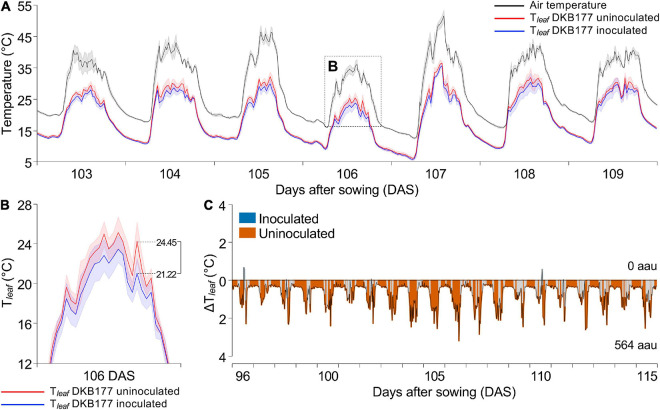
The SynCom-inoculated DKB177 plants displayed lower Tleaf than uninoculated plants. (A) The hybrid DKB177 showed a low Tleaf when inoculated with SynCom, especially in periods when the air temperature was high. The standard deviation is shown as the background for air temperature and both treatments. (B) Tleaf of uninoculated plants reaches a peak of 3.23°C higher at 106 DAS (inset from panel A). (C) The difference between Tleaf of inoculated and uninoculated plants (ΔTleaf), rounded every 30 min over time, revealed consistency in the high temperature presented by uninoculated DKB177. Values were displayed above the x-axis when Tleaf of inoculated plants is higher than Tleaf of uninoculated plants or below the x-axis when Tleaf of uninoculated plants is higher than Tleaf of inoculated plants, and colored in blue or red, respectively, when significantly different (P ≤ 0.05). Areas filled with light gray denote not statistically significant differences. The sums of areas in the graph above and below the x-axis were considered only for statistically significant differences. See Supplementary Figure 8 for the entire analyzed period. Tleaf, leaf temperature; ΔTleaf, difference of Tleaf; aau, arbitrary area units; DAS, days after sowing.
FIGURE 5
FIGURE 5
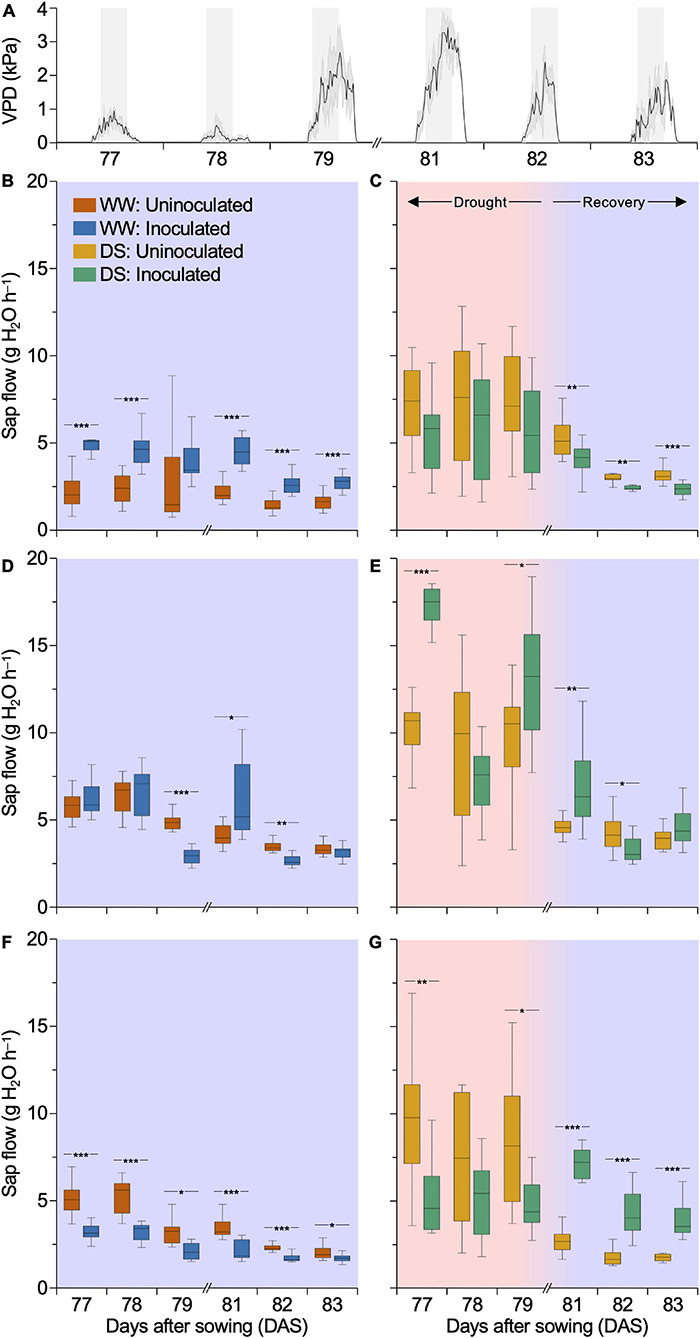
Synthetic community (SynCom) inoculation affects the sap flow of maize hybrids. (A) Fluctuation of VPD (kPa) from 77 to 83 DAS. The gray background highlights daily windows from 10:00 am to 4:00 pm, periods considered to measure sap flow of DKB177 (B,C), SX7341 (D,E), and P3707VYH (F,G). Box plots are shown for WW- (B,D,F) and DS-treated/rehydrated (C,E,G) plants. Rehydration was performed at 80 DAS. (B) In WW, SynCom leads to an increase in DKB177 sap flow by up to 2.22×. (C) Inoculated DKB177 plants tended to have their sap flow reduced in late stages of DS (77–79 DAS). During recovery (81–83 DAS), this reduction significantly reached up to 25.9%. (D) SX7341 presented an undefined pattern of sap flow under WW the regime. (E) A lack of pattern was also found during the DS and rehydration periods. (F) WW-treated P3707VYH had its sap flow reduced by up to 39.7% when inoculated, the same effect found in DS (G). (G) During recovery, SynCom inoculation led to a shift in sap flow of P3707VYH with an increase of up to 2.57× compared to the control. VPD: vapor-pressure deficit; WW, well watering; DS, drought stress; DAS, days after sowing. *P ≤ 0.05, **P ≤ 0.01, and ***P ≤ 0.001.
FIGURE 6
FIGURE 6
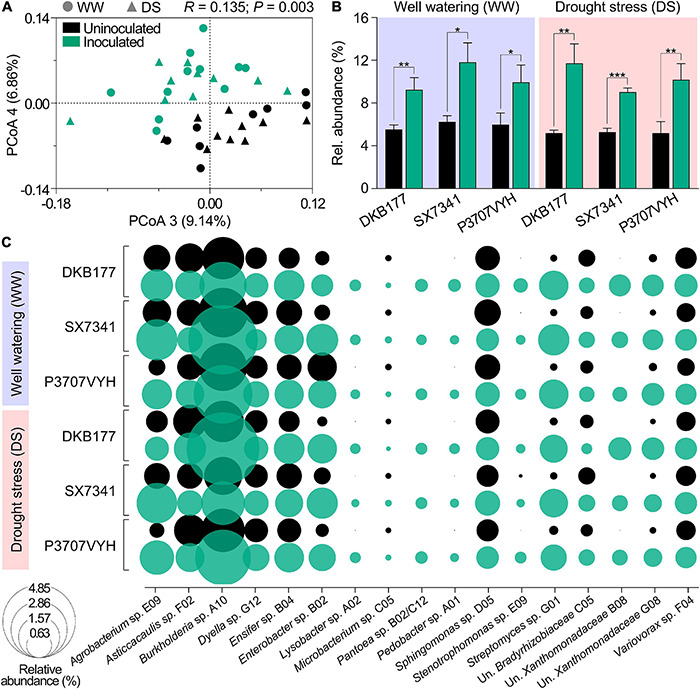
Members of SynCom robustly colonize different maize hybrids. (A) PCoA of the Bray–Curtis dissimilarity matrix of inoculated and uninoculated plants. (B) Relative abundance of OTUs present in SynCom in WW- and DS-treated inoculated and uninoculated DKB177, SX7341, and P3707VYH hybrids. (C) Relative abundance of community-based isolates in SynCom in WW- and DS-treated inoculated and uninoculated maize hybrids. OTUs of community-based isolates identified as robust colonizers are individually highlighted in Supplementary Table 3. Values expressed as the mean ± SD. PCoA, principal coordinates analysis; SD, standard deviation; Un., unknown. *P ≤ 0.05, **P ≤ 0.01, and ***P ≤ 0.001.

References

    1. Alvarez S., Marsh E. L., Schroeder S. G., Schachtman D. P. (2008). Metabolomic and proteomic changes in the xylem sap of maize under drought. Plant Cell Environ. 31 325–340. 10.1111/j.1365-3040.2007.01770.x - DOI - PubMed
    1. Armanhi J. S. L., de Souza R. S. C., Damasceno N. B., de Araújo L. M., Imperial J., Arruda P. (2018). A community-based culture collection for targeting novel plant growth-promoting bacteria from the sugarcane microbiome. Front. Plant Sci. 8:2191. 10.3389/fpls.2017.02191 - DOI - PMC - PubMed
    1. Bartels D., Sunkar R. (2005). Drought and salt tolerance in plants. CRC. Crit. Rev. Plant Sci. 24 24–58. 10.1080/07352680590910410 - DOI
    1. Beirinckx S., Viaene T., Haegeman A., Debode J., Amery F., Vandenabeele S., et al. (2020). Tapping into the maize root microbiome to identify bacteria that promote growth under chilling conditions. Microbiome 8 1–13. 10.1186/s40168-020-00833-w - DOI - PMC - PubMed
    1. Belimov A. A., Hontzeas N., Safronova V. I., Demchinskaya S. V., Piluzza G., Bullitta S., et al. (2005). Cadmium-tolerant plant growth-promoting bacteria associated with the roots of Indian mustard (Brassica juncea L. Czern.). Soil Biol. Biochem. 37 241–250. 10.1016/j.soilbio.2004.07.033 - DOI