


Synthesis of scaffold-free, three dimensional, osteogenic constructs following culture of skeletal osteoprogenitor cells on glass surfaces
- PMID: 34746337
- PMCID: PMC8554168
- DOI: 10.1016/j.bonr.2021.101143
Synthesis of scaffold-free, three dimensional, osteogenic constructs following culture of skeletal osteoprogenitor cells on glass surfaces
Abstract
Background: Efficient differentiation of stem cells into three-dimensional (3D) osteogenic construct is still an unmet challenge. These constructs can be crucial for patients with bone defects due to congenital or traumatic reasons. The modulation of cell fate and function as a consequence of interaction with the physical and chemical properties of materials is well known.
Methods: The current study has examined the osteogenic differentiation potential of human skeletal populations following culture on glass surfaces, as a monolayer, or in glass tubes as a pellet culture. The 3D prosperities were assessed morphometrically and the differentiation was evaluated through molecular characterization as well as matrix formation.
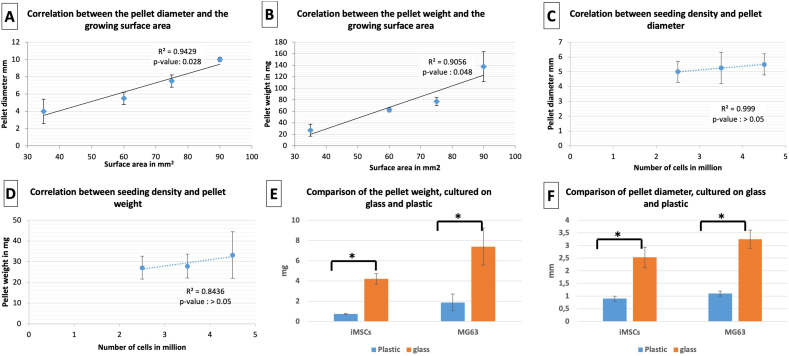
Results: Early temporal expression of alkaline phosphatase expression of skeletal populations was observed following culture on glass surfaces. Skeletal populations seeded on glass tubes, adhered as a monolayer to the tube base and subsequently formed 3D pellets at the air -media interface. The pellets cultured on glass displayed 4.9 ± 1.3 times the weight and 2.9 ± 0.1 the diameter of their counterpart cultured in plastic tubes and displayed enhanced production of osteogenic matrix proteins, such a collagen I and osteonectin. The size and weight of the pellets correlated with surface area in contrast to cell numbers seeded. Global DNA methylation level was decreased in pellets cultured on glass. In contrast, gene expression analysis confirmed upregulation extracellular matrix proteins and osteogenesis-related growth factors.
Conclusion: This simple approach to the culture of skeletal cells on glass tubes provides a scaffold-free, 3D construct platform for generating pellets enabling analysis and evaluation of tissue development and integration of multiple constructs with implications for tissue repair and regenerative application on scale-up.
Keywords: 3D culture; 3D, three-dimensional; A/S, Alcian blue/Sirius red/Weigert's haematoxylin; ALP, Alkaline Phosphatase; BMP, bone morphogenic protein; BMSC, human bone marrow stromal; CSF, colony stimulating factor; Ct, Cycle threshold; Differentiation; EGF, epidermal growth factor; FC, Fetal bone cells; FCS, Fetal Calf Serum; FGF, fibroblast growth factor; FN1, fibronectin; GLI, GLI family zinc finger 1; HIPPIE, Human Integrated Protein Interaction Reference; ITGA3, integrin A3; MMP, matrix metalloprotease; Osteogenesis; Osteoprogenitor cells; P/S, penicillin and streptomycin; Pellets; R, receptor; TGF, β transforming growth factor beta; TGFBR2 transforming growth factor beta receptor 2 VDR, vitamin D receptor; gDNA, genomic DNA; iMSC, immortalized human bone marrow derived, mesenchymal stem cells; vWF, von Willebrand factor.
© 2021 The Authors. Published by Elsevier Inc.
Conflict of interest statement
None.
Figures




References
-
- Annabi B., Lee Y.T., Turcotte S., Naud E., Desrosiers R.R., Champagne M., Eliopoulos N., Galipeau J., Beliveau R. Hypoxia promotes murine bone-marrow-derived stromal cell migration and tube formation. Stem Cells. 2003;21(3):337–347. - PubMed
-
- Barker S., LaRocca P. Method of production and control of a commercial tissue culture surface. 1994;16:151–153.
Grants and funding
LinkOut - more resources
Full Text Sources
Miscellaneous
