


A novel application of a data mining technique to study intersections in the social determinants of mental health among young Canadians
- PMID: 34746359
- PMCID: PMC8551646
- DOI: 10.1016/j.ssmph.2021.100946
A novel application of a data mining technique to study intersections in the social determinants of mental health among young Canadians
Abstract
Objectives: Adolescent mental health is an emergent clinical and public health priority in Canada. Gender-based differences in mental health are well established. The objective of this study was to evaluate a new data mining technique to identify social locations of young Canadians where differences in mental health between adolescent males and females were most pronounced.
Methods: We examined reports from 21,221 young Canadians aged 11-15 years (10,349 males, 10,872 females) who had responded to a 2018 national health and health behaviours survey. Using recursive partitioning for subgroup identification (SIDES), we identified social locations that were associated with the strongest differences between males and females for three reported mental health outcomes: positive psychosomatic health, symptoms of depression, and having a diagnosed mental illness.
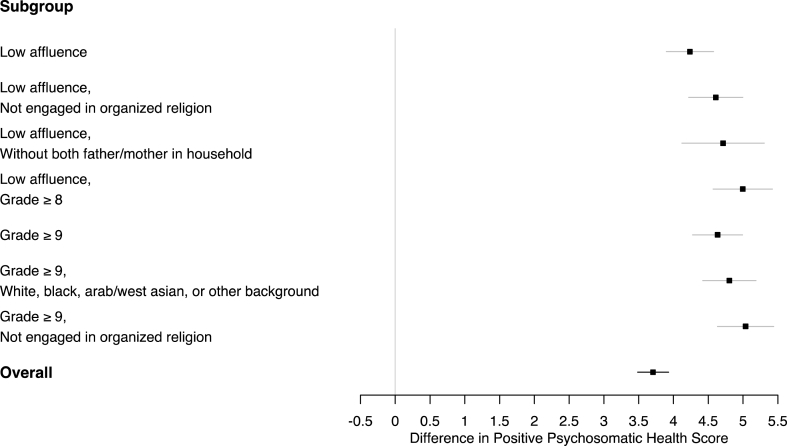
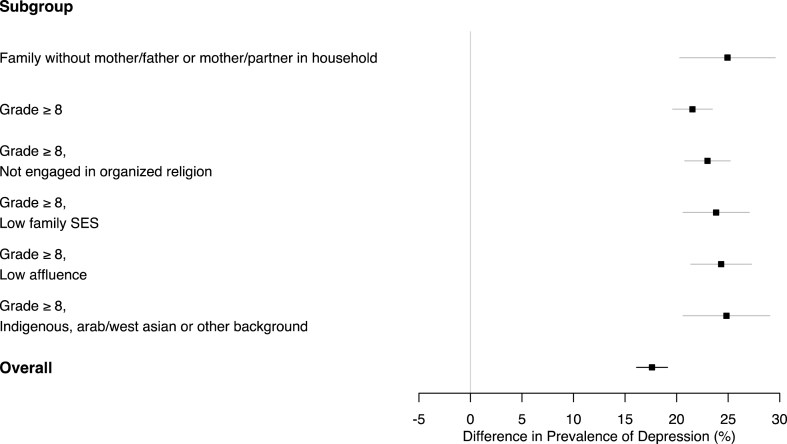
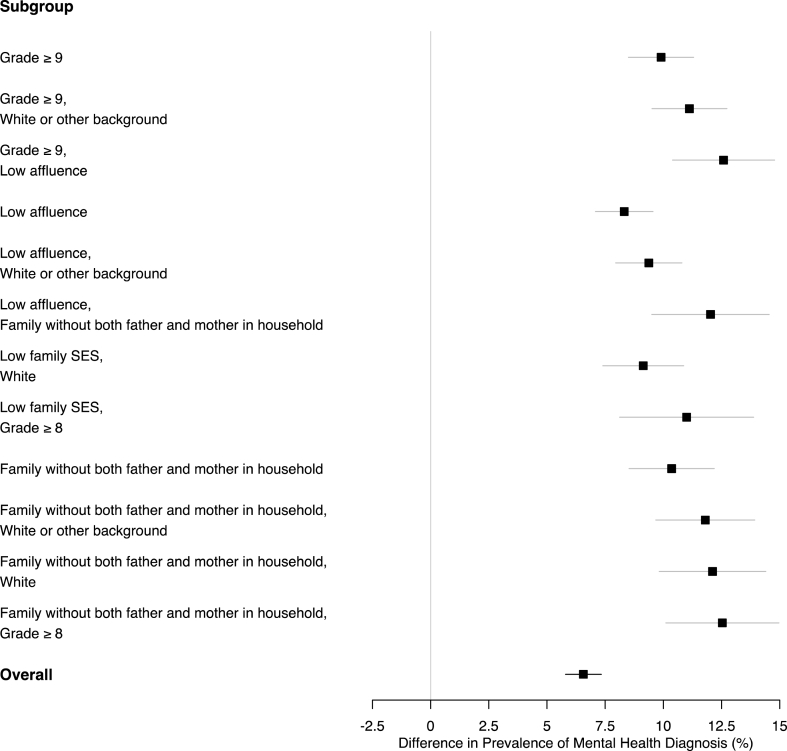
Results: The SIDES algorithm identified both established and new intersections of social factors that were associated with gender-based differences in mental health experiences, most favouring males.
Discussion: This analysis represents a novel proof-of-concept to demonstrate the utility of a subgroup identification algorithm to reveal important differences in mental health experiences between adolescent males and females. The algorithm detected new social locations (i.e., where gender intersected with other characteristics) associated with poor mental health outcomes. These findings set the stage for further intersectional research, involving both quantitative and qualitative analyses, to explore how axes of discrimination may intersect to shape potential gender-based health inequalities that emerge during childhood.
Keywords: Adolescence; Epidemiology; Intersectionality; Mental health; Social determinants.
© 2021 The Authors. Published by Elsevier Ltd.
Conflict of interest statement
None.
Figures
References
-
- Badura P., Hamrik Z., Dierckens M., Gobiņa I., Malinowska-Cieślik M., Furstova J., Pickett W. Journal of epidemiology and community health. 2021. After the bell: Adolescents' organised leisure-time activities and well-being in the context of social and socioeconomic inequalities. Published Online First: 05 January 2021. - DOI - PMC - PubMed
-
- Bauer G.R. Incorporating intersectionality theory into population health research methodology: Challenges and the potential to advance health equity. Social Science & Medicine. 2014;110:10–17. - PubMed
-
- Bauer G.R., Scheim A.I. Methods for analytic intercategorical intersectionality in quantitative research: Discrimination as a mediator of health inequalities. Social Science & Medicine. 2019;226:236–245. - PubMed
LinkOut - more resources
Full Text Sources
