. 2021 Nov 3;6(4):e960.
doi: 10.1097/PR9.0000000000000960. eCollection 2021 Nov-Dec.

Epigenetic signature of chronic low back pain in human T cells

Affiliations

Epigenetic signature of chronic low back pain in human T cells

Stéphanie Grégoire et al. Pain Rep. .

Abstract

Objective: Determine if chronic low back pain (LBP) is associated with DNA methylation signatures in human T cells that will reveal novel mechanisms and potential therapeutic targets and explore the feasibility of epigenetic diagnostic markers for pain-related pathophysiology.

Methods: Genome-wide DNA methylation analysis of 850,000 CpG sites in women and men with chronic LBP and pain-free controls was performed. T cells were isolated (discovery cohort, n = 32) and used to identify differentially methylated CpG sites, and gene ontologies and molecular pathways were identified. A polygenic DNA methylation score for LBP was generated in both women and men. Validation was performed in an independent cohort (validation cohort, n = 63) of chronic LBP and healthy controls.

Results: Analysis with the discovery cohort revealed a total of 2,496 and 419 differentially methylated CpGs in women and men, respectively. In women, most of these sites were hypomethylated and enriched in genes with functions in the extracellular matrix, in the immune system (ie, cytokines), or in epigenetic processes. In men, a unique chronic LBP DNA methylation signature was identified characterized by significant enrichment for genes from the major histocompatibility complex. Sex-specific polygenic DNA methylation scores were generated to estimate the pain status of each individual and confirmed in the validation cohort using pyrosequencing.

Conclusion: This study reveals sex-specific DNA methylation signatures in human T cells that discriminates chronic LBP participants from healthy controls.

Keywords: Biomarker; DNA methylation; Epigenetics; Low back pain; T cells.


Conflict of interest statement

Authors S. Gregoire, D. Cheishvili, M. Szyf, and L.S. Stone are coinventors on a provisional patent protecting the methylation signatures described here for possible use as a biomarker for chronic pain. D. Cheishvilli and M. Szyf are associated with HKG Epitherapeutics that develops epigenetic biomarkers for clinical use. The remaining authors have no conflicts of interest to declare.Sponsorships or competing interests that may be relevant to content are disclosed at the end of this article.

Figures
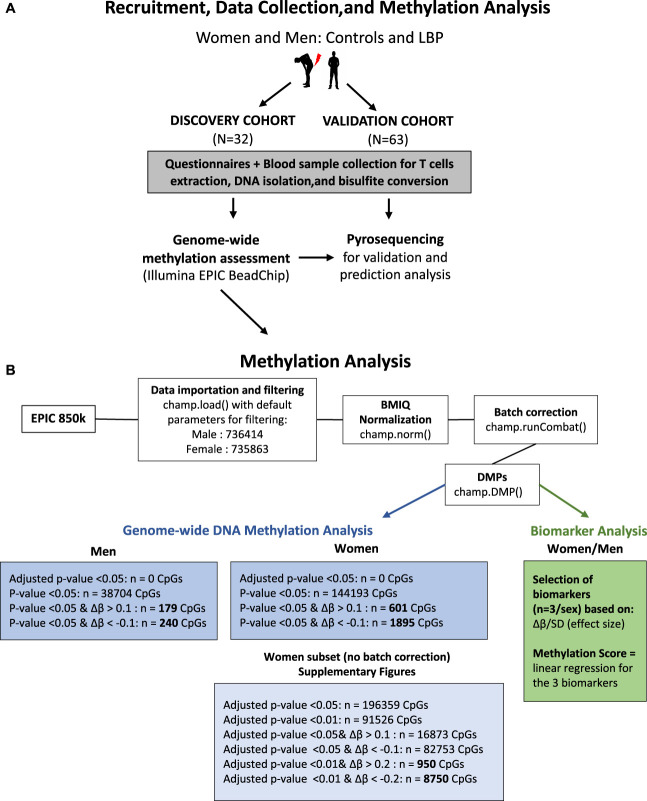
Figure 1.
Figure 1.
Overview of the study design including (A) the recruitment, data collection, and analysis, as well as (B) the flowchart for the genome-wide methylation analysis study*. *LBP, low back pain; ∆β, absolute difference in methylation value between control and LBP groups.
Figure 2.
Figure 2.
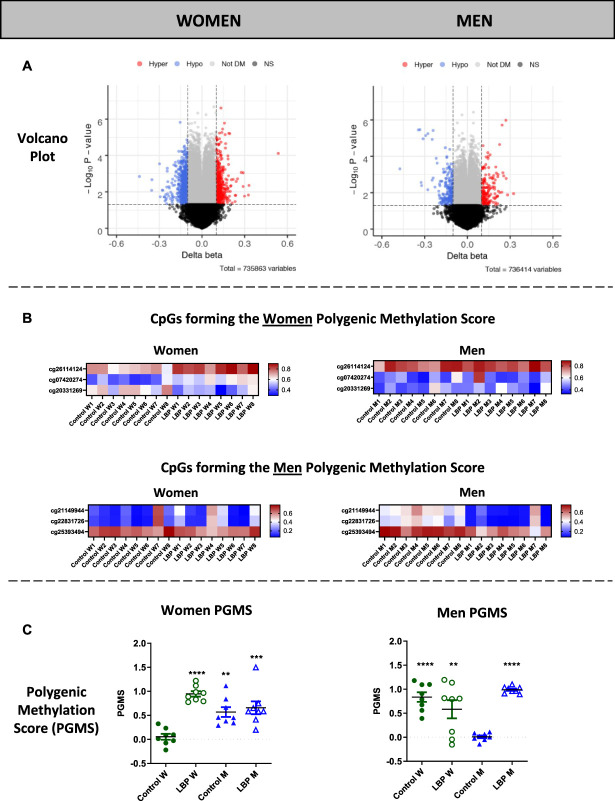
(A) Volcano plots of the differentially methylated positions with x and y axes displaying, respectively, the delta beta values (effect size) and the log10 of the P values for each CpGs site. Hypermethylated and hypomethylated CpGs in LBP vs controls (delta beta > 10% and P < 0.05) are represented in red and blue, respectively. (B) Heatmap representation of the methylation profile of the selected CpGs in both women and men used to construct the (C) polygenic methylation score. Two-way analysis of variance (ANOVA) followed by Sidak multiple comparisons, ** = P < 0.01, *** = P < 0.001, **** = P < 0.0001. *LBP, low back pain; Not DM = not differentially methylated, NS, no significant; W, women; M, men.
Figure 3.
Figure 3.
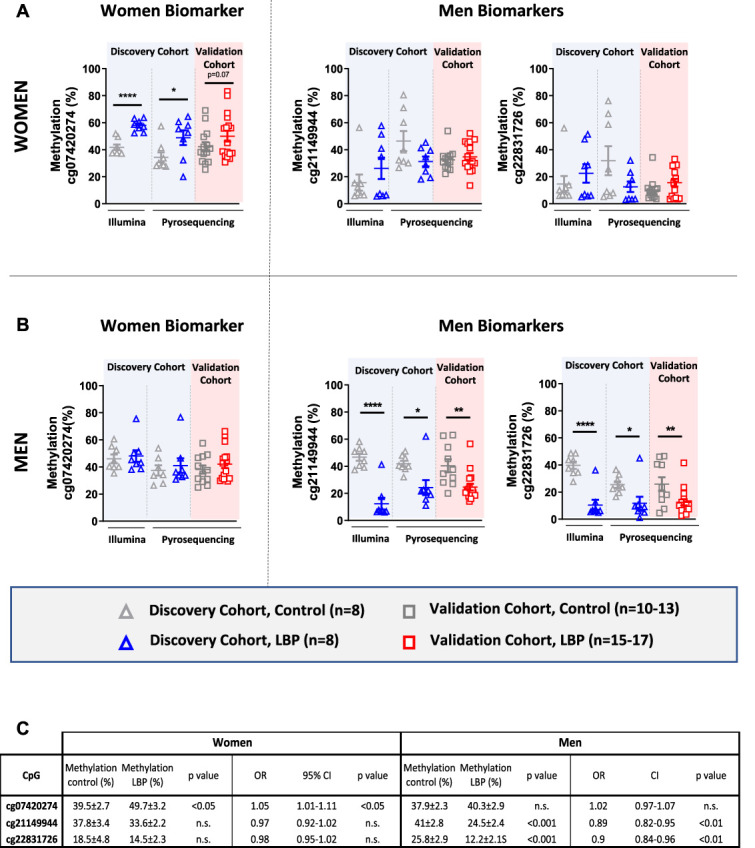
Percentage of methylation using Illumina (850K Epic Array) or targeted pyrosequencing of the 3 CpGs selected for validation in the discovery and validation cohorts in (A) women and (B) men. Association of the 3 CpGs methylation with the risk of having chronic low back pain using a logistic regression (C). Unpaired two-tailed (discovery cohort) or one-tailed (validation cohort) t test, * = P < 0.05, ** = P < 0.01, *** = P < 0.001.
Figure 4.
Figure 4.
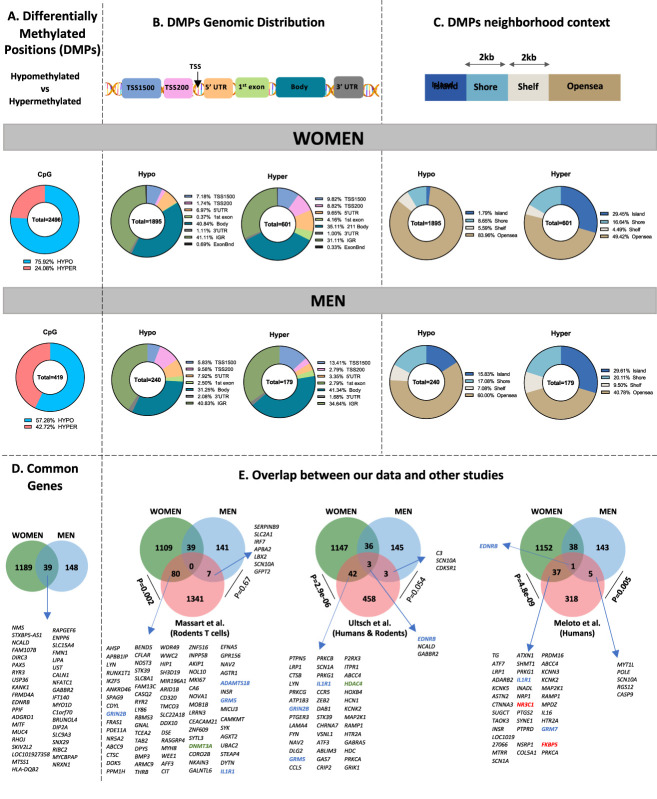
Characteristics of the differentially methylated positions (DMPs) between healthy controls and LBP participants*. Representation of (A) the hypermethylated and hypomethylated DMPs, (B) the genomic distribution, and (C) the neighborhood context of the DMPs detected in LBP participants compared with controls. Venn diagrams representing (D) the common differentially methylated genes between women and men in our study and (E) the overlap between our data and other studies on rat T cells (Massart et al), human pain genes (Meloto et al.), and rodent pain-related genes (Ultsh et al). For overlaps, pain, stress, and epigenetic-related genes mentioned in the text were highlighted in blue, red, and green, respectively. Significance of overlap between 2 groups was determined using the hypergeometric test. *LBP, low back pain.
Figure 5.
Figure 5.
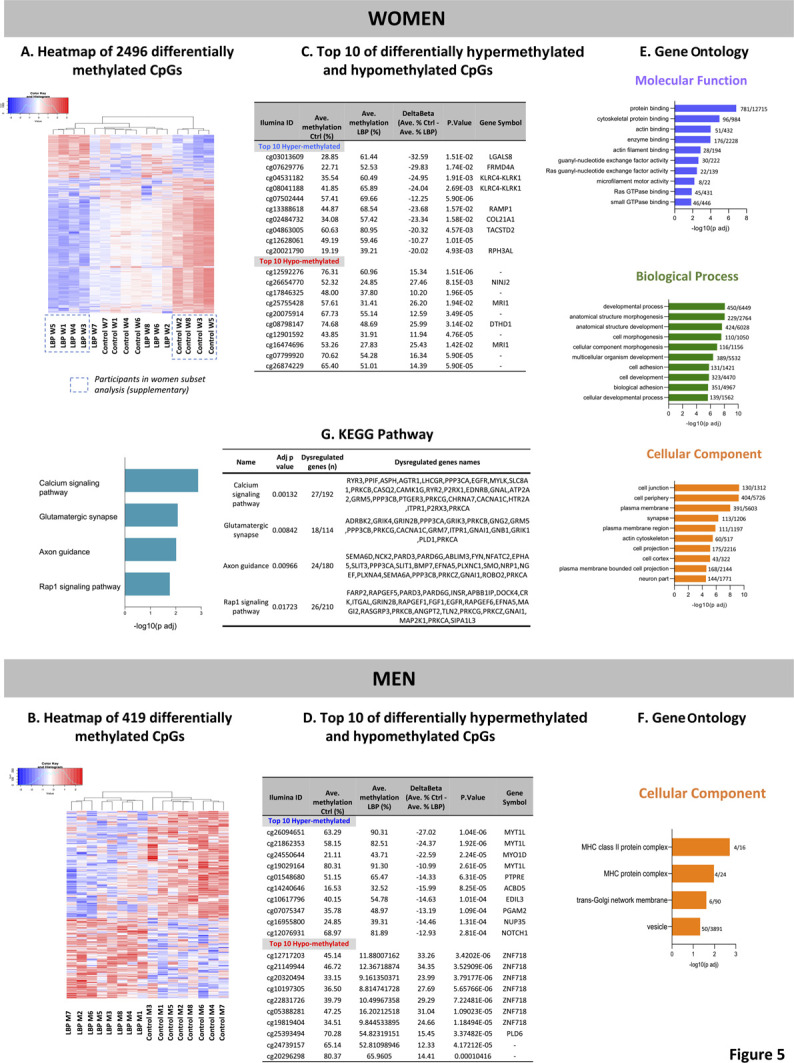
Heatmaps showing methylation signatures of (A) 2496 CpGs sites in women and (B) 419 in men. B values (after log2 transformation) are depicted using a red (hypermethylated in LBP) to blue (hypomethylated in LBP) methylation gradient. The top 10 differentially hypermethylated and hypomethylated CpGs are listed in both women (C) and men (D). Finally, the top 10 enriched Gene Ontology terms and KEGG pathways are shown in women (E and G) and men (F). Data are presented as enriched scores expressed as −log10 (adjusted P-value) with adj P-value <0.05. LBP, low back pain.

References

    1. Alvarado S, Tajerian M, Suderman M, Machnes Z, Pierfelice S, Millecamps M, Stone LS, Szyf M. An epigenetic hypothesis for the genomic memory of pain. Front Cell Neurosci 2015;9:88. - PMC - PubMed
    1. Arathimos R, Sharp GC, Granell R, Tilling K, Relton CL. Associations of sex hormone-binding globulin and testosterone with genome-wide DNA methylation. BMC Genet 2018;19:113. - PMC - PubMed
    1. Aroke EN, Jackson P, Overstreet DS, Penn TM, Rumble DD, Kehrer CV, Michl AN, Hasan FN, Sims AM, Quinn T, Long DL, Goodin BR. Race, social status, and depressive symptoms: a moderated mediation analysis of chronic low back pain interference and severity. Clin J Pain 2020;36:658–66. - PMC - PubMed
    1. Aroke EN, Overstreet DS, Penn TM, Crossman DK, Jackson P, Tollefsbol TO, Quinn TL, Yi N, Goodin BR. Identification of DNA methylation associated enrichment pathways in adults with non-specific chronic low back pain. Mol Pain 2020;16:1744806920972889. - PMC - PubMed
    1. Balagué F, Mannion AF, Pellisé F, Cedraschi C. Non-specific low back pain. Lancet 2012;379:482–91. - PubMed